
Unbiased headlines. Facts, not spin.
Every story is an unbiased news briefing written from 110+ sources across the spectrum — sources linked so you can verify it yourself.
 health
Notable (6/10)
July 1, 2026 at 11:34 PM
health
Notable (6/10)
July 1, 2026 at 11:34 PM
England Just Set Its Hottest June Ever. Now a Heat Dome Is Parking Over the U.S. for the Fourth of July.
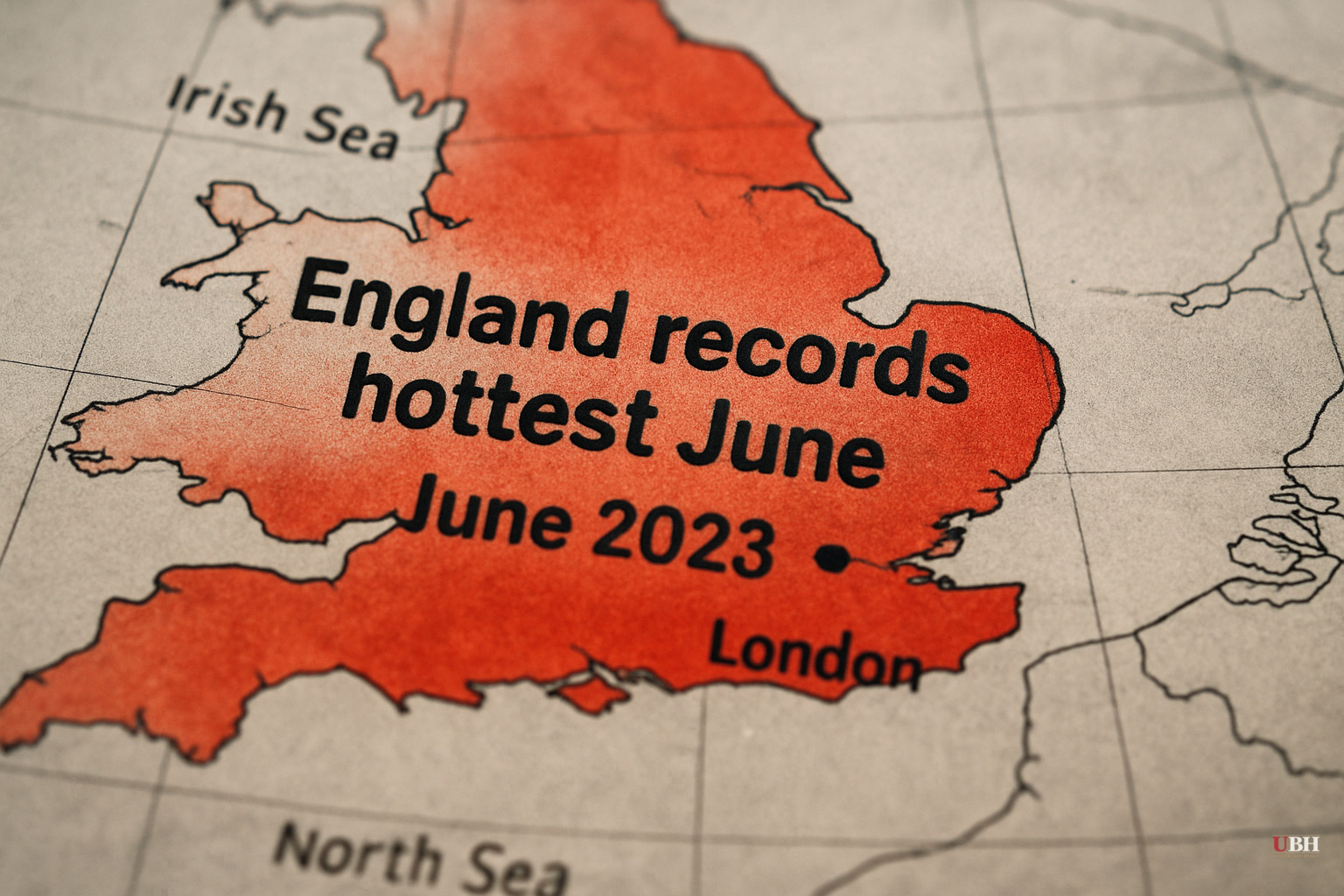
Since coverage of Europe's rising heat death rates, the full meteorological and mortality picture from June 2026 has come into sharper focus, and a new extreme heat event is now developing on the other side of the Atlantic.
England's Hottest June on Record
Provisional data from the Met Office, published June 30, confirmed England's mean June temperature reached 17.1°C, nearly 3°C above the long-run average. That makes it the warmest June for England since records began in 1884, and the second warmest for the UK as a whole.
The peak came on June 26, when Lingwood, Norfolk hit 37.7°C (99.9°F), shattering England's previous June record of 35.6°C set at Southampton in 1976. Wales set its own June record on June 25 with 35.9°C (96.6°F) at Cardiff Bute Park, beating the prior mark of 33.7°C. Northern Ireland equalled its June record of 30.8°C at Castlederg, County Tyrone. Scotland saw no new national record.
The Met Office noted that over 150 individual weather stations set their own highest June maximum temperature on record, with a similar number recording their warmest June minimum. Some of those stations have continuous records stretching back over 100 years.
The event was also notable for its nights. The UK's June minimum temperature ran more than 2°C above average, with England clocking overnight temperatures 2.6°C above average, according to the Met Office. Frequent "tropical nights," when temperatures never fell below 20°C, drove the mean figures up.
This was the first time since the UK introduced extreme heat warnings in 2021 that a red warning was issued for three consecutive days.
The Human Cost So Far
France's national health ministry reported approximately 1,000 excess deaths during the heatwave, with the elderly disproportionately affected. Spain recorded 1,029 excess deaths attributable to extreme heat, according to BBC News. Full figures across the rest of Europe will take weeks or months to compile.
Met Office chief scientist Prof. Stephen Belcher said the event carries direct public health implications: "Very high temperatures and humidity bring significant health implications from heat stress, as well as impacts to a range of sectors such as transport, energy and water supply."
For context, this heatwave is serious but almost certainly less lethal than August 2003, when an estimated 30,000 to 70,000 people died across Europe, according to BBC News. Awareness campaigns and heat warning systems introduced in the aftermath of 2003 have almost certainly blunted the toll.
The Skeptic's Fair Question
Critics of climate alarm are right to note that the 2003 comparison matters. Europe's heat mortality has dropped dramatically even as temperatures have risen, because governments now issue warnings, open cooling centers, and train emergency responders. That is a genuine policy success. The reasonable question is whether the right response to more frequent heat is better infrastructure and adaptation—air conditioning, urban greenery, building codes—rather than economy-disrupting emissions policy. That debate is legitimate, and the mortality data does not settle it in either direction.
What the data does settle: the temperature records themselves are not in dispute. The Met Office's provisional figures will go through formal verification in the coming weeks, but the raw readings from over 150 stations with century-long baselines are not the product of modeling or projection.
The 2026 Pattern
Met Office scientist Dr. Emily Carlisle noted that five of the first six months of 2026 have recorded mean temperatures at least 1°C above average, with only January falling below average. June followed the warmest spring on record for England and Wales. Spanish forecasters told the BBC that of the 12 June heatwaves recorded in Spain since 1975, half have occurred in the last decade.
Dr. Christopher Callahan, a climate scientist at Dartmouth College, published analysis this week on the European heatwave.
Heat Dome Now Targeting the U.S.
As Europe tallies its June numbers, a separate system is building over North America. A heat dome, a high-pressure system that traps warm air and prevents cooler air from moving in, is spreading across the central and eastern United States, according to Al Jazeera citing the National Weather Service.
The NWS described conditions as "dangerous." More than 60 million people are currently under heat alerts. Forecasters say heat index values in parts of the central and eastern U.S. could reach 46°C (115°F) when humidity is factored in. The hottest conditions are expected Thursday and Friday, with the heat persisting through the Fourth of July weekend and potentially into next weekend.
The timing is notable. Multiple FIFA World Cup matches are scheduled in U.S. cities during this period, and the holiday weekend typically drives large outdoor crowds.
The NWS says dozens of temperature records could fall. Whether any match the scale of what England recorded in June will depend on how the system tracks over the next 72 hours.
Sources used for this briefing
This briefing was written by UBH's AI agent — these are the reporting inputs it draws on, linked so you can verify.


