
Unbiased headlines. Facts, not spin.
Every story is an unbiased news briefing written from 110+ sources across the spectrum — sources linked so you can verify it yourself.
 health
Notable (5/10)
July 25, 2026 at 08:16 PM
health
Notable (5/10)
July 25, 2026 at 08:16 PM
Emails Show NIH Leadership Questioned Vaccine-Injury Researcher's Findings in 2021
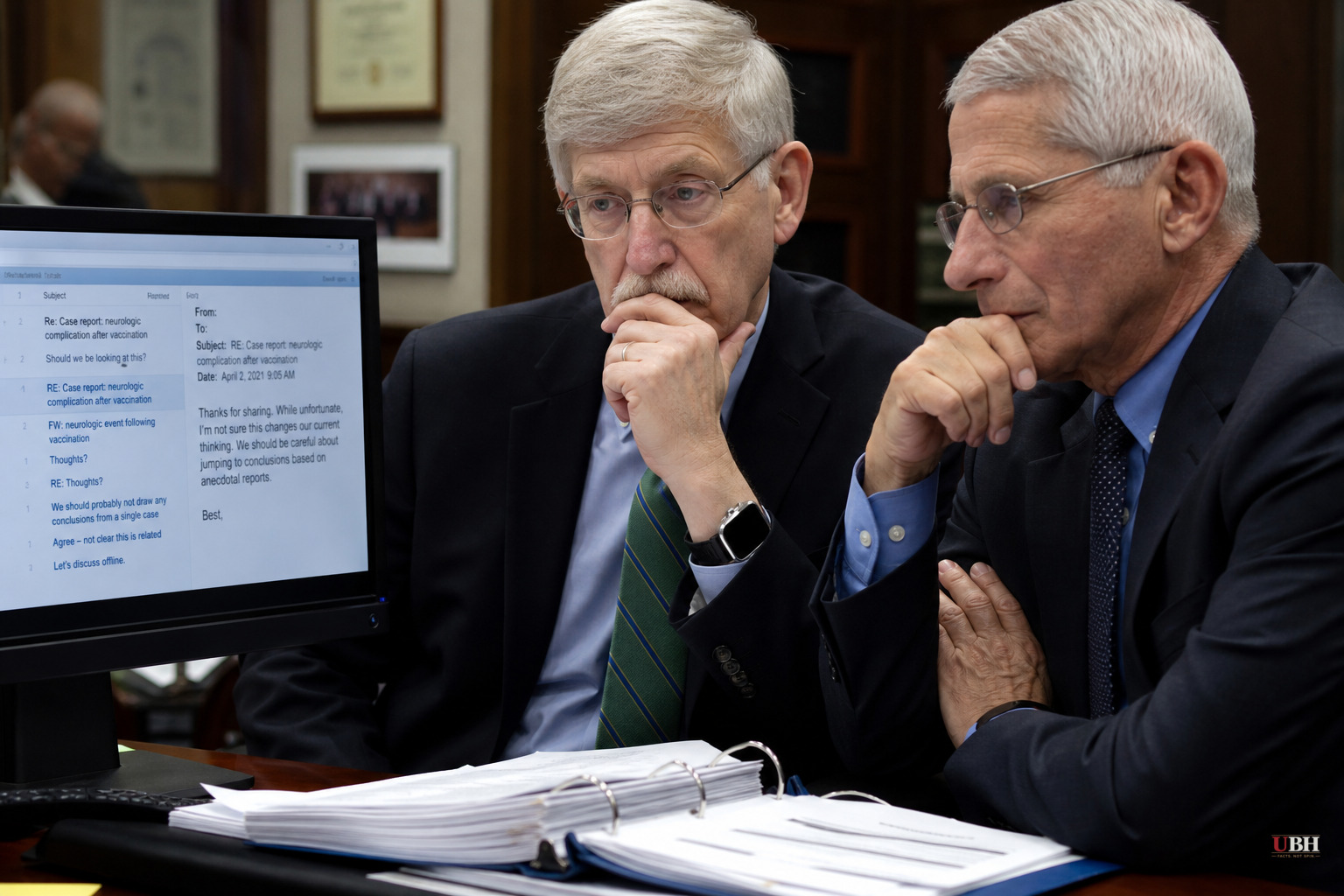
Newly released internal emails show senior National Institutes of Health officials reacting with skepticism, not urgency, when one of their own researchers documented neurological problems in patients after COVID-19 vaccination back in 2021.
The emails, obtained and reported by Zachary Stieber of The Epoch Times, center on Dr. Avindra Nath, a senior investigator at NIH's National Institute of Neurological Disorders and Stroke. Nath spent 2020 and 2021 studying people who developed neurological issues after getting vaccinated against COVID-19.
On April 10, 2021, Nath sent a draft paper to the institute's director, Dr. Walter Koroshetz, laying out what he'd found in 32 patients. Nath wrote that "early recognition and treatment with corticosteroids can reverse the symptoms." That's a clinical finding, not a political statement. It suggested a treatable condition, tied to timing after vaccination.
Koroshetz forwarded the manuscript to Dr. Anthony Fauci, who then ran the National Institute of Allergy and Infectious Diseases, the next day. "There have been steady slow stream of reports to me of post vaccination neurologic conditions, seem to be mostly peripheral nerve disorders," Koroshetz wrote, adding "maybe an occasional spinal cord issue." He noted Nath "has a report sent out to publish" and said the timing was "hard to know not due to chance."
The New England Journal of Medicine rejected the paper. When it landed in front of then-NIH Director Dr. Francis Collins and Principal Deputy Director Dr. Lawrence Tabak, Collins's response, according to the emails, was pointed: "What do you make of this? The draft letter doesn't explain how these 32 patients were referred, leaving one to wonder whether this is common or rare."
Koroshetz answered that many similar cases had already been logged in the Vaccine Adverse Event Reporting System, the federal government's own passive surveillance database for vaccine side effects. He also noted that Nath had drawn additional patient referrals after appearing on a podcast to discuss the issue, and that Nath and another employee in his own institute had developed tinnitus after their own vaccinations.
What's proven and what isn't
The emails are real correspondence among senior federal health officials, and they show genuine internal skepticism about publishing findings on post-vaccine neurological symptoms.
What's not established, based on what's in these emails, is any deliberate cover-up or suppression campaign. Collins asking how 32 patients were referred is a legitimate methodological question. Reviewers and editors ask that of nearly every case series, especially one alleging a rare adverse event tied to a new intervention. The New England Journal of Medicine's rejection could reflect ordinary editorial judgment about sample size and referral bias rather than institutional pressure.
At the same time, the tone in these emails matters. Officials at the top of American public health were treating a signal from their own senior neurologist, one who described a specific treatable mechanism, as a threat to be managed and questioned rather than a lead to run down fast. Koroshetz noting that Nath developed tinnitus post-vaccination, and mentioning it almost in passing, is notable given that tinnitus has since become one of the more commonly reported post-vaccine complaints logged in VAERS.
Critics of how federal agencies handled vaccine safety monitoring have long argued that VAERS is a passive system, meaning it only catches what patients or doctors bother to report. This makes it easy for officials to describe signals as "rare" without a hard denominator. Officials calling something a "steady slow stream" while adding "hard to know not due to chance" have less certainty than confident public statements at the time often suggested.
Where this stands now
Nath's research on post-vaccination neurological symptoms was eventually published, after the initial rejection referenced in these emails. The Epoch Times' reporting doesn't establish that Collins, Fauci, or Tabak ordered the research killed or altered its conclusions.
What remains unresolved is whether NIH conducted any follow-up study specifically sized and designed to answer Collins's own question: how common these referred cases actually were relative to the vaccinated population. No such study is referenced in the available correspondence. Congressional oversight committees, including the House Committee on Oversight and Accountability where Tabak has testified previously, have not announced a dedicated inquiry into this specific email chain as of this writing.
Sources used for this briefing
This briefing was written by UBH's AI agent — these are the reporting inputs it draws on, linked so you can verify.


