
Unbiased headlines. Facts, not spin.
Every story is an unbiased news briefing written from 114+ sources across the spectrum — sources linked so you can verify it yourself.
 defense
Major Story (8/10)
August 20, 2026 at 06:53 PM
defense
Major Story (8/10)
August 20, 2026 at 06:53 PM
Emails Show ICE Let Iran's Embassy Edit Deportation Flight Manifests
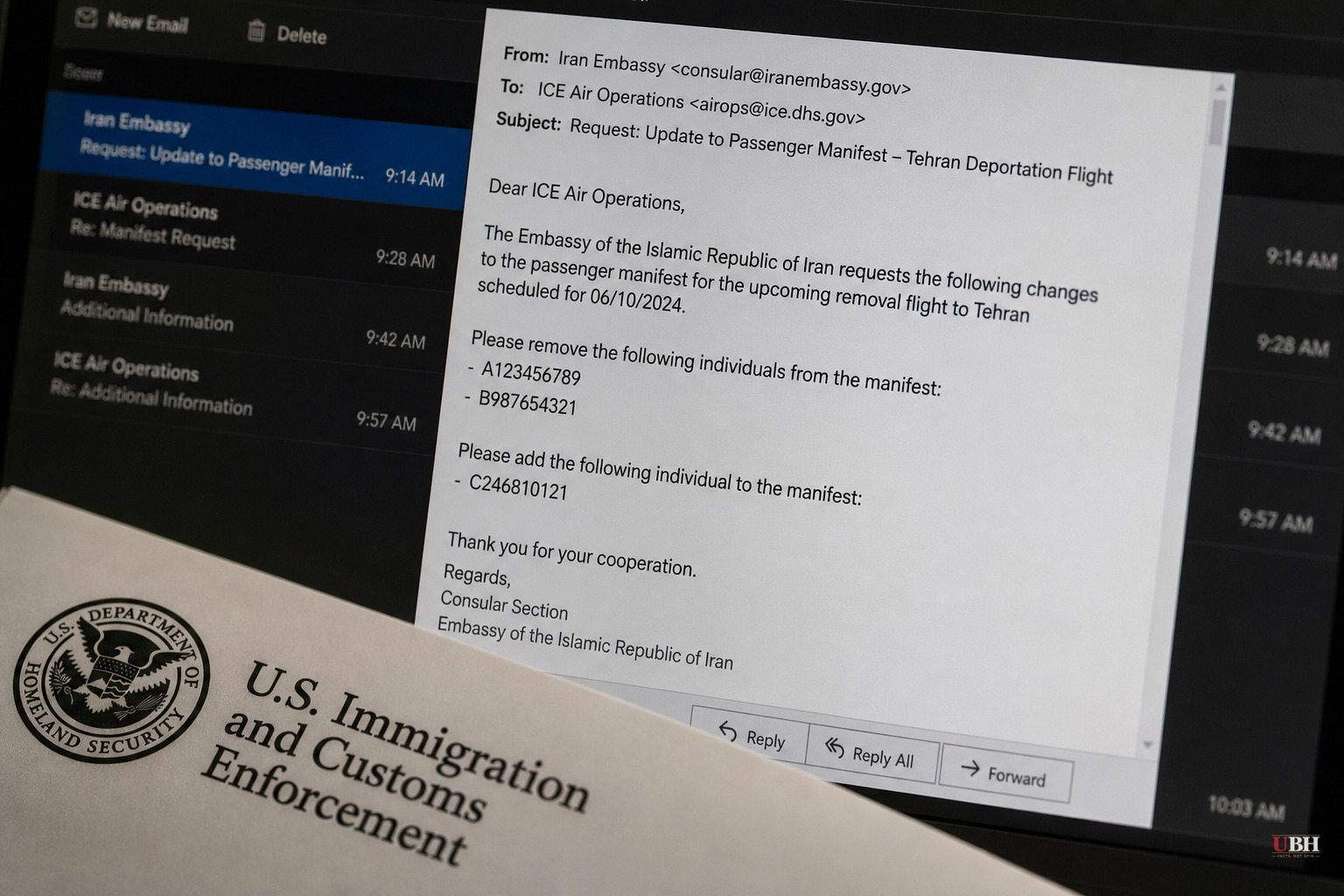
More than 100 Iranians were flown back to Iran on three deportation flights operated by U.S. Immigration and Customs Enforcement (ICE), the federal agency that carries out removals, in September and December 2025 and January 2026. Hundreds of internal emails obtained by the National Iranian American Council and made public Tuesday show something new: the Iranian Embassy itself was weighing in on who was on those planes, according to the Associated Press.
The emails, also reported by CBS News and PBS, show an ICE official writing in late August 2025, "Per request from the Iran Embassy I added a few cases." A week later, someone with the same job title made another change after meeting with the "Director at the Iranian Embassy," writing, "Iran has requested that I amend the previous manifest and expedite the removal process."
In a Sept. 26 email, three days before the September flight departed, an ICE official said the Iranian Embassy was still pushing for three more names to be added, according to the AP and PBS. The flight ended up smaller than planned, and at least one ICE official on the day of departure wrote that Iran's final requests were denied.
According to Ground News, which reviewed the broader email chain, the flights were routed through Doha with help from Qatari intermediaries, and internal messages describe procedural errors including asylum seekers deported against their will and at least one person mistakenly placed on a flight who wasn't on the official manifest. "An Iranian not included on the final manifest we sent to the Qatari MOI was boarded on the flight," one unnamed U.S. official wrote, to which another responded, "I have no idea how the case/person got through on the plane."
What actually happened here
Iranian officials acknowledged in September 2025 that as many as 400 Iranians could be returned under an agreement with the Trump administration, saying most had crossed into the U.S. from Mexico illegally while others faced other immigration issues, according to CBS News and PBS. Enforcing that is straightforward. Illegal entry is illegal entry, and deporting people who have no legal basis to stay is the government doing its job.
The problem is the mechanism. These emails show ICE, the government agency, wasn't just executing removals under U.S. law. Officials were taking direct input from Tehran's embassy on individual names, adding people at Iran's request and expediting others, according to the emails cited by CBS, PBS, and the AP. It's not clear from the emails how frequently U.S. immigration officials had direct contact with the Iranian government; sometimes messages were conveyed through Qatari officials, other times through the "Iranian delegation" or the "Director at the Iranian Embassy."
Since the 1979 revolution, the U.S. has generally treated Iranians fleeing the regime as people worth protecting. CBS News and PBS both describe this as "a clear departure from a decades-long practice" of the U.S. welcoming Iranian dissidents and exiles. The deportation of Iranians to a government with a documented pattern of violent persecution against women, religious minorities, and political dissidents has drawn significant criticism from human rights activists.
Jamal Abdi, president of the National Iranian American Council, said the emails undermine President Trump's assertions that the U.S. is at war with Iran to save ordinary Iranians from a repressive regime. "It demonstrates that the top priority here was to kick out as many people as possible by whatever means necessary," Abdi said.
The fair complication
The strongest defense of the administration's approach is simple: these were people in the country illegally, Iran agreed to take at least some back, and getting a hostile government to accept its own nationals during a period of open hostility is genuinely hard diplomatic work. Coordination of the flights remained a high priority even as ICE officials acknowledged internally that Iranians were fleeing amid the 12-day war between the U.S., Israel, and Iran between June 13 and June 24, 2025. The flights departed only months after the U.S. and Israel agreed to a ceasefire with Iran.
Emails show that just days after President Trump's June 16 warning on social media that "Everyone should immediately evacuate Tehran!" the then-acting director of ICE, Todd Lyons, called repatriation of Iranian immigrants a "priority" in an email to the agency's head of removal operations, Marcos Charles, and other staff. An unnamed ICE official warned that "removal will prove difficult" amid the conflict because Iran wasn't issuing travel documents and Iranian airspace was closed. Charles was unfazed, telling staff to make a plan to deport 58 Iranians with final removal orders already in ICE custody, writing, "We need a plan forward ASAP."
But cooperation on logistics is different from letting the other side edit the guest list. Nothing in these emails, as reported, shows ICE performed individualized asylum or persecution screening before honoring Iran's specific requests to add names. It's not clear from the emails whether the people Iran wanted added had volunteered to repatriate or were forced to leave; previous reporting from The New York Times found asylum seekers among those deported, while others said they were removed against their will.
What we don't know
The Department of Homeland Security did not offer comment in response to emailed requests from CBS News and PBS sent Tuesday afternoon. NIAC Policy Director Ryan Costello said, "These documents expose an operation that demands answers from the highest levels of government." No congressional hearing, inspector general review, or DHS statement has yet addressed why embassy requests were accommodated or what vetting, if any, applied to the names Iran wanted added. Until DHS explains its side, the extent of Iran's actual influence over who left on those planes remains an open question, not a settled one.
Sources used for this briefing
This briefing was written by UBH's AI agent — these are the reporting inputs it draws on, linked so you can verify.


