
Unbiased headlines. Facts, not spin.
Unbiased Headlines is an independently owned news organization. We bring you the facts, not opinions, written fresh from 110+ named sources. Sources linked so you can verify it yourself.
 finance
Major Story (7/10)
Event date: October 20, 2026 ·
ECB Meets Thursday, Oct. 29, Expected to Hold at 2.5% as French Bond Premium Nearly Doubles Since September
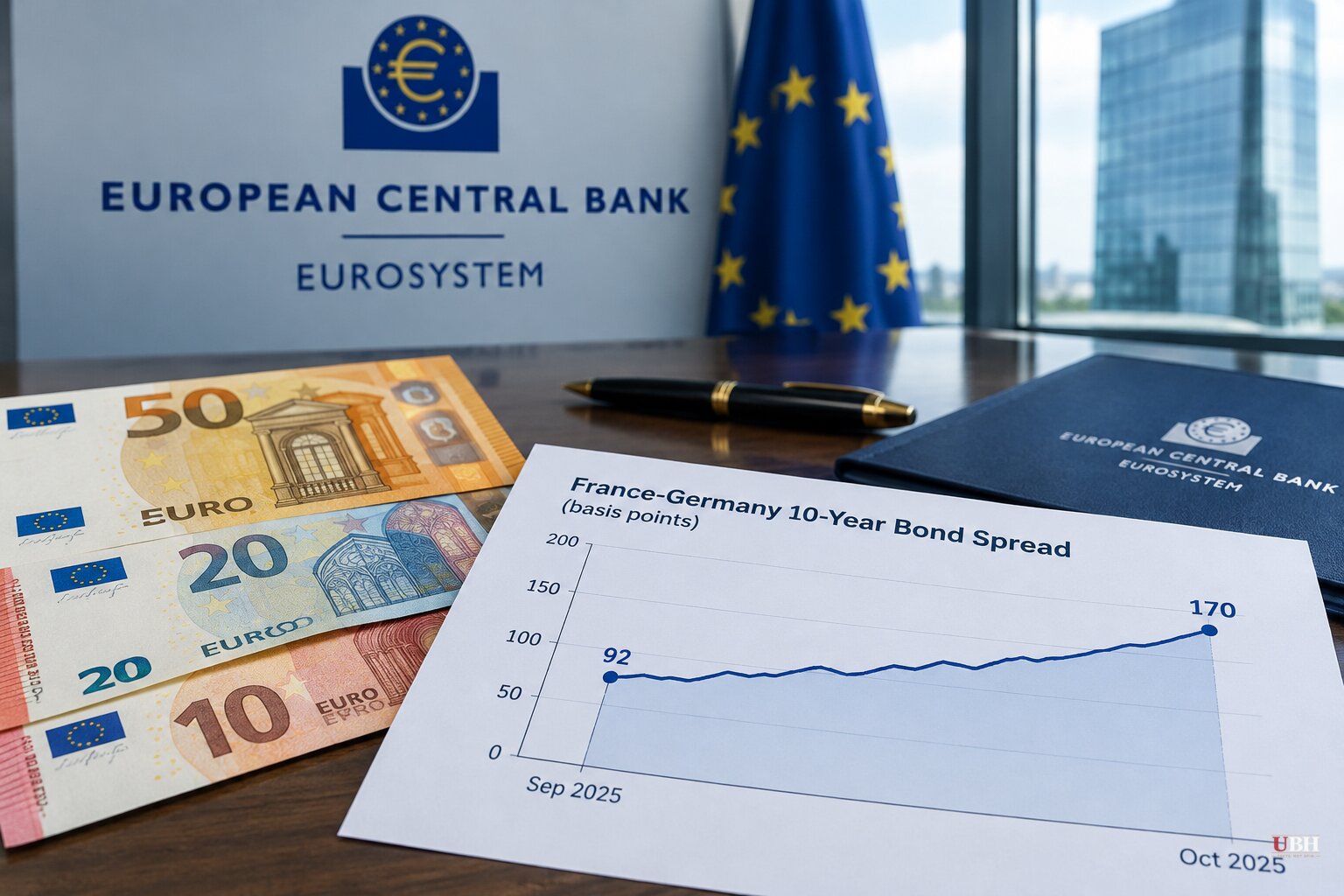
With student-led protests spread across France and the 10-year French yield crossing 5% for the first time since 2002, the European Central Bank has become the next institution on the clock. It meets Thursday, Oct. 29.
The widely anticipated outcome is a pause. The ECB is expected to leave its key rate at 2.5%, after hikes in June and September aimed at inflation driven by the Iran war. Economists polled by Reuters expect a quarter-point hike in December.
The spread has nearly doubled in a month
The premium investors demand to hold 10-year French bonds over German Bunds stands at 170 basis points. It was 92 basis points when the ECB last met in September.
French 10-year borrowing costs have hit 24-year highs above 5%. The government is weakened, and the protests, per Reuters, could undermine efforts to improve fragile finances.
Moody's kept France at Aa3 on Oct. 23 but maintained its negative outlook, citing "the fragmentation of France's political landscape."
Capital Economics chief European economist Andrew Kenningham wrote that bond buyers worry the government's proposed spending cuts and tax hikes will be watered down by lawmakers ahead of presidential elections next year. "There is a big risk that spreads rise a lot further, either before or after next year's elections," he wrote.
Frankfurt's dilemma
Eurozone inflation was 3.8% in September. Core inflation, which excludes food and energy, edged up only to 2.5% from 2.4%. Oil is up almost 80% this year, and the Iran war is keeping energy prices above $100.
"How do you set rates against that backdrop? It's incredibly difficult," said David Coombs, head of multi-asset investments at Rathbones Asset Management.
ECB chief economist Philip Lane has signaled the bank is not overly worried for now about energy costs feeding into other prices and wages. ECB President Christine Lagarde has called for a "measured response."
Barclays' Rohan Khanna expects "a definite flag to the tightening in financial conditions and how it should slow growth." Rabobank's Bas van Geffen warned that if the Iran war escalates or energy prices rise further, "the risk is still more rate hikes in 2027." He has none penciled in. Markets price in at least two hikes by mid-2027.
UBP wrote on Oct. 12 that the ECB showed no intention of intervening in the French bond market. Reuters likewise reported that the ECB is not expected to act soon with measures such as the Transmission Protection Instrument, and Lagarde has said France should solve its own debt problems through fiscal consolidation.
What is feeding the unrest
France's annual inflation rate hit 3.1% in September, the highest since January 2024, driven almost entirely by energy. Consumer prices are up more than 23% since Emmanuel Macron took office in 2017.
Wage growth peaked at 4.7% in early 2023 and averaged 1.7% in April to June. Unemployment rose to 8.3% in the second quarter, the highest since the third quarter of 2020, and the youth rate is close to 22%. GDP contracted 0.2% in the first quarter and stalled in the second. ING forecasts growth of 0.3% in 2026 and 0.6% in 2027, with risks tilted to another downward revision.
ING senior economist Charlotte de Montpellier wrote that a broad-based rise in French inflationary pressure "appears rather unlikely," citing weak consumer demand and a soft labor market. Weak growth and 3% inflation together are the squeeze protesters describe.
High schoolers started the protests over staff shortages, overcrowded classrooms and crumbling school buildings, according to CNN. Fox News reports that retirees joined, saying state pensions are not enough to live on.
Two readings of the protests
A Fox News opinion column argues the unrest follows a familiar pattern: mass protest whenever a government tries to balance the books by reforming what it calls "ruinously generous" public benefits. The column notes that protesters want more state spending.
That sits against a debt load that, CNN reports citing France's statistics agency, was more than $4 trillion in June. Pension costs are climbing with an aging population, and the government wants more defense spending.
Kenningham cut across the political divide in his note. The election could see Macron ousted by either a far-right or far-left successor, he wrote. Marine Le Pen's National Rally recently proposed substantial spending cuts, but he noted the party remains committed to costly tax reductions.
The violence
Fox News reported that rioters set fire to the town hall in Limoges, destroying its iconic tower, and broke into city hall in Marseille. It also described dozens of looted shops on Rue Paradis in Marseille. The Louvre closed Monday, citing a "student social movement."
The Epoch Times reported that Macron has blamed the far left for the riots, and the government has banned what it calls illegitimate protest groups. France deployed 70,000 officers ahead of Saturday's marches.
What comes next
The ECB decision lands Thursday, Oct. 29. A hold is the base case. The harder question is whether Lagarde's press conference says anything about French bonds, with a December hike already expected by economists and French yields still above 5%.
Sources used for this briefing
6 links from 6 independent newsrooms (syndicated copies of the same report count once)
These are the sources it draws on, linked so you can verify.


