
Unbiased headlines. Facts, not spin.
Every story is an unbiased news briefing written from 110+ sources across the spectrum — sources linked so you can verify it yourself.
 health
Major Story (7/10)
June 26, 2026 at 06:27 AM
health
Major Story (7/10)
June 26, 2026 at 06:27 AM
Ebola Samples Are Riding Public Transit in Eastern Congo. Faster Tests Are Helping, but Not Fast Enough.
Since the White House's $1.4 billion supplemental funding request last week, reporting from inside the Democratic Republic of Congo has made clear what the operational gap actually looks like on the ground.
The Nia-Nia Problem
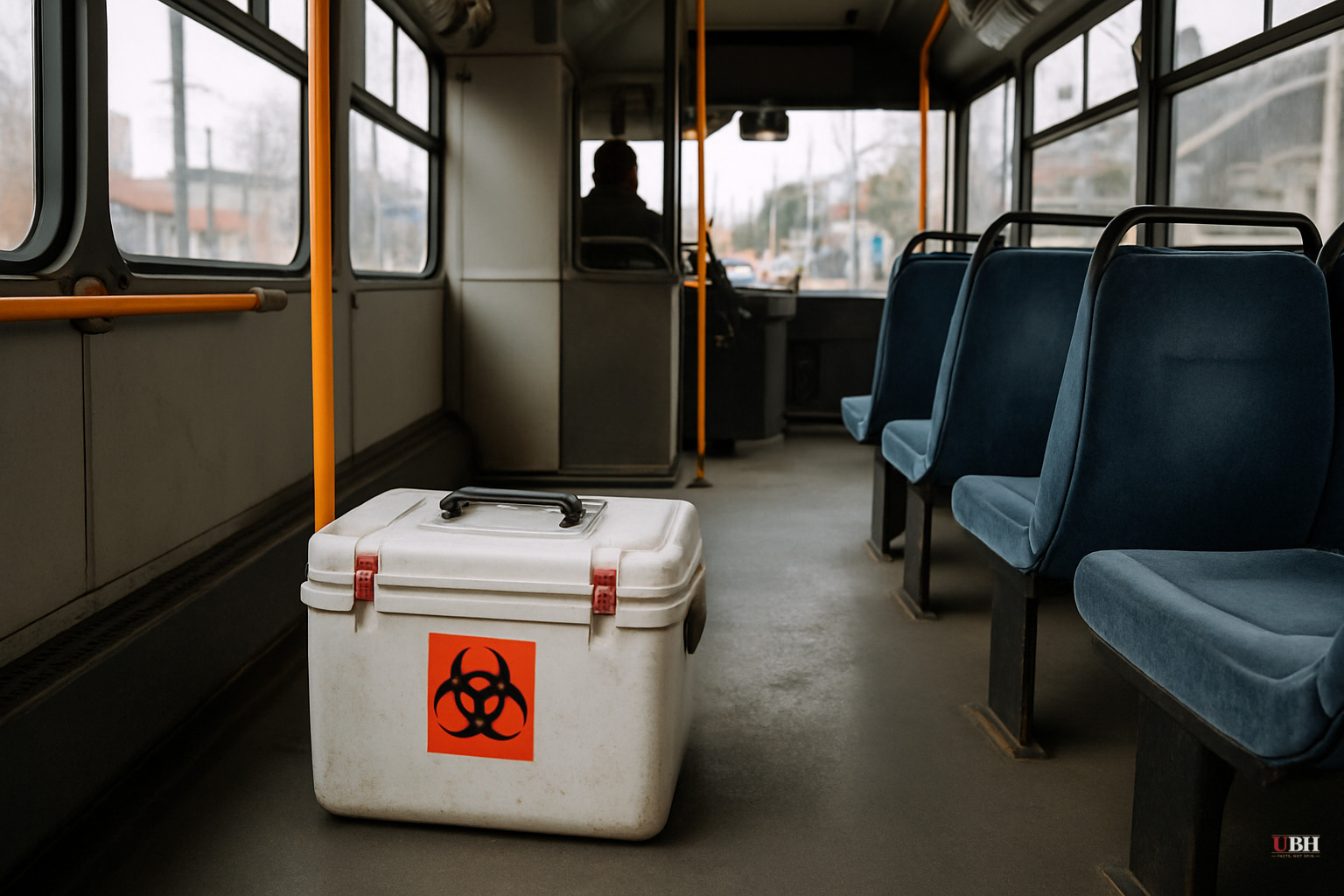
In the Nia-Nia health zone of Ituri Province, the epicenter of the Bundibugyo outbreak, Ebola samples are moving through the outbreak zone on public transportation. Radio Okapi, a DRC-based radio network, reported this week that health officials have no dedicated vehicle for sample collection and transport. They are using shared public vehicles because they have no alternative.
"We need a dedicated vehicle to collect samples from health areas and transport them directly to the laboratory," said Joseph Pemanakue, the chief doctor for the Nia-Nia health zone. "This would also allow us to ensure surveillance and monitoring of cases on the ground, and if we had a mobile laboratory in Nia-Nia, the samples could be analyzed immediately."
This is both a biosafety and security failure. Pemanakue is asking for it to stop, but nobody has given him the vehicle yet.
The security situation makes everything harder. Nia-Nia experiences regular incursions from armed insurgent groups, according to Radio Okapi. Several clinics in the zone have been closed, forcing patients and samples alike to travel farther to centralized facilities, which are themselves inadequately equipped.
Where Testing Has Actually Improved
Since the outbreak was declared on May 15, 2026, WHO and its partners have deployed RadiOne rapid diagnostic devices to Mongbwalu General Referral Hospital and other sites in Ituri Province. According to the WHO Africa office, those machines deliver results in under one hour, compared to the multi-day turnaround that previously required shipping samples more than 2,000 kilometers to the national referral lab in Kinshasa.
Daily testing capacity in Bunia, Ituri's provincial capital, and Mongbwalu has expanded from 30 to 80 tests, per WHO. Four laboratory technicians in Mongbwalu have been trained in biosafety protocols and machine operation with WHO support.
"The equipment is lightweight, portable, usable without heavy infrastructure and user-friendly after a short training," said Dr. Olga Ntumba Tshitenge, a WHO laboratory diagnostics expert, describing the RadiOne as a meaningful advance for remote deployment.
NPR reported that Abdirahman Mahamud, who directs health emergency alert and response operations at WHO, acknowledged the backlog of untested samples has largely cleared. But he was direct about what that means: "We are very much aware we are still behind the curve."
How the Outbreak Got This Big
The testing gap isn't new. It's structural. According to NPR, DRC health officials began noticing suspicious deaths in mid-April. The first samples were tested April 30, according to Jean-Jacques Muyembe, general director of INRB, DRC's national biomedical research center. Those samples ran through GeneXpert, the machine that forms the backbone of DRC's Ebola surveillance network, and came back negative.
The problem: GeneXpert cannot detect the Bundibugyo strain. That error wasn't caught until samples made it to Kinshasa for specialized testing, weeks later. The month-long diagnostic delay allowed the outbreak to expand before anyone rang the alarm. Suspected cases have since climbed above 1,100.
"The initial response has been pretty significantly hampered by the lack of appropriate diagnostics on the ground," said Caia Dominicus, senior technical adviser for the International Pandemic Preparedness Secretariat, speaking to NPR.
WHO's Mahamud has projected the outbreak could reach 20,000 cases by August if current transmission trends continue.
The Sample-Sharing Standoff
Bloomberg News reported this week that some researchers working on new tests and treatments are still relying on samples from earlier epidemics, not the current outbreak, because they cannot get fresh specimens. DRC government sources told Bloomberg that African governments are sometimes reluctant to share pathogen samples externally, concerned that their countries' biological materials get used to develop vaccines and treatments that those same countries then receive "limited or delayed access" to.
That concern is not unreasonable. The WHO has been unable to broker a consensus agreement on pathogen-sharing and benefit-distribution among member states, according to Breitbart's reporting, which cited the same Bloomberg sourcing. The standoff predates this outbreak and has complicated multiple previous epidemic responses.
The Money Fight in Washington
The Trump administration's $1.4 billion supplemental request to Congress covers supplies, personnel, treatment, and regional logistics. It maps directly onto the failures Pemanakue is describing from Nia-Nia. But Reuters reported that congressional aides say the request faces headwinds, including from some Republicans who are frustrated that the administration has been withholding funds already appropriated for global health and foreign assistance. That tension, between asking for new money while sitting on old money, is a real complication the White House has not yet publicly addressed.
WHO's Mahamud said current testing capacity is insufficient to track the outbreak if it spreads geographically or caseloads increase further. Whether the RadiOne deployment can be scaled fast enough to reach zones like Nia-Nia, where a dedicated vehicle is still a pending request, before the August projection becomes reality remains unanswered as of June 26.
Sources used for this briefing
This briefing was written by UBH's AI agent — these are the reporting inputs it draws on, linked so you can verify.


