
Unbiased headlines. Facts, not spin.
Every story is an unbiased news briefing written from 110+ sources across the spectrum — sources linked so you can verify it yourself.
 health
Low Interest (4/10)
Event date: September 3, 2026
health
Low Interest (4/10)
Event date: September 3, 2026
Duke Health Implants First US Remote-Controlled Bladder Device for Men After Prostate Cancer Treatment
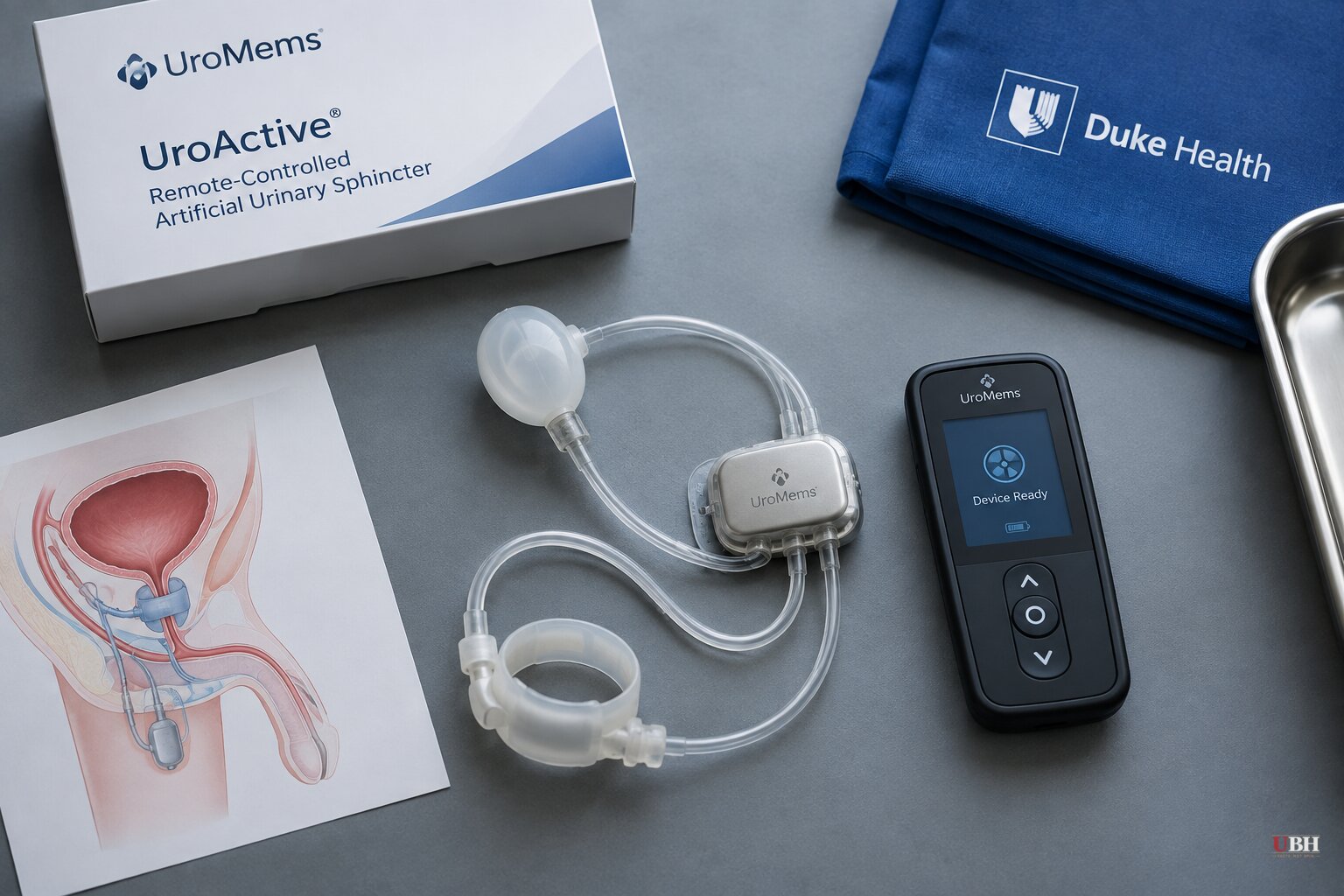
A surgical team at Duke Health, led by urologist Andrew Peterson, M.D., performed the first U.S. implantation of a remote-controlled artificial urinary sphincter (AUS) at the end of August, according to Duke Health and Newswise. The device, called UroActive, targets a problem that affects millions of men treated for prostate and other pelvic cancers: stress urinary incontinence.
Peterson said 10% to 20% of men develop incontinence severe enough after prostate cancer treatment that they need diapers or pads, according to Duke Health. It's a quality-of-life issue that keeps men out of restaurants, off dance floors, and away from the activities they used to enjoy, Peterson told Duke Health.
The Old Fix Had a Design Problem
The current gold-standard treatment is a manually operated AUS with a pump implanted in the scrotum. Patients squeeze it to release urine. For older men or those with limited grip strength or mobility, that's a real obstacle, according to MedPage Today.
Peterson didn't sugarcoat how patients react when the old device is described to them. "Some men are really averse when you tell them about the old device and this pump that goes in the scrotum," he told MedPage Today. "They want to know whether they have to, basically, 'mash on my junk.'"
UroActive replaces that with a metal control unit, similar in size to a pacemaker, implanted under the skin in the abdomen. It houses a pump, reservoir, and battery. Patients press a remote the size of a car key fob to deflate the urethral cuff and urinate, according to Renal and Urology News. The cuff automatically re-inflates after a preset time, and a built-in "UroTimer" failsafe allows permanent deactivation if something goes wrong.
"It's like a personalized Tesla," Peterson said. "You can change every component of it. You can program the device to stay open for 1 minute, for 45 seconds, for 3 minutes. However long a particular man needs."
The Data So Far Is Thin, But Positive
The evidence backing UroActive right now comes from a first-in-human trial in France of just six men, published in The Journal of Urology by Pierre Mozer, M.D., Ph.D., of Hôpital Universitaire Pitié-Salpêtrière in Paris, and colleagues, and reported by Renal and Urology News. All six had prior radical prostatectomies. At one year, every patient hit at least a 50% reduction in pad weight, and five of six reached 75% improvement. Daily pad use dropped from a median of 3.7 to 1.0. No devices required revision or removal.
That's a small sample. Six patients is not a basis for sweeping claims, and Peterson himself was careful to frame it that way, telling MedPage Today the French cohort now has three years of follow-up with "quite good" satisfaction scores, without overselling it as proof the device works broadly.
A larger U.S. and French trial, SOPHIA2, recently finished enrolling 140 patients across 14 U.S. sites. Duke enrolled both the first and last U.S. patients. The primary endpoint is a 50% or greater reduction in 24-hour pad weight at six months, and results are expected next year, according to MedPage Today.
The study is funded by UroMems, the device's manufacturer, according to Duke Health. That doesn't make the results wrong, but it's a financial relationship readers deserve to know about, and it's a reason the upcoming independent-site results in SOPHIA2 matter more than the small French pilot.
Not a Fix for Everyone's Bladder Problem
Separately, Epoch Times reported that roughly 50 million Americans deal with nocturia, waking repeatedly at night to urinate, but only about 1.5 million ever seek treatment. That's a distinct condition, typically driven by nighttime overproduction of urine tied to hormone shifts with age, not the sphincter-muscle damage from prostate surgery that UroActive targets. The two problems get lumped together in casual conversation, but they have different causes and different fixes.
The human stakes of getting this right are illustrated by Joe Faulstich, a prostate cancer survivor treated at Loyola Medicine. After 14 years of stress incontinence following his 2011 diagnosis and treatment, Faulstich was spending more than $200 a month on pads and briefs before he received an artificial urinary sphincter from urologic surgeon Ahmad El-Arabi, M.D., according to Loyola Medicine. His case underscores why men wait years, sometimes over a decade, before getting a device implanted at all, and why the search for a less awkward option has traction.
UroActive has not been approved by the FDA. It remains investigational, and the real verdict comes when SOPHIA2's 140-patient results are published next year. Until then, this is a promising early-stage device with a six-patient French pilot behind it, not a proven replacement for the standard AUS.
Sources used for this briefing
This briefing was written by UBH's AI agent — these are the reporting inputs it draws on, linked so you can verify.


