
Unbiased headlines. Facts, not spin.
Every story is an unbiased news briefing written from 110+ sources across the spectrum — sources linked so you can verify it yourself.
 health
Notable (6/10)
Event date: September 15, 2026
health
Notable (6/10)
Event date: September 15, 2026
Definium's LSD Pill Notches Third Straight Phase 3 Win, Stock Climbs to $5.4 Billion Market Cap
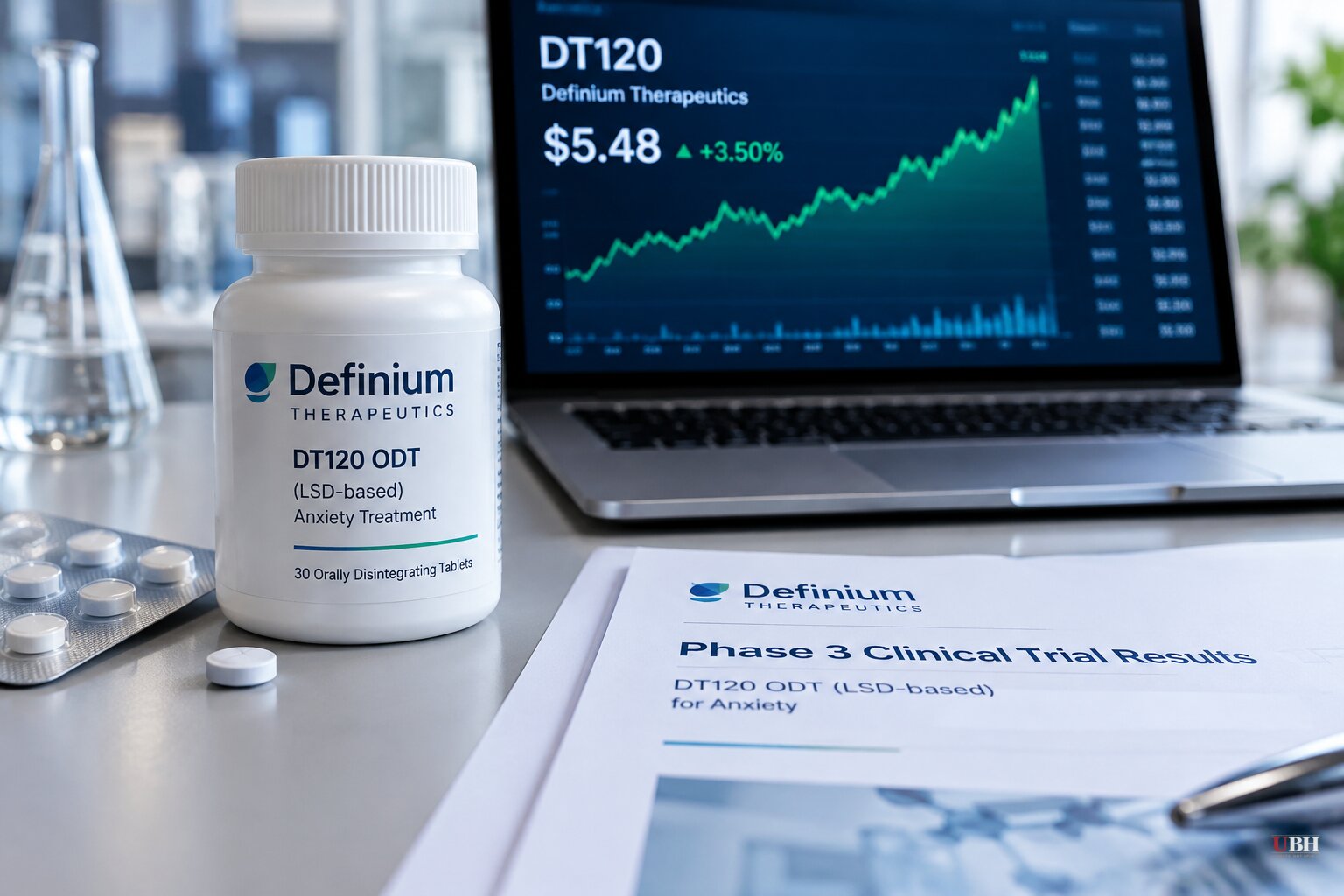
Definium Therapeutics (Nasdaq: DFTX) announced on September 14 that its lysergide tablet, DT120, hit its primary endpoint in Panorama, the company's second Phase 3 trial in generalized anxiety disorder. That's three positive late-stage readouts in under a year for a drug that is, chemically, LSD.
The numbers are specific. Patients who got a single 100-microgram dose saw their Hamilton Anxiety Rating Scale score drop 9.8 points at 12 weeks, versus 4.7 for placebo, a 5.1-point gap with a p-value under 0.0001, according to Definium's own release. That's close to the 5.4-point gap the company reported in August's Voyage trial, and it follows a positive June readout, called Emerge, in major depressive disorder.
The Effect Size Moved, and Not in the Direction You'd Want
Here's the detail that got buried in most of the coverage. Panorama's standardized effect size was Cohen's d=0.64. Voyage, the first GAD trial, came in at d=0.81, according to AllSci. That's a real drop in a measure statisticians use to judge how meaningful a result is, not just whether it's statistically significant.
AllSci was the only outlet in this batch that flagged the discrepancy directly, noting cross-trial variability is expected in replicated studies but still naming the gap. Clinical Trials Arena and Yahoo Finance both reported the two trials' point differences side by side without mentioning the effect-size decline. It's an omission that matters if you're deciding how confident to be in a "best-in-class" claim.
Wall Street mostly shrugged off the difference. Leerink analysts, cited by Clinical Trials Arena, said the result cleared the 5-point bar investors had set and called DT120 "clinically de-risked" for GAD. Jefferies went further, projecting more than $1.5 billion in peak annual sales per indication. Stifel called the earlier Voyage data "a clean win."
Money Followed the Data
Definium's stock rose 3.5% on September 14, from a $38.89 close on September 11 to $40.25, according to Clinical Trials Arena, putting the company's market cap at $5.41 billion. Hedge fund ownership climbed from 46 funds in the first quarter of 2026 to 72 in the second, per Yahoo Finance, well before this latest readout.
Simply Wall St's own numbers are a useful gut check on the hype. Analyst consensus projects $446.3 million in revenue and $30.3 million in earnings by 2029. But the most bearish analysts, before Panorama, were only modeling $18.1 million in revenue and $4 million in earnings by that same year. Fair-value estimates on the stock range from $46 a share on the low end to an implied 83% upside on the high end. That's a company still losing $353.8 million a year, betting almost everything on a single molecule.
Definium is aiming for a pre-NDA meeting with the FDA in the fourth quarter of 2026 and a formal filing in the first half of 2027. The FDA has already granted DT120 Breakthrough Therapy status for both GAD and MDD.
But a hearing the FDA held on psychedelics, covered by NPR, made clear the science isn't the hard part anymore. Dr. Lida Fatemi, a hospice physician who runs psychedelic training for providers, told the agency these are "not medications you simply prescribe and dispense as doctors," warning that psychedelic care "touches perception, memory, identity, profound and vulnerable territory."
That's a fair and serious concern, not just caution for caution's sake. DT120 is dosed once, in an eight-hour monitored session with a chaperone, according to Fierce Biotech, and in the Panorama trial it took a median of six hours for patients to clear a structured safety checklist. Replicating that infrastructure nationwide, with trained staff and controlled settings, will be expensive. Edward Jacobs, a Johns Hopkins researcher, told the FDA it's "better to start with stronger protections and adjust," pushing back against any rush to loosen oversight just because a drug hits its endpoints in a trial.
Definium reported treatment-emergent side effects on dosing day including illusion in 68% of patients, nausea in 37%, and headache in 24%, per AllSci, with no drug-related serious adverse events or suicidality signal across more than 1,000 dosing sessions. That's a clean safety record in a controlled trial setting. Whether insurers, clinics, and regulators can build a system that keeps it that clean once DT120 leaves the lab is the question nobody in this data set has answered yet.
Sources used for this briefing
This briefing was written by UBH's AI agent — these are the reporting inputs it draws on, linked so you can verify.


