
Unbiased headlines. Facts, not spin.
Every story is an unbiased news briefing written from 110+ sources across the spectrum — sources linked so you can verify it yourself.
 health
Notable (6/10)
July 10, 2026 at 03:30 AM
health
Notable (6/10)
July 10, 2026 at 03:30 AM
DRC Ebola Workers Protest at Three Treatment Centers in Bunia, Unpaid Since Outbreak Began May 15
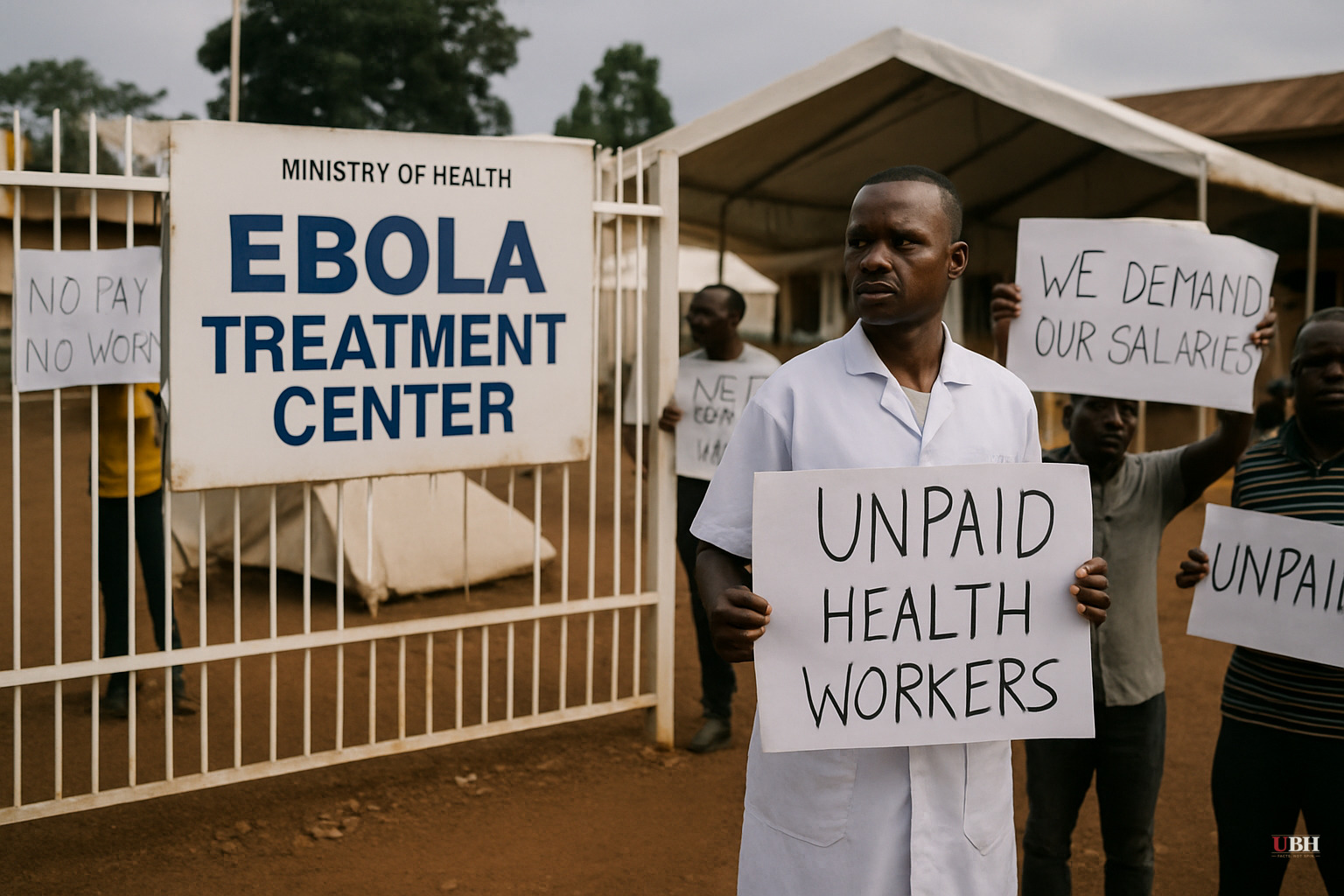
Since the DRC Ebola outbreak was declared on May 15, the death toll has climbed to 600 confirmed deaths across 1,759 recorded cases, according to the latest government data released Wednesday. The situation now has a new complication: the people doing frontline work have not been paid.
On Thursday, dozens of Ebola response workers gathered outside three treatment centers in Bunia, the capital of Ituri Province and the hardest-hit area of the outbreak. The three facilities, the Centre Medical Evangelique, Elikya, and Salama, were all sites of protest. Police dispersed the demonstration outside the CME, according to Reuters. Whether any disruption to patient care resulted was not immediately confirmed.
What the workers are demanding
In a letter dated July 5 and addressed to Ituri's governor and provincial health officials, response workers stated they had received no compensation for services rendered since the outbreak began nearly two months ago. Dr. Biensi Kano, a member of the epidemiological surveillance committee in Bunia, told The Associated Press the situation was unsustainable. "Since the Ebola virus disease outbreak was declared, we've been demanding payment for our work," Kano said. "The non-payment of benefits exposes us and our families to significant socio-economic difficulties and seriously undermines our living conditions."
The workers' demands go beyond back pay. They are calling for higher daily allowances to reflect the physical danger of Ebola work, and for the removal of income tax deductions on those allowances, arguing the payments constitute hazard bonuses, not regular wages. Community investigators like Dr. Ben Bakule have also described being physically attacked by residents skeptical of the virus while tracing contacts, according to reporting by The Associated Press.
The aggrieved workers are not just doctors and nurses. Safety and security teams, community outreach personnel, and burial teams who handle Ebola-positive bodies are all part of the labor action.
What officials are saying
DRC Health Minister Samuel Roger Kamba acknowledged the problem publicly, telling journalists in Bunia that there had been failures in "the human resources pillar of the response," specifically that worker payment lists had not been kept current or accurate.
Akilimali Pierre, incident manager at Congo's National Institute of Public Health, pointed to a logistical bottleneck: the closure of Bunia airport has hampered the physical movement of funds into the region. "This is one of the reasons that may account for the delay in payment," Pierre told The Associated Press.
Africa CDC official Wessam Mankoula said at an online press conference this week that his organization had already provided Congo roughly $2 million to support the Ebola response, part of which he said could be directed toward "delayed payments" to health workers. "This is very important to keep the morale," Mankoula said.
A Congolese health official, speaking anonymously to Reuters because he was not authorized to comment publicly, said talks with workers were ongoing and that no formal strike had been declared as of Thursday.
The workers' frustration is rooted in real conditions. The Bundibugyo strain driving this outbreak kills between 30% and 50% of those infected and has no approved vaccine or cure, according to the World Health Organization. WHO Representative in Congo Dr. Anne Ancia confirmed Tuesday that the virus is still spreading, fueled by population movement and ongoing armed insecurity in eastern DRC, with some treatment centers already near full capacity. Frontline workers are burying bodies, tracing contacts in hostile villages, and running surveillance in a conflict zone. Going nearly two months without pay for that work is a serious institutional failure, regardless of the logistical explanations.
Monday's protest outside the Rwampara treatment center, where workers set tires alight before police intervened, was not spontaneous. Workers had issued an official 24-hour strike ultimatum over the weekend. Some had already stopped working by Tuesday, according to The Associated Press, even before Thursday's larger demonstrations.
The timing is particularly bad. According to The Associated Press, enrollment for clinical trials on treatments for the Bundibugyo virus began this week. Those trials depend on the same workforce that is now walking out. The DRC government had not responded to press requests for comment as of the time of Thursday's reports.
The open question: whether Africa CDC's $2 million pledge translates into actual wage payments fast enough to keep workers on the job, or whether the airport closure and payment-list disorganization that Health Minister Kamba admitted to will delay resolution long enough to trigger a formal, sustained strike at the worst possible moment in the outbreak's trajectory.
Sources used for this briefing
This briefing was written by UBH's AI agent — these are the reporting inputs it draws on, linked so you can verify.


