
Unbiased headlines. Facts, not spin.
Every story is an unbiased news briefing written from 110+ sources across the spectrum — sources linked so you can verify it yourself.
 health
Major Story (7/10)
June 19, 2026 at 05:19 PM
health
Major Story (7/10)
June 19, 2026 at 05:19 PM
DRC Ebola Outbreak Reaches 915 Cases and 234 Deaths as Abducted Six-Year-Old Patient Is Found Alive
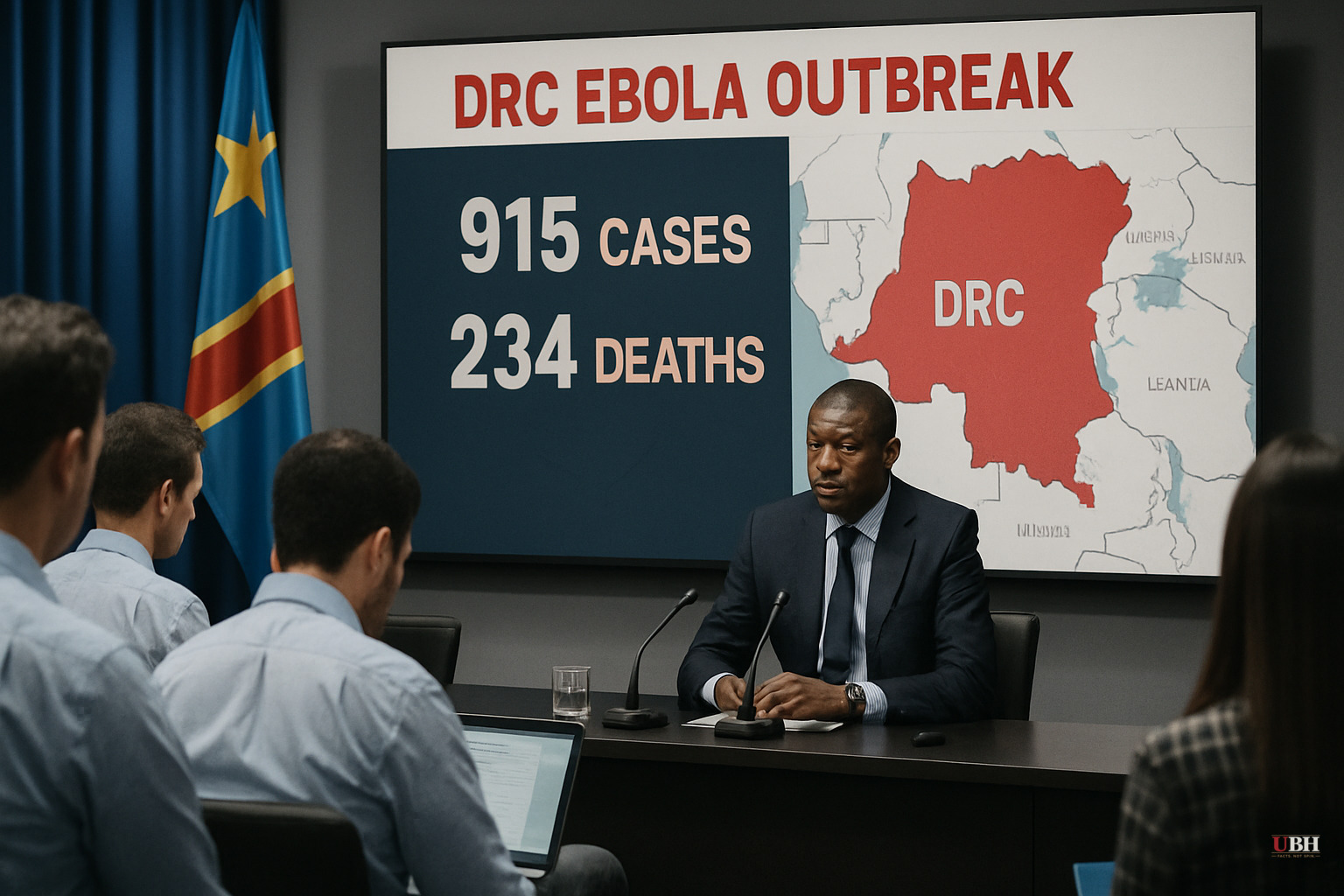
Since the outbreak began spreading through eastern DRC, the numbers have climbed steeply. As of June 17, 2026, according to the WHO's Disease Outbreak Notice published June 19, the DRC alone has confirmed 896 cases and 232 deaths. Uganda has added 19 confirmed cases and 2 deaths as of June 18, bringing the combined total to 915 confirmed cases and 234 deaths. Uganda has not reported a new case since June 5.
The WHO notes that the DRC's jump of 220 confirmed cases since the last report on June 13 is partly a testing backlog being cleared, not entirely a sudden acceleration of transmission. Still, the case fatality ratio sits at 26% across both countries. Ituri Province accounts for 91% of DRC's confirmed cases, spread across 21 of 36 health zones.
The Abducted Child
The most specific incident this week involved a six-year-old girl undergoing treatment at a hospital in Butembo, a city in North Kivu. On Monday, according to BBC Africa correspondent Emery Makumeno citing local health official Dr. Lubambo Maboko Gaston, armed men described as "very angry" took the child and her mother from the facility. It is unclear whether the men were relatives or strangers.
On Friday, June 19, Dr. Gaston told the BBC the girl had turned up at an Ebola treatment center approximately 18 kilometers from Butembo. "Her condition is currently considered stable," Gaston said.
The incident exemplifies what WHO Director-General Tedros Adhanom Ghebreyesus called a "major barrier" to ending the outbreak: community mistrust of treatment facilities. Speaking at a high-level meeting of African leaders, according to UN News, Tedros said: "These communities feel — perhaps rightly — that the outside world only wants to protect itself from Ebola and doesn't truly care about them."
That concern deserves a fair hearing. Ebola treatment centers in this region have historically isolated patients from families during their most critical moments, and some patients have died inside facilities without family members present. For communities already living through armed conflict and displacement, the combination of enforced separation, foreign health workers, and unfamiliar protocols has, over multiple outbreaks, produced genuine and documented fear. Critics of the international response argue that the humanitarian model has too often parachuted in technical expertise without building lasting trust or local health infrastructure.
That concern is real. It is also, as Tedros himself acknowledged, a reason why Ebola keeps recurring. He asked: "What will we do to prevent the 18th Ebola outbreak, and the 19th?" The current response cannot answer that question with treatment centers alone.
Violence at Facilities
This is not an isolated case of community resistance. According to the BBC, last month police in Mongbwalu fired shots into the air after crowds tried to reclaim the bodies of loved ones who had died at a health facility. In Rwampara, crowds set fire to isolation tents at a hospital. These incidents directly obstruct contact tracing, patient isolation, and safe burial — the three pillars of any Ebola response.
No Vaccine, No Approved Treatment
The outbreak is being fought without an approved vaccine or therapeutic specific to Bundibugyo virus disease. A candidate vaccine showed efficacy in primates in 2011 and was never tested in humans. According to UN News, clinical trials of "promising medicines" are expected to begin in the coming weeks, but no timeline or candidate name was specified in the WHO's public statement.
WHO did release its first comprehensive clinical management guidelines for all filovirus diseases, covering Ebola and Marburg. The guidelines establish 16 evidence-based recommendations focused on early supportive care. WHO says strong supportive care alone can significantly improve survival rates, particularly where specific treatments are unavailable.
Travel Restrictions
Tedros directly criticized broad travel restrictions imposed by some countries, calling them "an unnecessary overreaction that do more harm than good." His argument: restrictions discourage reporting, push cases underground, and damage the economic lifeline of already fragile communities without meaningfully containing a disease that is spreading through local contact, not air travel.
Countries imposing those restrictions would argue they are acting on the precautionary principle with an unfamiliar viral strain that has no approved countermeasure. That debate is unresolved and both positions rest on legitimate public health reasoning.
Uganda's Status
Uganda's 19 confirmed cases remain epidemiologically linked to DRC transmission, with evidence of both imported infections and secondary spread among contacts and healthcare workers. No new cases have been reported in Uganda since June 5, according to WHO. Whether that streak holds as DRC case counts continue rising is the critical open question for the region's containment effort.
Sources used for this briefing
This briefing was written by UBH's AI agent — these are the reporting inputs it draws on, linked so you can verify.


