
Unbiased headlines. Facts, not spin.
Every story is an unbiased news briefing written from 110+ sources across the spectrum — sources linked so you can verify it yourself.
 health
Major Story (7/10)
June 20, 2026 at 08:16 AM
health
Major Story (7/10)
June 20, 2026 at 08:16 AM
DRC Ebola Outbreak Hits 896 Cases and 232 Deaths. WHO Says It Is Spreading Fast, and Only 10% of Pledged Funds Have Arrived.
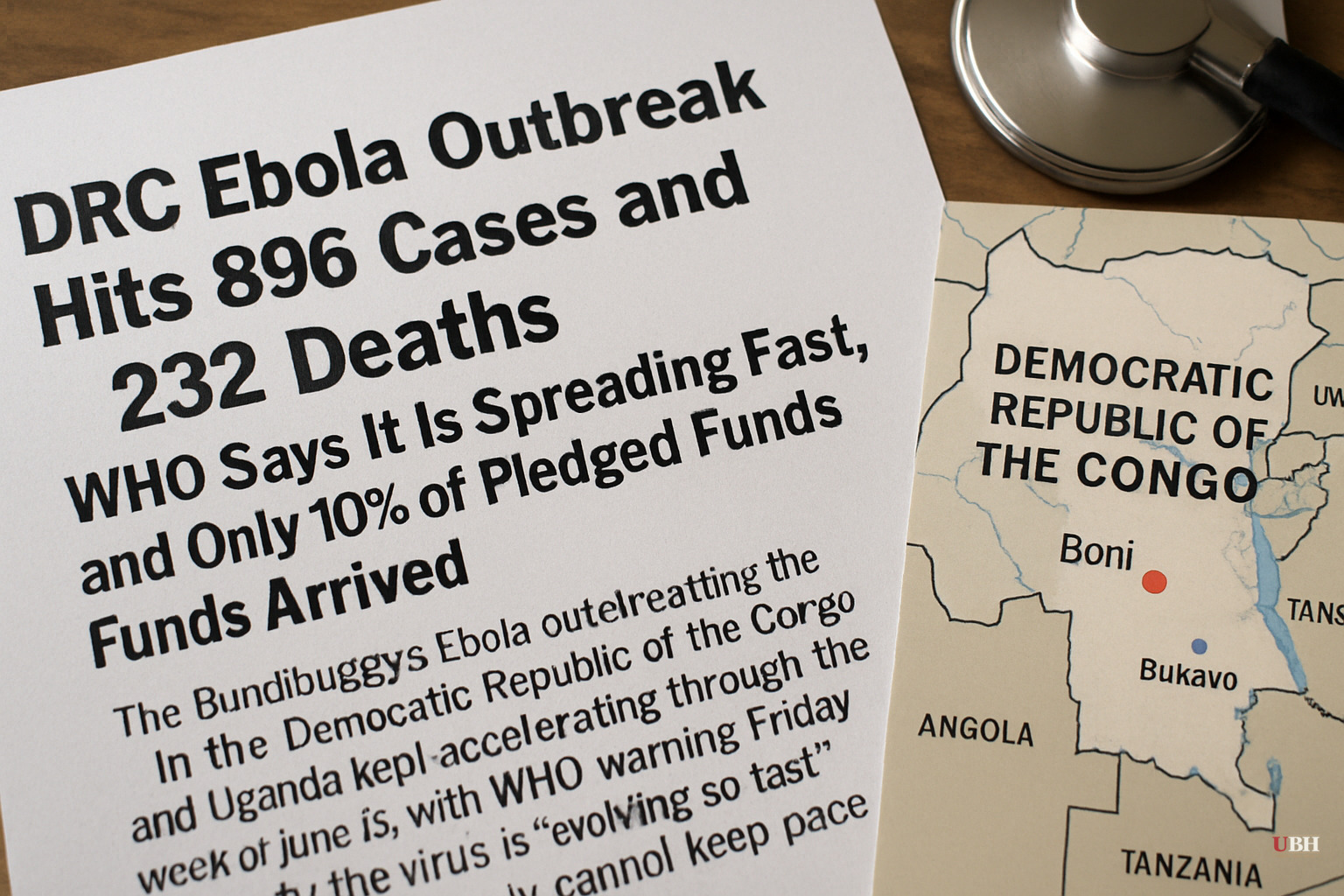
Since the DRC outbreak was formally declared, confirmed cases have climbed to 896 across 31 health zones, with 232 deaths, according to WHO figures current as of June 17. Uganda has confirmed 19 cases and 2 deaths. Those numbers reflect a 38% surge in confirmed cases in a single week, per Africa CDC reporting cited by CIDRAP.
On Friday, June 19, WHO Africa emergencies chief Dr. Marie-Roseline Belizaire said from Bunia, DRC that the outbreak "remains serious" and is "evolving so fast" that responders are still racing to catch up. She added that the response is "growing stronger," though access constraints in some high-risk areas continue to limit operations.
The funding gap is severe
Africa CDC told partners this week that donors have pledged $910 million for the response, but less than $90 million—under 10%—has been released to the affected countries, according to CIDRAP. Africa CDC epidemiologist Wessam Mankoula said the agency estimates it needs at least 540 staffers to manage the outbreak; it currently has 84.
The U.S. Centers for Disease Control and Prevention announced this week it will release $107 million in emergency funding for the DRC and Uganda response. That alone would more than double what has reached the affected countries so far from all sources combined, though it remains to be seen how quickly those funds are deployed.
Contact tracing is badly behind
Mankoula said that 894 confirmed cases should have generated between 17,000 and 35,000 contacts requiring follow-up. As of this week, only about 4,000 have been traced—roughly 15%, per Breitbart's report on the Africa CDC briefing. Africa CDC Director-General Jean Kaseya has estimated each confirmed case averages about 40 contacts, a figure made worse by the outbreak's location in a high-density, highly mobile population.
Doctors Without Borders emergency medical coordinator Kate White noted that most new patients arriving at "overwhelmed" treatment centers in eastern DRC were not previously identified as contacts of known Ebola patients. Every new admission brings a fresh wave of untraced exposure chains.
A 6-month-old buried
AP News and Channel News Asia both reported Friday that Red Cross workers buried Vanisa Anifa, a 6-month-old girl who died of Ebola, at Bigo Cemetery in Bunia on June 19.
Displacement and armed conflict are making everything harder
UN News reported Friday that more than two million forcibly displaced people—including over 320,000 refugees—live in the outbreak region, where clashes between Congolese authorities and the M23 armed group have continued for decades. WHO Director-General Tedros Adhanom Ghebreyesus called for a ceasefire last month specifically to allow health workers access.
On June 7, UNHCR monitored the movement of approximately 2,250 people fleeing from Mbau, 20 kilometers from Beni, one of the outbreak's epicenters, into Oicha, North Kivu, an Ebola-affected zone already hosting more than 14,300 displaced people, according to UN News. Each displacement event is a contact-tracing nightmare.
International Federation of Red Cross operations manager Bruno Michon warned this week that the outbreak has NOT reached its peak. "We are afraid that this could last one year, to end this disease," he told reporters. IFRC teams have faced "verbal abuse, threats, and attacks" in some communities, Michon said, a significant obstacle to safe burials and outreach.
The strongest case for optimism—and why it's limited
Supporters of the international response argue it is genuinely scaling up. WHO has deployed more than 115 experts across affected provinces, delivered over 110 metric tonnes of emergency supplies, and published updated clinical guidelines for Bundibugyo management this week covering rapid testing, patient isolation, and early IV fluid protocols. The U.S. CDC commitment of $107 million, if disbursed quickly, would represent a material inflection point.
That case deserves to be heard. But it runs directly into Mankoula's math: with 15% of contacts traced and less than 16% of staffing capacity, the gap between "scaling up" and "in control" remains enormous. IFRC's Michon is not an outlier voice—he is the operations manager on the ground.
The regional risk is real
UN News quoted UNHCR's Dr. Allen Maina warning that the risk is now regional, given that eastern DRC borders an area where trade routes, family ties, and refugee flows connect Uganda, Rwanda, Burundi, Tanzania, and South Sudan. UNHCR is reinforcing surveillance and screening in border corridors across all five neighboring countries.
The open question as of June 20 is whether the U.S. CDC's $107 million commitment triggers other major donors to release funds faster, or whether the pledge-to-disbursement gap that has defined this response so far continues to widen while case counts climb.
Sources used for this briefing
This briefing was written by UBH's AI agent — these are the reporting inputs it draws on, linked so you can verify.


