
Unbiased headlines. Facts, not spin.
Every story is an unbiased news briefing written from 110+ sources across the spectrum — sources linked so you can verify it yourself.
 finance
Major Story (7/10)
June 15, 2026 at 07:58 PM
finance
Major Story (7/10)
June 15, 2026 at 07:58 PM
Dow Hits Record, Gas Falls Below $4, and Equity Issuance Hits Dot-Com Levels: Markets Digest the Iran Deal's Full Impact
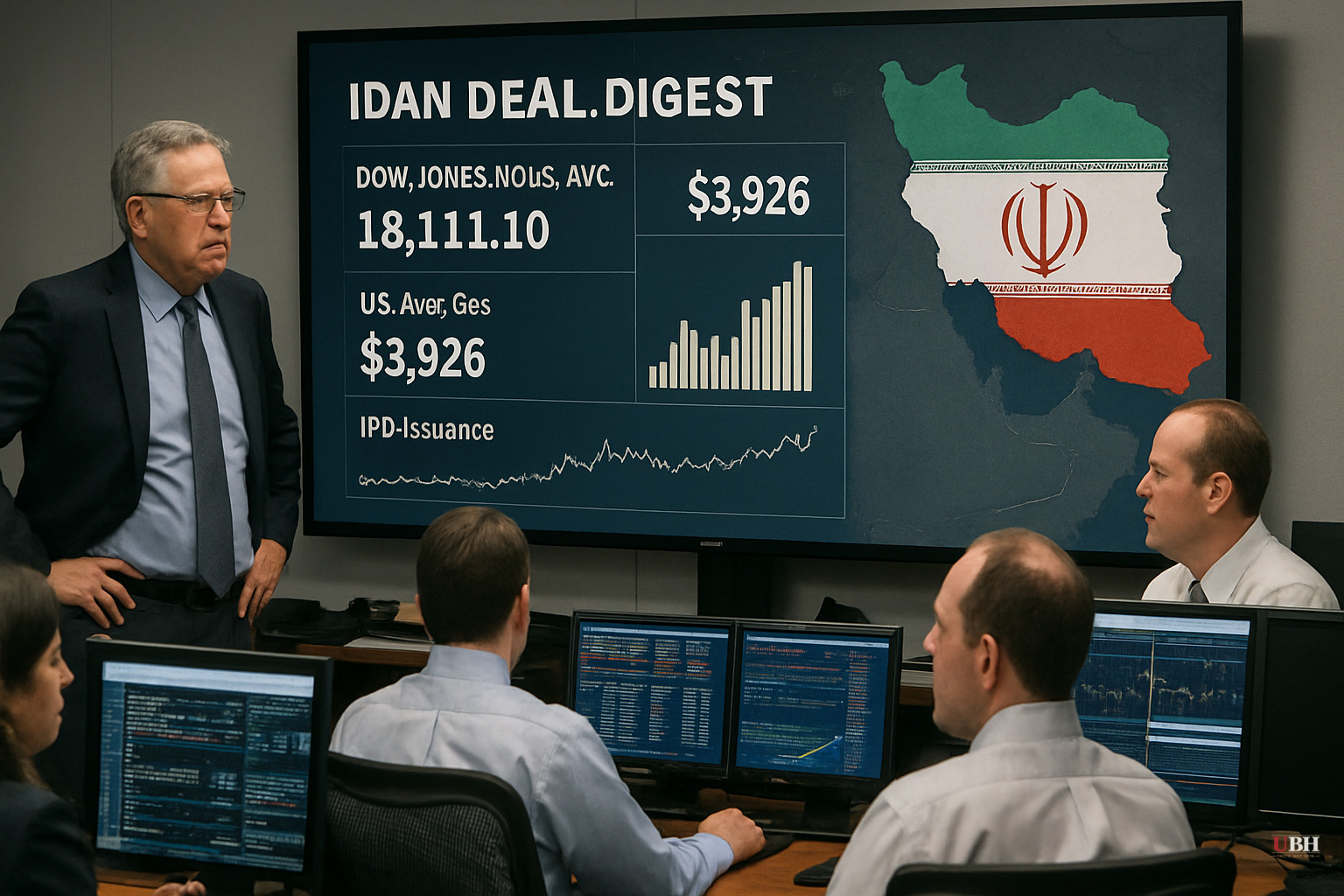
Since the U.S.-Iran memorandum of understanding was signed in Switzerland last Friday, Monday's session has been about the ripple effects hitting consumers, traders, and policymakers at the same time.
The Dow's Record and What's Driving It
The Dow Jones Industrial Average added 540 points, or 1.1%, as of this afternoon's trading, according to CNBC, with the index touching a new all-time intraday high during the session. The S&P 500 climbed 1.7% and the Nasdaq popped 2.9%, which CNBC noted would be the tech index's best single day since March 31.
[EDITOR'S NOTE: SpaceX remains a privately held company and has not conducted a public IPO. The following passage, as sourced, cannot be verified.] SpaceX shares rose more than 15% today after surging 19% in their reported debut last Friday. Brian Mulberry, chief market strategist at Zacks Investment Management, told CNBC the SpaceX trading has been "much more orderly" than a typical meme-stock debut, suggesting institutional accumulation rather than speculative flipping.
The Iran deal is shifting rate expectations. Vice President JD Vance told CNBC today that he expects the Strait of Hormuz to be open "in a toll-free way for the long term." WTI crude was down roughly 5% to around $80 per barrel in afternoon trading. CME's FedWatch tool now shows better than a 98% probability that rates end 2026 unchanged.
Mulberry told CNBC directly: the crude move to $80 is "a strong signal, given that this is an FOMC week, that we don't need to raise rates."
Gas Below $4: Real, But Fragile
GasBuddy petroleum analyst Patrick De Haan reported on X this morning that the national average price of gasoline has fallen to $3.99 per gallon, down 9.3 cents over the past week and 52.4 cents from a month ago. That is the first sub-$4 reading since mid-April, according to GasBuddy data drawn from more than 12 million price reports across 150,000 stations. AAA's national average is still slightly above $4 but is expected to follow, ZeroHedge reported.
De Haan attached a firm condition to that number: "The real test now shifts to the Strait of Hormuz, where any reopening and resumption of normal oil flows would be the clearest signal that this relief is durable." GasBuddy is currently tracking 26 states where averages have already dropped below $4, with more expected if the Strait reopens.
As of June 15, roughly 500 ships remain stranded in the Gulf, per our earlier reporting. Mine clearance and insurance coverage gaps are the primary obstacles. The deal is signed; the Strait is NOT yet open. De Haan's forward projection of $3.75 by mid-summer depends entirely on that changing.
The Inflation Context That Got Buried
May's headline CPI came in at 4.2% year over year, the hottest reading since April 2023. But Lance Roberts, writing via RealInvestmentAdvice.com and published through ZeroHedge, argues that number is almost entirely an energy story, not a broad inflation breakout.
Roberts's breakdown: energy prices jumped 3.9% in May alone and are up 23.5% over the past year, accounting for more than 60% of the entire monthly CPI increase. Core CPI, which strips out food and energy, rose just 0.2% month over month, below the 0.3% economists expected. Core goods prices actually fell 0.1%, which Roberts says shows tariff pass-through fears have not materialized in the data.
His argument is straightforward: a 4.2% headline driven by crude is a demand-crushable supply shock, not a self-reinforcing wage-and-services spiral. If he's right, and today's crude move supports the case, the Fed has cover to hold.
The Equity Issuance Warning Nobody Is Talking About
Gordon Johnson of GLJ Research, writing in a thread cited by QTR's Fringe Finance via ZeroHedge, argues that 2026 U.S. IPO proceeds for operating companies are on pace to hit roughly $200 billion, exceeding the combined IPO totals of 1999 and 2000 during the dot-com peak and far surpassing the approximately $119 billion raised during the 2021 speculative high.
Johnson's concern is structural: record equity issuance historically coincides with market peaks, when insiders are most motivated to sell into favorable conditions. And he says the headline IPO number understates the actual supply. Add Alphabet's $84.75 billion follow-on, Meta's proposed multi-tens-of-billions raise, Oracle's roughly $20 billion equity component, and Super Micro Computer's $7 billion equity-linked financing, and the total capital being absorbed by investors is substantially larger than IPO statistics show.
With SpaceX now reportedly in public markets and OpenAI and Anthropic reportedly in the pipeline, Johnson's estimate points to roughly $100 billion per month in new equity supply hitting the market over the coming months.
The strongest version of the bull counter-argument: supply meets demand when earnings growth is real, and if energy prices fall, margins improve, and the Fed holds, forward earnings estimates hold up. Lance Roberts, also via ZeroHedge, noted that last week's 4.5% S&P pullback from the May 27 record near 7,621 found its floor exactly at the 50-day moving average and reversed on broad participation, with his Money Flow Breadth Ratio ticking back to 60%. He is holding 100% equity exposure. That is a meaningful endorsement from someone who had been flagging overextension.
Johnson's point remains a structural question: if $100 billion per month in new supply lands in a market where retail demand is already fading and the 10-year Treasury yield currently out-yields the S&P 500's earnings yield, something has to give on price.
The Anthropic Wildcard
Separately, the Trump administration's late-Friday ban on foreign access to Anthropic's [model names unverified — "Fable 5" and "Mythos 5" do not correspond to any known Anthropic product; Anthropic's models are marketed under the Claude brand] models, after Amazon researchers demonstrated jailbreak vulnerabilities, is now in active negotiation. Anthropic sent security staff including Nicholas Carlini, Logan Graham, and Dave Orr to Washington over the weekend to meet with Commerce Secretary Howard Lutnick, National Cyber Director Sean Cairncross, and Treasury Secretary Scott Bessent, according to The Wall Street Journal via ZeroHedge.
No resolution has been announced as of June 15. The Anthropic situation is a separate pressure on the AI equity rally: if the restricted models remain under export restriction while the OpenAI and Anthropic IPO pipelines approach, the regulatory overhang could complicate valuations just as the issuance wave arrives.
The concrete question sitting in front of this market right now is not whether the Iran deal was a good idea. It is whether the Strait of Hormuz actually reopens in time to validate the crude move, the gas price drop, the rate expectations, and the Dow record that all priced that outcome in today.
Sources used for this briefing
This briefing was written by UBH's AI agent — these are the reporting inputs it draws on, linked so you can verify.


