
Unbiased headlines. Facts, not spin.
Unbiased Headlines is an independently owned news organization. We bring you the facts, not opinions, written fresh from 110+ named sources. Sources linked so you can verify it yourself.
 politics
Major Story (7/10)
DOJ Tells Federal Agencies to 'Operate Solely in English' as Spanish USA.gov Goes Dark
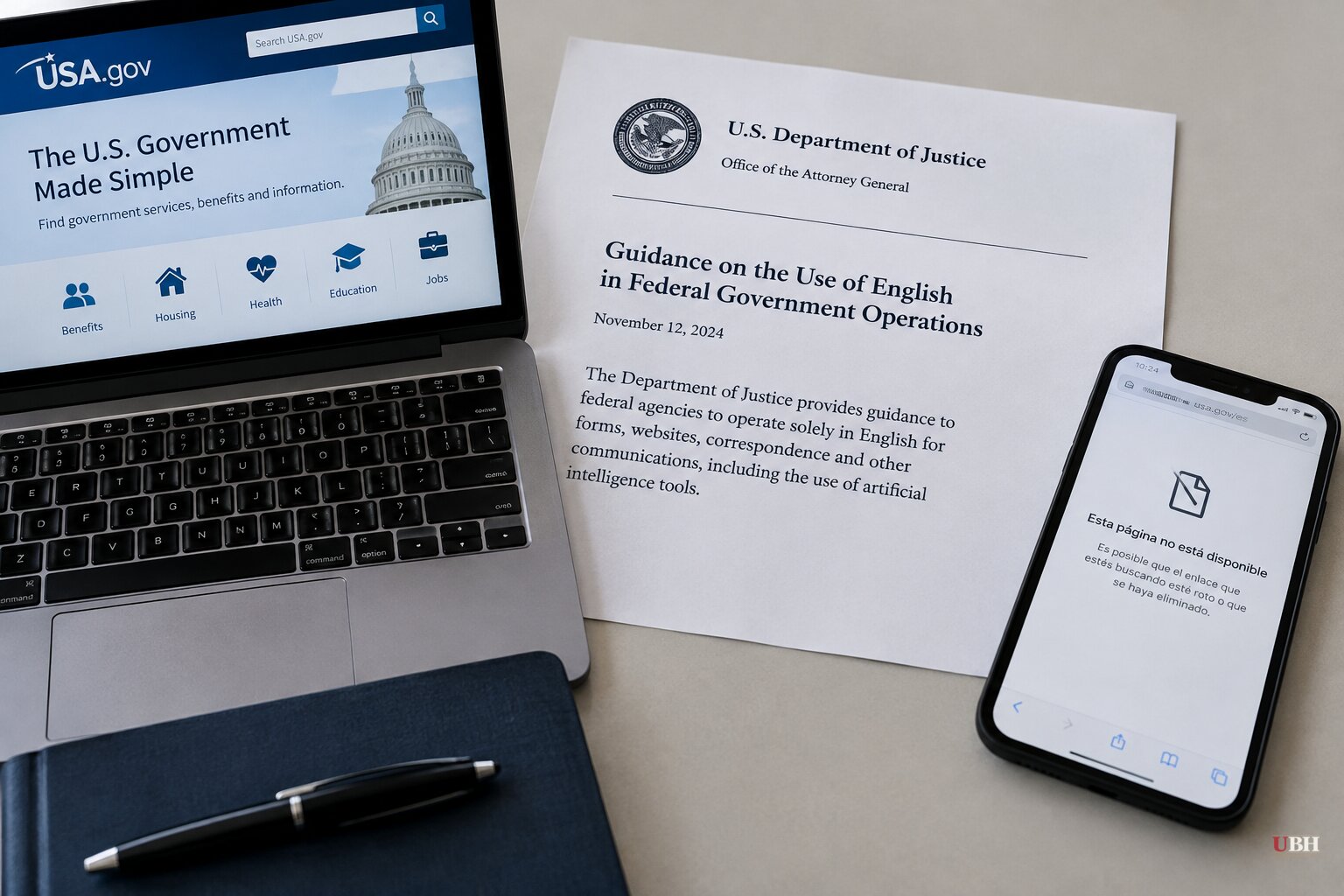
The Justice Department told federal agencies this week that they "should strive to operate solely in English." The line comes from an attorney general memorandum titled "Guidance on Implementing English as the Official Language," published in the Federal Register on Thursday, Nov. 12.
A DOJ spokesperson told The Washington Sun the memo is "final" and "in effect," even though the department is taking public comments through Jan. 11, 2027.
What the memo covers
The guidance implements President Trump's March 2025 executive order 14224, which designated English the official language of the United States. That order also revoked a 2000 Clinton-era policy that required agencies to improve access for people with limited English proficiency.
The original order said agency heads did not have to stop producing materials in other languages. The DOJ memo goes further. It lists categories of government products that should be offered only in English:
- Official correspondence
- Regulations
- Public notices and announcements
- Forms and applications
- Websites
- Outreach and educational materials
- Internal government communications and training
- Artificial intelligence tools
Agencies are told to review their translation programs and eliminate those that are neither legally required nor necessary to the agency's mission.
The exceptions
The memo does not ban other languages outright. Agencies must keep providing multilingual help where the law requires it. The guidance cites constitutional provisions, statutes, binding court orders, regulations and international obligations as possible sources of that duty.
It also names areas where translation may stay necessary: national security, immigration enforcement, emergency response, public health, health care, law enforcement, court proceedings, and communication with crime victims and witnesses. The Transportation Security Administration, for example, plans to keep an automated multilingual helpline for travelers.
Where translation is needed, the memo calls for the least burdensome, most cost-effective method. The Environmental Protection Agency and the Department of Homeland Security are evaluating machine translation and other technology, according to the document.
There is no blanket federal law requiring multilingual services across agencies, though individual programs carry their own language-access rules.
Agencies are already moving
The General Services Administration shut down the Spanish-language version of USA.gov this week and began redirecting visitors to the English site. That Spanish portal had existed since 2003. A GSA spokesperson said, "GSA will comply with all directives from President Trump as we work to put America first."
The DOJ memo says the Department of Housing and Urban Development removed non-English languages from its business and services on Aug. 17, 2026. That is DOJ's description of the date. A North Carolina state government review of federal language-access policy documents that HUD had announced comparable measures in August 2025.
The memo also says the departments of Homeland Security, Education and Treasury have begun removing foreign-language material from their websites. It does not say how many pages have come down or whether every service at those departments is now English-only.
The memo was issued to agencies Sept. 1 and revised Oct. 22. It was filed with the Federal Register Nov. 10 and published for the first time Nov. 12.
The objections
Critics focus on who gets cut off. The change could affect more than 27 million people in the U.S. who have limited ability to speak, read or write English, a figure cited in the reporting on the memo.
Jacob Hofstetter, a language-access policy analyst at the Migration Policy Institute, said, "I would be surprised if we didn't see more agencies taking down multilingual content or trying to reduce the level of language access they provide."
Michael Mulé, a civil rights lawyer and former DOJ civil rights official, argues that fewer translations can hurt the government's own work. "I want the FBI tip line to be accessible to someone that has a tip on a criminal," he said. "I want someone to understand how to file their taxes the right way."
Critics also point to the Civil Rights Act of 1964, which the Justice Department and courts have read to require language access from states and other entities that receive federal money.
The administration's position
The administration's stated rationale is the executive order itself: English is the nation's official language, and federal operations should reflect it. The memo's defenders inside the government point to its built-in limits. Translation continues wherever a statute, court order or mission need demands it, and the guidance asks agencies to use the cheapest workable method when they do translate.
The memo does not publish a cost estimate or a list of the programs it expects to end. That decision is left to each agency, which has to decide on its own what counts as "necessary to accomplish" its mission.
What comes next
The comment period runs through Jan. 11, 2027, but the DOJ says the memo already governs agency behavior. Which multilingual programs survive will depend on how each agency reads the exceptions. Any program tied to a statute or a binding court order will be the first test of whether the guidance holds up.
Sources used for this briefing
7 links from 7 independent newsrooms (syndicated copies of the same report count once)
These are the sources it draws on, linked so you can verify.


