
Unbiased headlines. Facts, not spin.
Every story is an unbiased news briefing written from 110+ sources across the spectrum — sources linked so you can verify it yourself.
 finance
Notable (6/10)
June 18, 2026 at 06:14 PM
finance
Notable (6/10)
June 18, 2026 at 06:14 PM
DOJ Probes JPMorgan and Citigroup Over Financial Flows Tied to Iran's Supreme Leader Mojtaba Khamenei
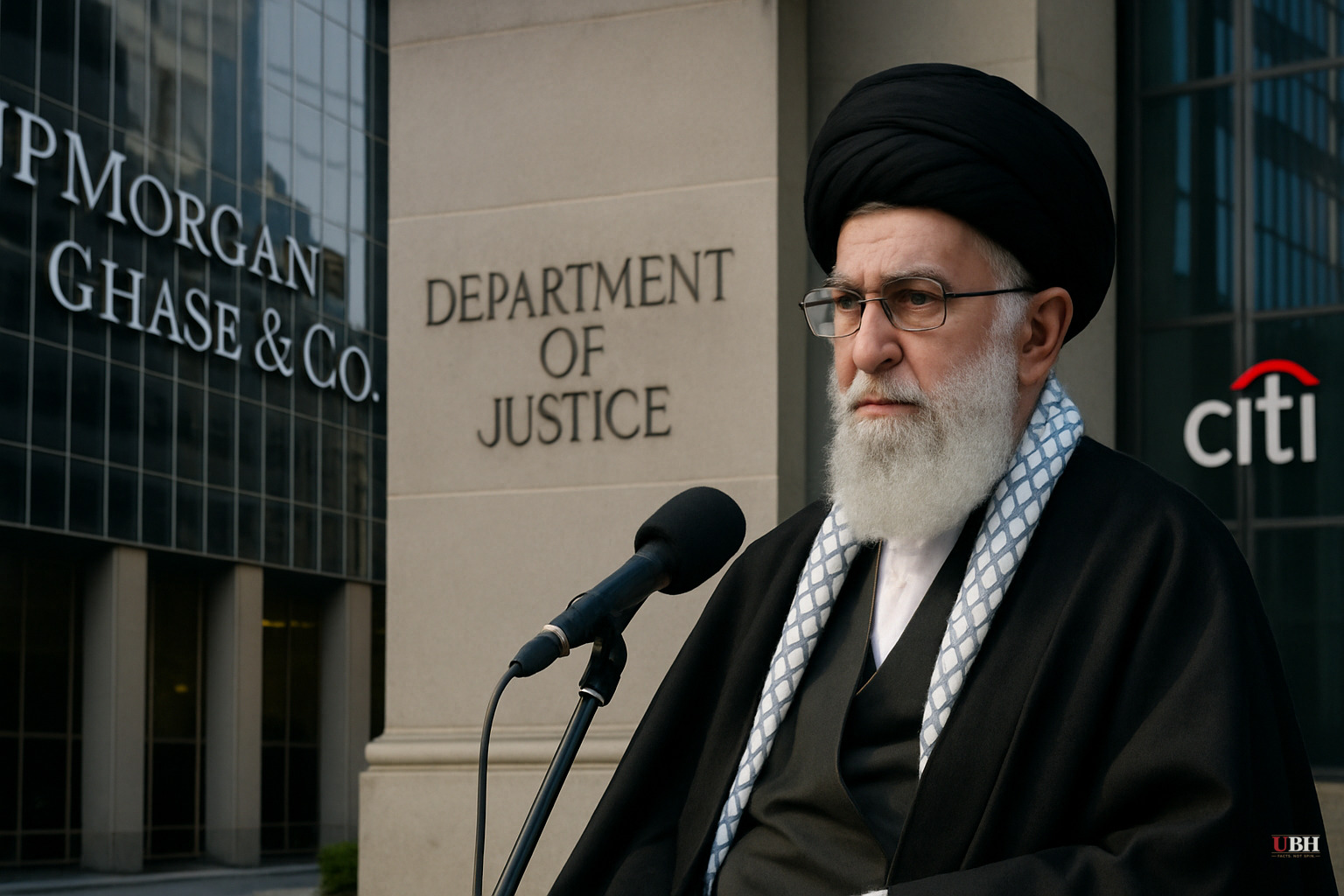
What the DOJ Is Actually Looking At
The Justice Department has been examining how Mojtaba Khamenei, Iran's Supreme Leader since March, built a sprawling international investment portfolio that reportedly touches Wall Street banks, according to four officials with direct knowledge cited by Bloomberg News and confirmed by the Straits Times on June 18, 2026.
Investigators are looking at JPMorgan Chase and Citigroup specifically, examining whether either bank served as a conduit for large money movements tied to firms Khamenei controls. The probe also covers European and Middle Eastern lenders, financial institutions in the UK, Switzerland, Liechtenstein, and the UAE, and property-related payments to global brands including Hilton Worldwide Holdings.
Neither JPMorgan nor Citi has been accused of knowingly facilitating anything. The DOJ, JPMorgan, and Citi all declined to comment.
Two Separate but Related Investigations
Crypto Briefing's coverage adds a layer that the other outlets largely glossed over. A separate DOJ civil forfeiture complaint, filed March 6, 2026, targeted over $15.3 million connected to the network of Hossein Shamkhani, an Iranian oil trader and son of a prominent advisor to Ayatollah Ali Khamenei. That complaint alleges the funds are tied to oil distribution operations that supported Iran's Revolutionary Guard Corps, designated by the US as a terrorist organization.
Shamkhani was sanctioned by the Treasury Department's Office of Foreign Assets Control on July 30, 2025. The Crypto Briefing report names Standard Chartered alongside JPMorgan in the Shamkhani thread, not Citigroup. The Khamenei network probe and the Shamkhani forfeiture complaint are related but are not the same investigation.
Standard Chartered is no stranger to this territory. The bank paid $1.1 billion in 2019 to resolve prior sanctions violations, according to Crypto Briefing.
Khamenei's Money Pipeline, as Known
Bloomberg first reported in January 2026 that Khamenei, prior to becoming Supreme Leader, had assembled a business empire spanning Persian Gulf shipping, Swiss bank accounts, and British luxury properties. Before assuming leadership after his father was killed in a US-Israel airstrike at the start of the Iran war, Khamenei relied on financier Ali Ansari to move funds abroad using shell companies. Ansari, through his lawyer, has denied any relationship with Khamenei.
Khamenei was sanctioned by the US in 2019 for acting on behalf of his father and working closely with the commander of the IRGC, according to the Treasury Department. He has not appeared publicly since taking power in March.
Ansari was sanctioned by British authorities, accused of "financially supporting" the activities of Iran's Islamic Revolutionary Guard Corps. Through his lawyer, Ansari has previously denied any relationship with Khamenei and said he would appeal against the British measures.
The DOJ's Stated Goal
Molly Moeser, who runs the DOJ's money laundering division, laid out the concern directly at an industry conference in New York in May. "The efforts collectively of the government over the last 10 years have really driven Iran out of legitimate financial institutions," she said. The problem is that Iran keeps finding workarounds.
"Because the US dollar is still the most stable currency and the currency everybody wants to make payments in, Iran looks for every opportunity to use shell companies, use shadow structures to still get access to the US dollar," Moeser warned.
The DOJ's immediate aim, according to multiple sources, is identifying gaps in due-diligence procedures at US correspondent banks, not necessarily building a criminal case against the banks themselves.
The Diplomatic Complication
Iran International reported that a US-Iran interim peace agreement was signed on June 17, outlining a halt to the ongoing war, a 60-day negotiation period, steps toward reopening the Strait of Hormuz, and discussions over frozen assets and sanctions relief.
Khamenei is reportedly involved in the decision-making around that agreement. The DOJ is now investigating his personal financial network at the same moment Washington is negotiating a broader deal with Tehran. The Straits Times flagged this tension explicitly, noting that the probe "became more diplomatically sensitive as Washington and Tehran edged closer to an interim peace deal."
The Strongest Counterargument
Skeptics of aggressive bank enforcement have a legitimate point here. JPMorgan and Citigroup process trillions of dollars annually through correspondent banking relationships they cannot fully audit in real time. When sanctioned networks use shell companies, obscured beneficial ownership, and multi-jurisdictional layering, even banks with robust compliance programs can be used without their knowledge. The distinction between a bank being used as an unwitting conduit and a bank actively facilitating sanctions evasion is not semantic. It determines whether fines, deferred prosecution agreements, or criminal charges follow. No named official or source in these reports has alleged that either bank knew what it was processing.
That said, "we didn't know" has historically not been a complete defense when regulators find compliance gaps. Standard Chartered's $1.1 billion settlement in 2019 was over exactly this kind of structural failure.
What Comes Next
The existence of a probe does not mean charges will be filed. Every source is explicit on this point. The DOJ's immediate deliverable appears to be a map of systemic vulnerabilities, not indictments.
The unresolved question with real stakes: if the US-Iran interim peace deal advances toward sanctions relief and unfrozen assets, does the DOJ's investigation into Khamenei's financial network slow down, get shelved, or run in parallel without political interference? No source has answered that, and the administration has not said.
Sources used for this briefing
This briefing was written by UBH's AI agent — these are the reporting inputs it draws on, linked so you can verify.


