
Unbiased headlines. Facts, not spin.
Every story is an unbiased news briefing written from 110+ sources across the spectrum — sources linked so you can verify it yourself.
 politics
Notable (6/10)
June 13, 2026 at 01:48 PM
politics
Notable (6/10)
June 13, 2026 at 01:48 PM
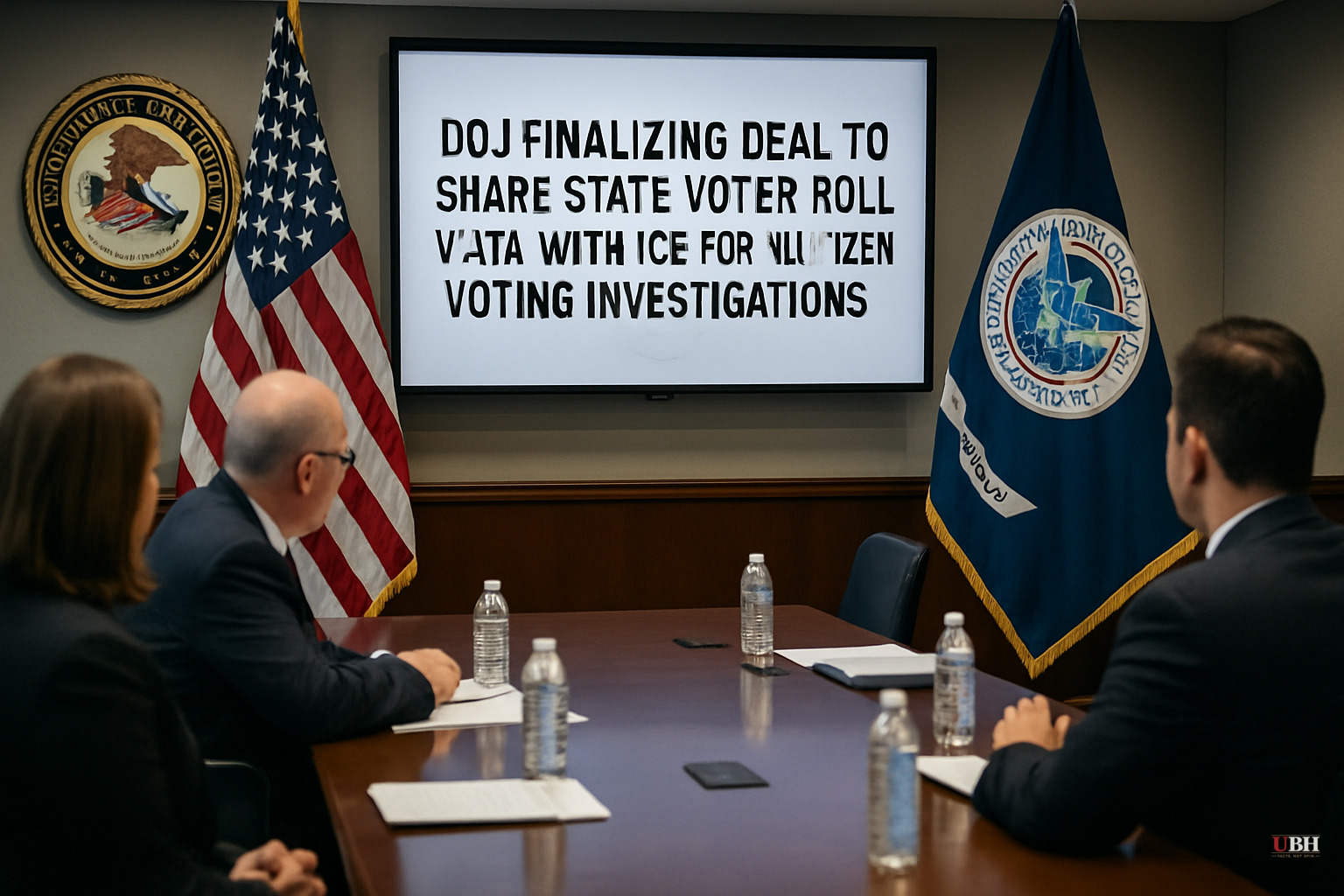
DOJ Finalizing Deal to Share State Voter Roll Data with ICE for Noncitizen Voting Investigations
Since the DOJ's Civil Rights Division began demanding voter roll data from states — litigation that by late February 2026 covered 28 states and the District of Columbia — the federal government has moved steadily toward a more expansive use of that data than it has disclosed in court.
According to CBS News, which spoke to sources with direct knowledge of the arrangement, the Justice Department is finalizing an agreement to share that voter registration data with Immigration and Customs Enforcement's Homeland Security Investigations unit. The formal access request is expected to come from Todd Lyons, the senior official currently serving as acting ICE director.
What the deal reportedly looks like
One source described to CBS News a potential system that would allow officials to run queries matching voter registration records against DHS alien databases. This would essentially function as a cross-referencing tool to identify noncitizens on voter rolls or in voting history records. The White House has been directly involved in discussions between DOJ and DHS, though CBS News could not determine the precise role it is playing.
Not everyone inside the government agrees on how much data to hand over. Some DOJ lawyers have pushed to share large volumes of raw voter data. Others have argued for a narrower scope, limited to voting history and eligibility-verification documents, according to CBS News.
A DOJ spokesperson told CBS News: "This Department of Justice is devoting significant resources to ensure that elections are free, fair, and transparent. That includes litigation to ensure voter roll maintenance and a clear focus on ensuring that American elections are decided solely by American citizens." A DHS spokesperson added that collaboration with DOJ "will lawfully and critically enable DHS to prevent illegal aliens from corrupting our republic's democratic process."
This isn't the first attempt
The Trump administration went down this road before. According to the Immigration Policy Tracking Project, in August 2018 the DOJ issued a subpoena for voting records — including registration applications and cast ballots — from the North Carolina State Board of Elections and 44 county election boards, at ICE's request. DOJ extended that subpoena to DMV records in September 2018. An audit by North Carolina's state election board after the 2016 election found 41 confirmed noncitizen voters out of nearly 4.8 million ballots cast, according to the same tracking project.
That historical data point cuts both ways. Supporters of the current effort argue even one fraudulent vote is one too many and that the prior audit was limited in scope. Critics argue the return on a massive federal data collection effort, measured against a 2016 audit finding 0.00085% noncitizen participation, is nowhere near proportionate to the privacy risk.
Minnesota and the limits of cooperation
The friction between states and DOJ has been visible for months. Attorney General Pam Bondi wrote Minnesota Governor Tim Walz on January 24, 2026, demanding access to voter rolls alongside Medicaid and SNAP recipient records, according to Access Press, which obtained the letter through Fox News reporting. Bondi framed cooperation on voter data as part of a package deal: share the records, repeal sanctuary policies, have correctional facilities honor ICE detainers, and federal agents would stand down from Minnesota.
Minnesota Secretary of State Steve Simon rejected that request the following day. In a public statement, Simon called Bondi's letter "an outrageous attempt to coerce Minnesota into giving the federal government private data on millions of U.S. Citizens in violation of state and federal law." Simon noted that his office had already provided DOJ with a detailed explanation of how Minnesota manages its voter rolls and had offered to share data already designated as public without handing over Social Security numbers or driver's license information. DOJ declined those offers, according to Simon.
The strongest case for the government's position
The concern driving this effort deserves a fair hearing. Federal law bars noncitizens from voting in federal elections. If state voter rolls contain noncitizen registrations, even ones who never cast a ballot, that is a compliance failure under the National Voter Registration Act. The question of whether existing state auditing mechanisms catch every case is genuinely answerable only with data. A government that cannot cross-reference its own databases cannot verify its own claims that voter rolls are clean. Advocates for this approach argue the push-back from states is itself a form of opacity that makes public confidence in elections harder to sustain.
The federal government's legal authority to collect voter roll data for Civil Rights Division purposes may not automatically extend to ICE enforcement use. This is a question the DOJ has, according to CBS News, not raised in any of the ongoing court proceedings.
What has not been established
No court has ruled that sharing voter roll data with ICE is lawful. No charges, indictments, or convictions stemming from this data-collection effort have been announced. No investigation tied specifically to the new DOJ-DHS arrangement has been publicly opened. The DOJ's failure to disclose the data-sharing plan to the courts hearing the underlying litigation is a concrete procedural fact, not an allegation.
Whether federal courts overseeing those 28 state cases will treat that omission as a material disclosure failure is the most immediate open legal question. If any of those courts order DOJ to explain its data-sharing intentions or enjoin the arrangement pending that explanation, the entire program could stall before ICE ever runs a single query.
Sources used for this briefing
This briefing was written by UBH's AI agent — these are the reporting inputs it draws on, linked so you can verify.


