
Unbiased headlines. Facts, not spin.
Every story is an unbiased news briefing written from 110+ sources across the spectrum — sources linked so you can verify it yourself.
 politics
Major Story (7/10)
July 19, 2026 at 06:06 PM
politics
Major Story (7/10)
July 19, 2026 at 06:06 PM
DOJ Files First-Ever Case in a Deportation Court That Sat Empty for 30 Years
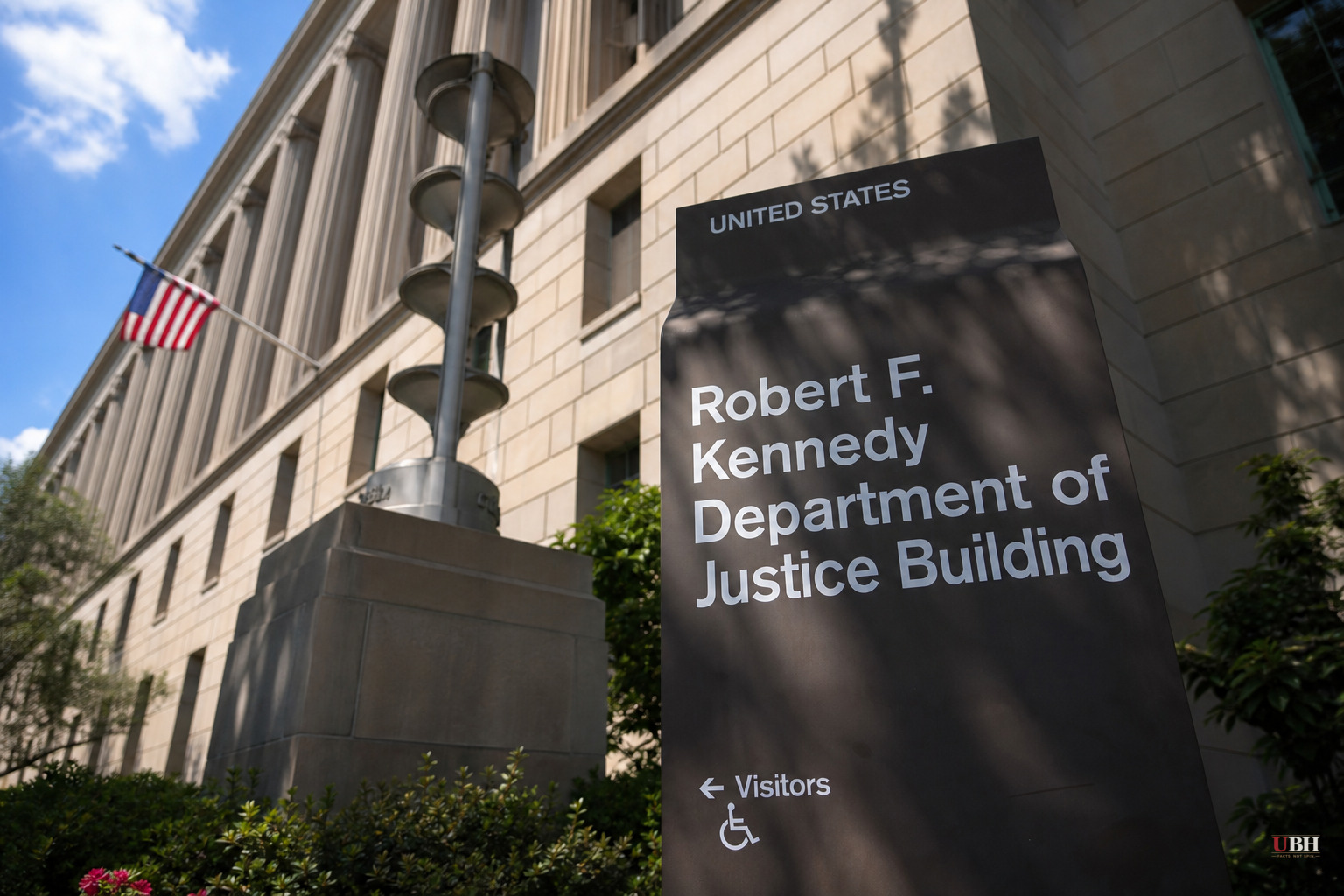
Congress built this court in 1996. Nobody used it until now.
The Justice Department filed a petition this past Wednesday with the Alien Terrorist Removal Court, seeking the removal of an individual whose identity is blacked out on the single-page filing posted to the court's website, according to The Guardian, the Philadelphia Inquirer, and the Los Angeles Times. It's the first application the court has ever received since Congress created it as part of the Antiterrorism and Effective Death Penalty Act of 1996.
Chief Judge Joan Ericksen, a federal judge based in Minnesota, held a hearing the next day, Thursday. In her written response, she said the five-member court had "questions about the nexus that the government alleges between the actions of the respondent and the specific sections and subsections it invokes with respect to those actions." She told the Justice Department to come back with more information by Wednesday.
How the Court Actually Works
The law lets the attorney general or deputy attorney general file a sealed application asking to deport someone the government says qualifies as an "alien terrorist." If the court grants the application, it then has to hold a public hearing where the government carries the burden of proving the person actually meets that legal definition, according to all three outlets citing the underlying statute.
Federal law defines "alien terrorist" broadly. It covers someone who has "engaged in a terrorist activity," someone who endorses or espouses terrorist activity, and even someone who belongs to a political or social group that encourages terrorist activity. A group-membership standard alone, without more, is the kind of provision civil libertarians on the right and left have both flagged over the years as ripe for overreach if not applied carefully.
The court itself is made up of five judges, all selected by Chief Justice John Roberts, according to the Federal Judicial Center's public summary cited by the Guardian, the Inquirer, and the LA Times. It had never received an application and never held a hearing in three decades of existence, until last week.
Why Now
This isn't happening in a vacuum. The Trump administration has moved aggressively over the last year to carry out deportations, including invoking the 1798 Alien Enemies Act to remove Venezuelan migrants the government says belong to a terrorist gang, as reported by all three outlets.
That case ran into U.S. District Judge James Boasberg in Washington, D.C. During a hearing last year, Boasberg pointed directly at this dormant court as the proper venue for exactly this kind of national-security removal case. "In fact, Congress has an answer for us, doesn't it? Because they created the Alien Terrorist Removal Court," Boasberg said, according to the Guardian, the Inquirer, and the LA Times. "So if there's a national security concern with having these hearings ... you can always go to the ATRC, which would be a first, but that's what it's there for, right?"
Now the administration has taken him up on it.
Due Process Considerations
Immigration advocates and civil liberties groups have raised concerns that a court operating largely under seal, hearing cases where the respondent's identity isn't even public yet, creates due-process risk. If the government can label someone a terrorist based on group affiliation rather than a specific act and litigate that behind closed doors before any public hearing, that's a process that deserves scrutiny regardless of who's in the White House.
But that's also exactly the structure Congress wrote into law in 1996, under a different president, with bipartisan support for the underlying statute. The court's own rules require a public hearing with the burden of proof on the government before anyone is actually removed. Ericksen's decision to send DOJ back for clarification reflects the system working as designed.
What Happens Next
The Justice Department has until Wednesday to give Ericksen's court the additional information she asked for on the legal "nexus" between the respondent's alleged conduct and the specific statutory provisions DOJ cited. Until that happens, the person's identity, the specific allegations, and the outcome all remain sealed.
The petition was first reported by Court Watch, an independent legal news site, according to the Inquirer and the LA Times. Whether this becomes a template for future national-security deportation cases, or stays a one-off test run that stalls on the nexus question, depends on what DOJ files next.
Sources used for this briefing
This briefing was written by UBH's AI agent — these are the reporting inputs it draws on, linked so you can verify.


