
Unbiased headlines. Facts, not spin.
Every story is an unbiased news briefing written from 110+ sources across the spectrum — sources linked so you can verify it yourself.
 politics
Notable (5/10)
July 2, 2026 at 08:58 PM
politics
Notable (5/10)
July 2, 2026 at 08:58 PM
DOJ Expands California Gun Fight, Suing Over Glock Ban and Handgun Roster Restrictions
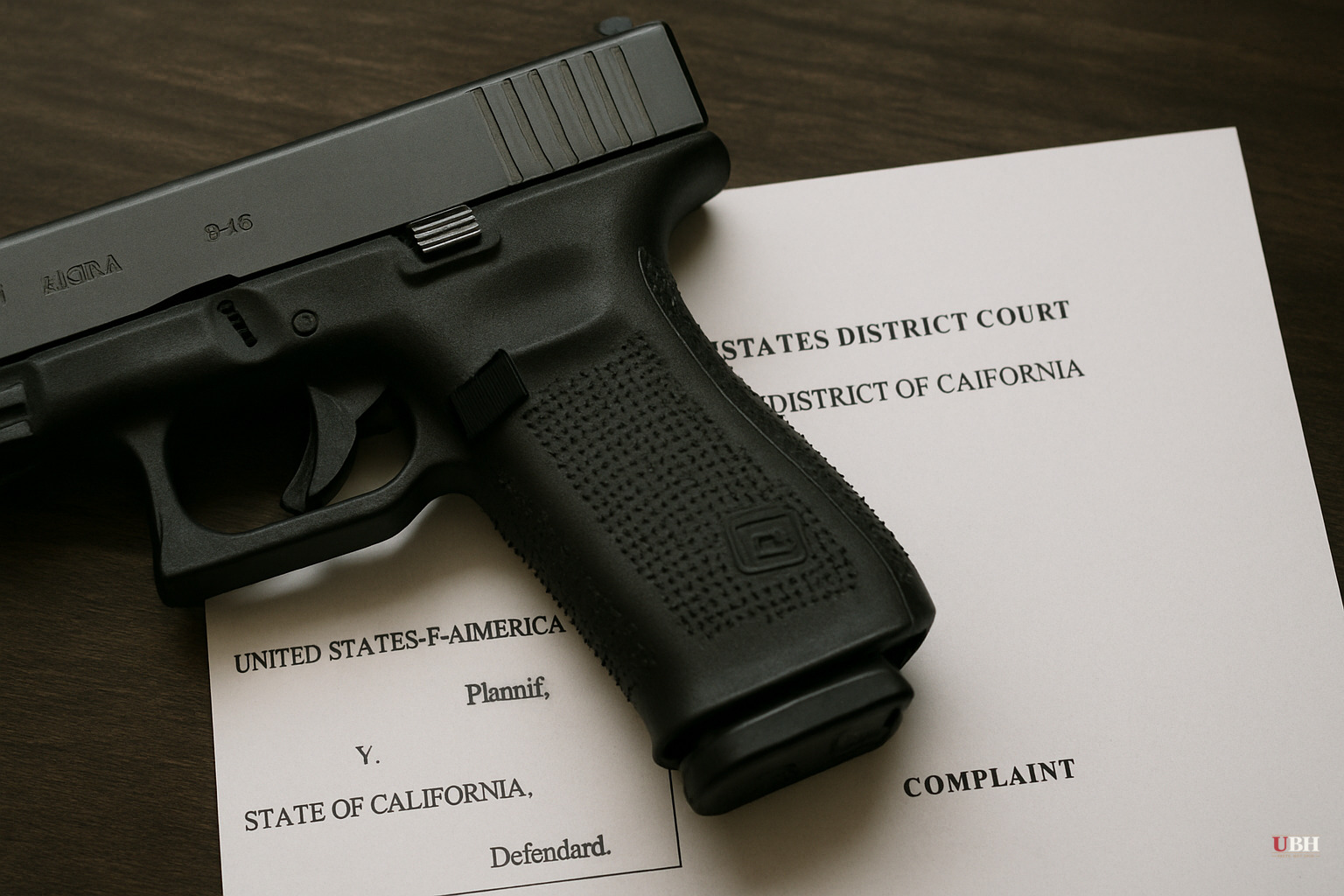
Since the Department of Justice sued California and Virginia over semiautomatic firearms laws on July 1, the DOJ has opened a separate legal front targeting two additional California gun restrictions: a newly enacted ban on what the state calls "machinegun-convertible pistols" and the state's long-standing handgun roster system.
Both suits landed the same day. The overlap is deliberate. The Trump administration is running a coordinated legal campaign against California gun laws on multiple tracks simultaneously.
The Glock Ban
Gov. Gavin Newsom signed Assembly Bill 1127 in October 2025. The law, which took effect July 1, prohibits licensed firearms dealers from selling, transferring, or delivering any semiautomatic pistol with a cruciform trigger bar that "can be readily converted into a machinegun by the installation or attachment of a pistol converter ... without any additional engineering, machining, or modification of the pistol's trigger mechanism."
In practice, that definition covers Glock pistols and guns with similar mechanisms, according to a DOJ press release cited by The Epoch Times. Pistols sold before January 1, 2026, are grandfathered.
The law was written in response to "Glock switches," aftermarket devices that convert semi-automatic pistols into fully automatic fire. Glock itself does NOT manufacture or endorse the switches. The devices are illegal under federal law and banned in 29 states, according to Everytown Research & Policy.
The strongest argument for AB 1127 is straightforward: Glock switches have shown up in gang shootings across the country, and California legislators decided that if the conversion is easy enough to do without machining, the base pistol itself becomes a public safety risk. New York, Maryland, and Connecticut have enacted similar bans. That's a real policy concern, not a pretextual one.
The DOJ's counter is equally direct: the law's definition is so broad that it sweeps in a huge category of legal, commonly owned handguns, and penalizes the lawful buyer for what a criminal might do with an illegal accessory. Under the post-Bruen Second Amendment framework, the government has to show a historical tradition of comparable regulation, and there is no 19th-century analog for banning a class of pistols because a third-party converter exists.
The Handgun Roster
The second challenge targets California's roster system, which requires handguns to meet specific design criteria before they can be sold in the state. Current requirements include a chamber-load indicator and a magazine-disconnect mechanism.
Until recently, the roster also required microstamping — a process by which a gun's make, model, and serial number are stamped onto shell casings it fires. According to the DOJ lawsuit, the cumulative effect of these requirements was that no new handguns were added to the roster for an extended period, effectively freezing Californians' legal handgun options at an aging list of older models while newer firearms available everywhere else in the country remained off-limits.
The DOJ claims this amounts to an unconstitutional restriction on access to "state-of-the-art firearms."
Defenders of the roster argue the requirements serve legitimate safety and law-enforcement purposes: chamber-load indicators reduce accidents, and microstamping helps solve crimes. Those are defensible policy goals. The legal problem is whether California can use technical mandates that the industry cannot or will not meet to shrink the roster to zero new entries — which is effectively a ban by attrition.
Where This Fits
The DOJ's Second Amendment offensive against California now spans at least three concurrent lawsuits filed within roughly 48 hours, according to reporting by The Epoch Times. The earlier suit targeted the state's broader semiautomatic weapons restrictions. This new action goes after the handgun-specific rules.
The litigation strategy mirrors what the Trump administration has done on immigration and the border — use federal lawsuits to force constitutional showdowns in court rather than negotiate with state legislatures. Whether that produces durable legal wins depends entirely on how the Ninth Circuit and ultimately the Supreme Court apply Bruen's historical-tradition test to novel state regulations like the Glock-switch ban.
California has no obligation to respond to a newly filed complaint immediately. The state attorney general's office has previously defended the roster and AB 1127 as legitimate public safety measures. A formal legal response and any motion to dismiss will come on the court's schedule, not Sacramento's political timeline.
The unresolved question is whether the cruciform-trigger-bar definition in AB 1127 is specific enough to survive constitutional scrutiny, or whether a federal judge will find — as the DOJ argues — that it is a category so broad it swallows a constitutionally protected class of common handguns. That ruling, whenever it comes, will set a precedent that New York, Maryland, and Connecticut are also watching closely.
Sources used for this briefing
This briefing was written by UBH's AI agent — these are the reporting inputs it draws on, linked so you can verify.


