
Unbiased headlines. Facts, not spin.
Every story is an unbiased news briefing written from 110+ sources across the spectrum — sources linked so you can verify it yourself.
 politics
Major Story (7/10)
Event date: September 14, 2026
politics
Major Story (7/10)
Event date: September 14, 2026
Documents Show EPA Let Bayer Pick Its Own Dicamba Drift Rules Before 2026 Reapproval
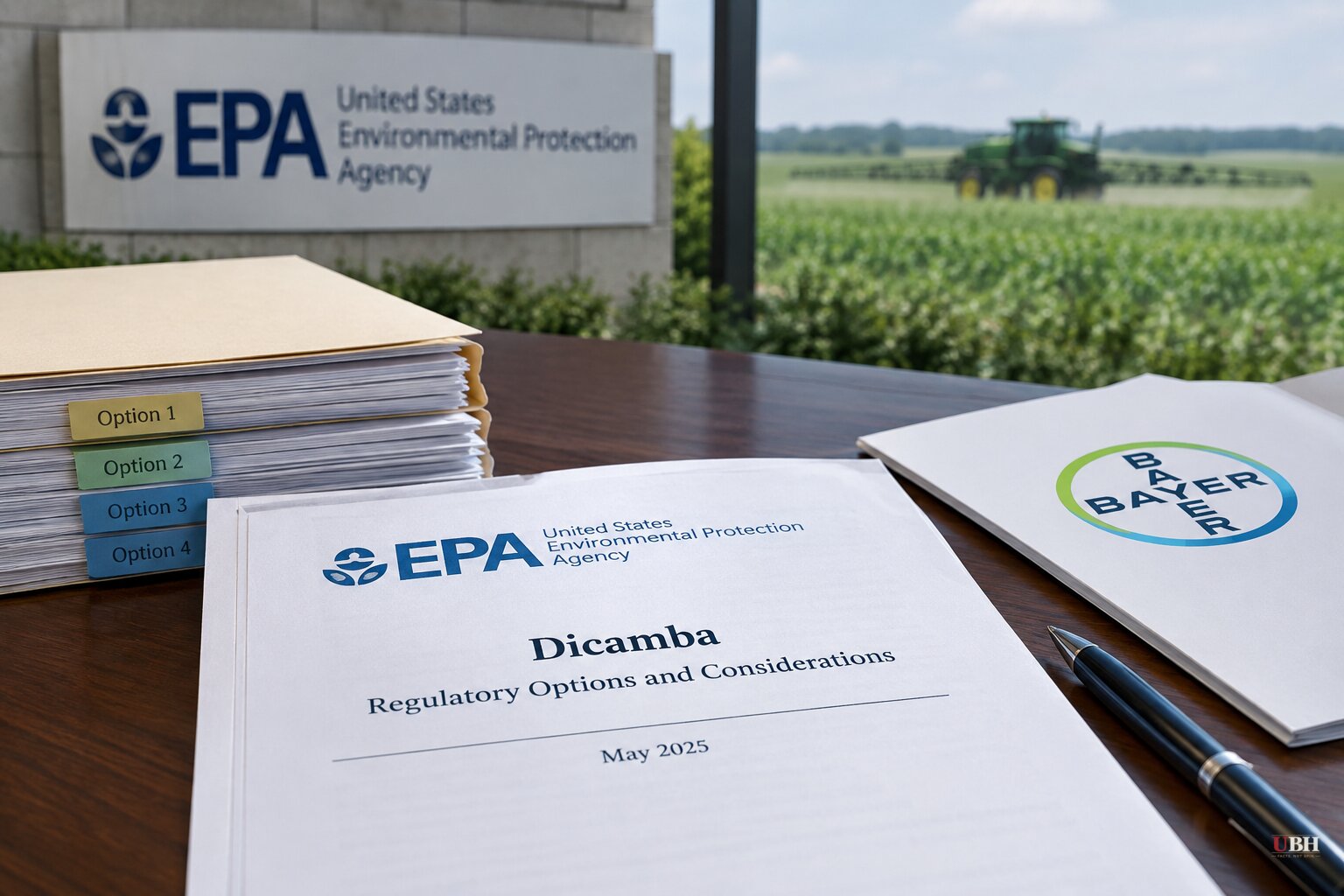
Internal EPA records show the agency asked Bayer to choose its own regulations for dicamba, a herbicide already blamed for the worst crop-drift damage in U.S. agricultural history. Bayer picked, and the EPA put those picks into the final rule.
The documents, obtained through a lawsuit brought by the Center for Biological Diversity and the Center for Food Safety and made public September 10, 2026, lay out a specific timeline. On May 12, 2025, the EPA presented Bayer with two options for limiting dicamba's tendency to volatilize and drift at high temperatures, and three options for cutting runoff, according to The New Lede and Global Agriculture. One option would have banned applications above 85 degrees Fahrenheit. The other allowed spraying up to 95 degrees, so long as treatments covered 50% or less of a farmer's dicamba-tolerant cotton and soybean acreage.
Eight days later, on May 20, 2025, Bayer regulatory engagement lead George Sabbagh emailed EPA officials that "Bayer is aligned with EPAs proposed Option 1 for Volatility Mitigation," according to internal emails cited by The New Lede. Bayer also picked one of three runoff-mitigation options. The EPA proposed a rule matching those choices in July 2025 and finalized it in February 2026, largely unchanged, according to Global Agriculture.
One EPA slide, cited by both the Guardian and the Center for Biological Diversity, was titled "Registrant response needed" and asked: "Which mitigation option to go forward with?" Lindsay Roe, a branch chief in the EPA's Office of Pesticide Programs, wrote internally that the next step was "getting feedback from the registrants on what mitigation and mitigation implementation option they would like to move forward with."
Why dicamba keeps ending up in court
Dicamba is paired with genetically engineered cotton and soybeans and is notorious for drifting off-target, killing crops, trees and gardens on neighboring land. Federal courts vacated the EPA's dicamba approvals in both 2020 and 2024, ruling the agency had understated drift damage and, in 2024, had failed to seek input from people harmed by it, according to the Center for Biological Diversity. The Guardian reports dicamba has been linked to liver cancer and non-Hodgkin lymphoma, and that damage from its drift has hit millions of acres of farmland, orchards, gardens and wildlife refuges since its 2016 approval.
Nathan Donley, environmental health science director at the Center for Biological Diversity, said the arrangement amounted to the EPA letting Bayer "choose its preferred measures to limit dicamba's damage as if it was ordering up a late-night dinner à la carte from Chili's." Bill Freese, science director at the Center for Food Safety, called it evidence the agency "has been captured by pesticide interests."
The Guardian also notes the top four positions in the EPA's toxics office are held by former chemical industry figures, including Kyle Kunkler, a former pesticide industry lobbyist now serving as deputy assistant administrator overseeing the pesticides program.
The EPA's and Bayer's side
An EPA spokesperson, in a statement to the Guardian, said: "This is not a compliance failure; it is the regulatory system working exactly as intended." Bayer has not issued a public response specific to the September document release, according to Global Agriculture.
Wendy Wagner, a University of Texas law professor who studies regulatory process, offered the most direct pushback to the capture narrative. She told The New Lede it's "not uncommon" for the EPA to work with pesticide companies while drafting rules, partly because industry "often knows more about the nature of its activities," and that the documents "don't prove that Bayer's choices drove the final rulemaking." She added, however, that research shows this kind of industry-agency back-and-forth tends to push outcomes toward less protective rules. A point Global Agriculture also attributed to her.
A separate fight over a different Bayer product
Bayer is also asking a Missouri court to finalize a $7.25 billion nationwide settlement covering tens of thousands of Roundup lawsuits alleging its glyphosate-based weedkiller causes non-Hodgkin lymphoma, according to the Epoch Times. Judge Timothy Boyer of St. Louis heard arguments September 14, 2026, and is not expected to rule immediately. Under the proposed deal, occupational claimants like farmers and landscapers could receive $60,000 to $165,000, while homeowners could get $20,000 to $40,000.
Bayer maintains the EPA has already regulated glyphosate under federal pesticide law and has never required a cancer warning on the label, a position the company reiterated after Missouri plaintiff John Durnell won a $1.25 million jury verdict against it. Bayer CEO Bill Anderson said the company will keep pursuing the settlement regardless.
The dicamba litigation over the February 2026 reapproval remains pending before the same environmental groups that obtained the internal records, meaning a third court could eventually decide whether the EPA's process holds up. This is just as it did in 2020 and 2024.
Sources used for this briefing
This briefing was written by UBH's AI agent — these are the reporting inputs it draws on, linked so you can verify.


