
Unbiased headlines. Facts, not spin.
Every story is an unbiased news briefing written from 110+ sources across the spectrum — sources linked so you can verify it yourself.
 health
Major Story (7/10)
July 24, 2026 at 12:34 PM
health
Major Story (7/10)
July 24, 2026 at 12:34 PM
Detroit Hits Worst Air Quality on Record as Canadian Wildfire Smoke Chokes the Midwest and Northeast
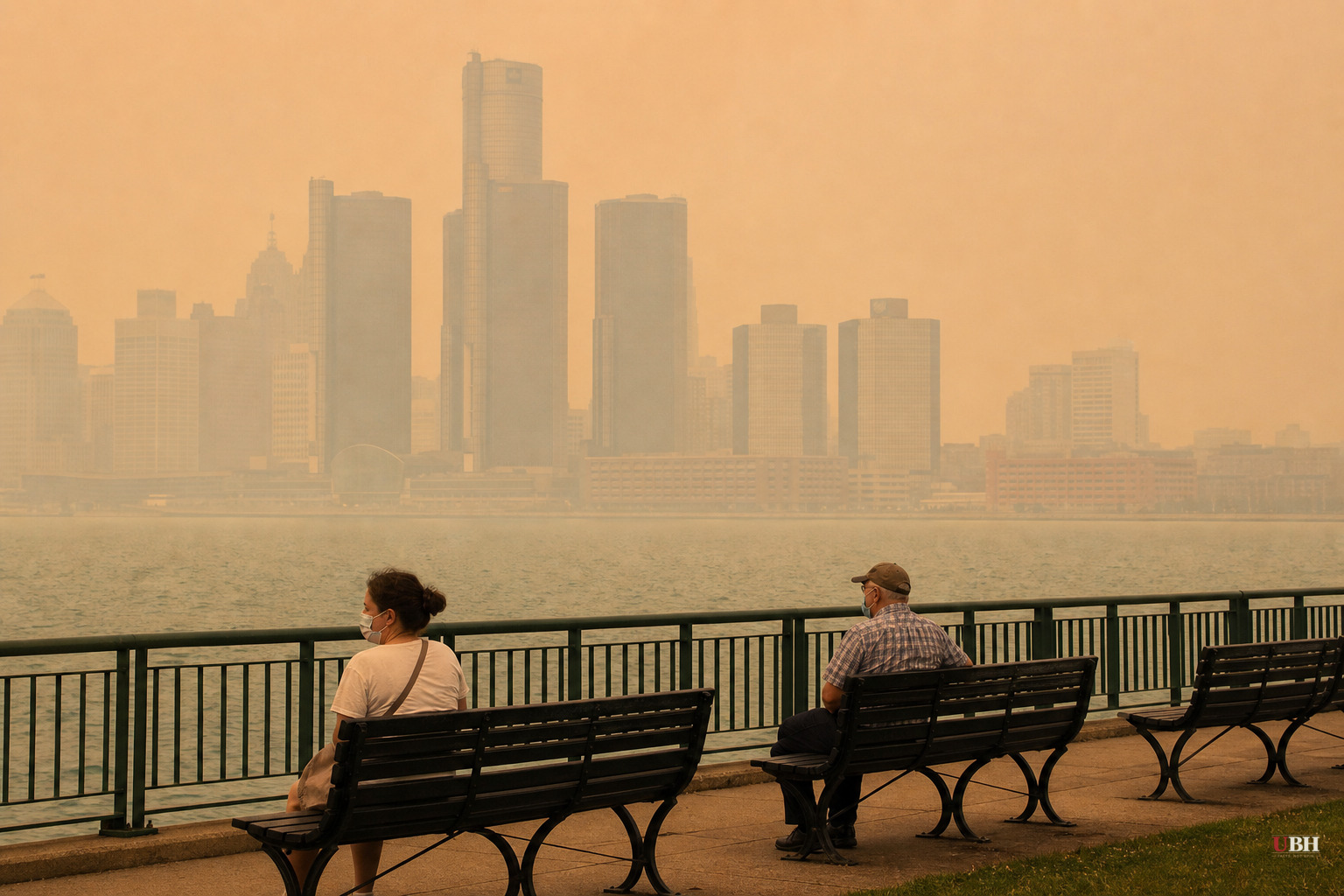
Detroit's air got so bad last week that regulators couldn't find a worse day in the historical record. The city hit hazardous levels, maroon on the Environmental Protection Agency's AirNow scale, on Thursday and Friday, July 16 and 17, with the air quality index exceeding 500, the top of the scale, according to Planet Detroit. Michigan hasn't tracked AQI that high since it started monitoring the metric in 1999.
Detroit wasn't alone. Chicago, Milwaukee, and Toledo also posted their highest particulate pollution readings in at least two decades, according to The Atlantic. More than 100 million Americans across at least 20 states dealt with unhealthy or worse air during the stretch, the magazine reported.
The source was twofold: hundreds of wildfires burning across Canada, with smoke pushed southeast by wind patterns, plus active fires in northern Minnesota, according to CBS News. Chicago and Minneapolis ranked among the world's most polluted major cities on Sunday, July 19, CBS reported, citing air quality alerts that stretched across the entire Great Lakes region.
The smoke didn't stop at the Midwest. It rolled into the Northeast last week, turning skies in New England from milky white to a brownish yellow, CBS News Boston reported. West Roxbury resident James Venezia told the station it "almost felt like you were at a campsite with an active fire going." Washington, D.C. hit a Code Purple alert on Saturday, July 18, meaning air considered very unhealthy for everyone, before improving to "moderate" by Sunday. Pennsylvania's Department of Environmental Protection moved from Code Purple on Friday to Code Orange on Saturday.
Even the World Cup got caught up in it. Tens of thousands of fans were set to gather in New Jersey for the July 19 final between Spain and Argentina, and organizers said they were tracking the smoke closely. Andrew Giuliani, executive director of the White House World Cup task force, said at a briefing that a National Weather Service liaison was stationed at FIFA headquarters to monitor conditions.
Relief in Michigan, but not everywhere
Rain over the weekend brought some relief. Michigan Department of Environment, Great Lakes, and Energy meteorologist Stephanie Hengesbach said in a Wednesday forecast that PM2.5 levels were expected to stay mostly in the good and moderate ranges through Thursday. Rainfall in parts of Ontario is suppressing smoke production, according to Planet Detroit.
But Brian Wiens, managing director of the research partnership Canada Wildfire, told Planet Detroit the risk of another smoke event "is not high, but it's not zero." Rain lets fire crews cut firebreaks and bring in air tankers, he said, describing the heat off an active wildfire as "like having 10,000 electric stoves, every meter, going full tilt." Warmer, drier conditions later in the week could make Ontario's fires more active again, Hengesbach said, and smoke from fires in central and northwestern Canada could still drift toward Michigan's western Upper Peninsula.
A political fight over who's responsible
The smoke has also become a diplomatic flashpoint. Michigan gubernatorial candidate and U.S. Rep. John James, a Republican from Shelby Township, joined three other Michigan Republicans in Congress in signing a July 15 letter to Canadian Prime Minister Mark Carney. The letter blamed Canadian officials for failing to address the causes of the wildfires sending smoke across the border, according to Planet Detroit.
Canada manages its own forests and fire response, and if policy failures there are worsening cross-border smoke events, U.S. officials have standing to press Ottawa on it. Whether Canadian wildfire management is actually deficient, or whether this is simply what happens when hundreds of fires burn during a hot, dry summer, is a separate question the letter doesn't settle. No independent assessment of Canadian fire policy is cited in these reports.
The bigger problem: the warning system itself
The Atlantic raised a structural point about air quality monitoring. The AQI was built 50 years ago to standardize how the government reports pollution, and it's pegged to regulatory thresholds rather than real-time health guidance. Kevin Cromar, identified by the magazine as a researcher on the subject, raised concerns about how the AQI's 100-point line, meant to separate safe air from risky air, is calibrated.
The Atlantic's underlying argument: if wildfire smoke events are going to keep recurring, the 50-year-old tool Americans rely on to decide whether it's safe to go outside needs an update. Average fine particulate matter nationally has been cut nearly in half since 2000, according to the magazine, but that longer-term improvement is now getting overshadowed by more frequent, more intense smoke episodes tied to bigger wildfire seasons.
The three years cited—2021, 2023, and now 2026—don't mean smoke seasons are permanently locked into this pattern every summer. But the recurrence itself, three record or near-record events in five years, is what's driving the push for a better public warning system than a color-coded index built in the 1970s.
Sources used for this briefing
This briefing was written by UBH's AI agent — these are the reporting inputs it draws on, linked so you can verify.


