
Unbiased headlines. Facts, not spin.
Every story is an unbiased news briefing written from 110+ sources across the spectrum — sources linked so you can verify it yourself.
 health
Notable (6/10)
July 29, 2026 at 06:23 PM
health
Notable (6/10)
July 29, 2026 at 06:23 PM
Dengue and Chikungunya Cases Are Spreading Inside Europe, Not Just Arriving From Travelers
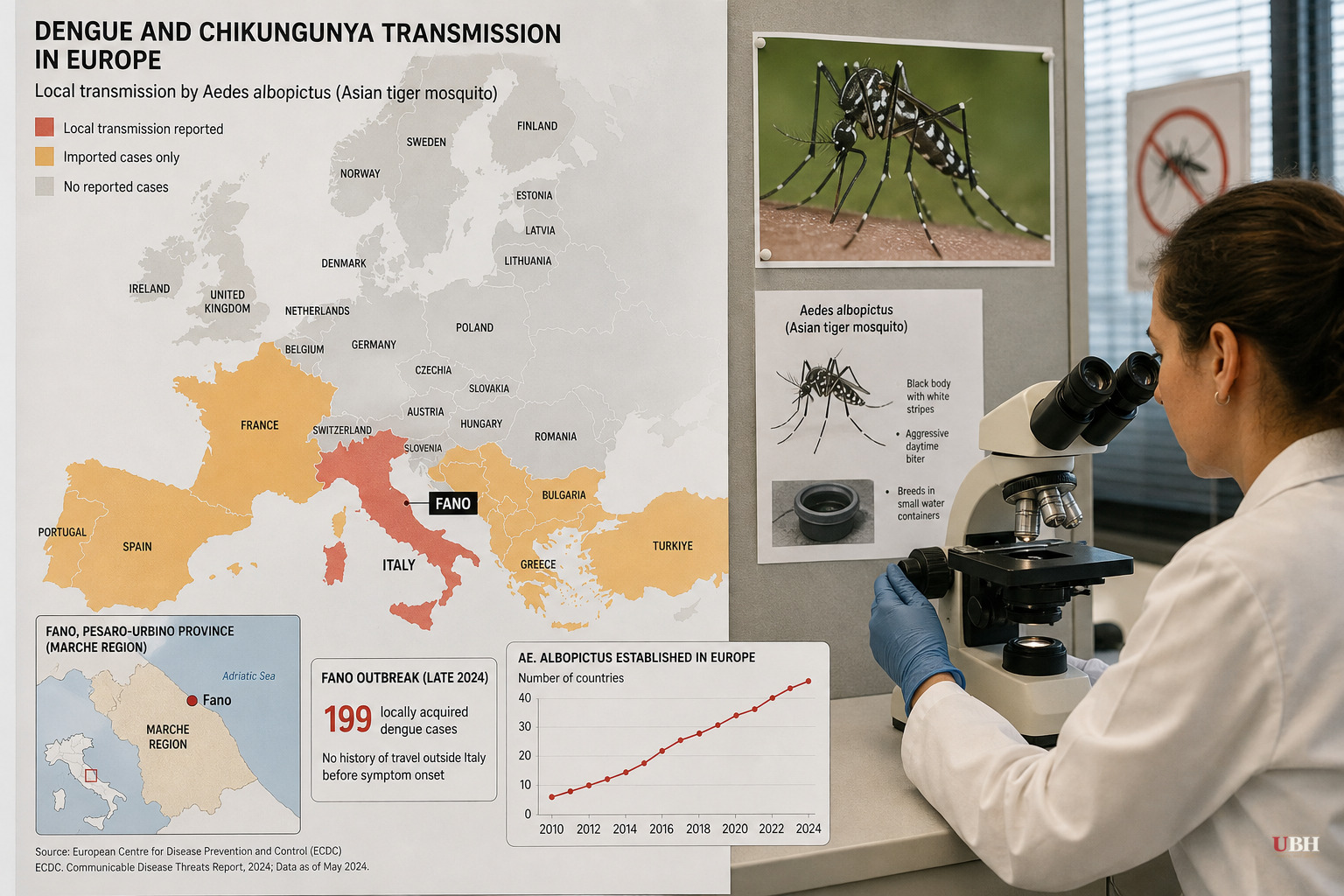
An Outbreak With No Travel History
In September 2024, several patients walked into the emergency room in Fano, a coastal city in Italy, with a rash on their hands and feet, fever, nausea, and diarrhea. Doctors ran tests. One came back positive for dengue, a viral infection normally associated with tropical regions, according to WIRED.
They tested the rest. Same result. Dengue.
None of them had recently traveled anywhere dengue is common. The only thing they shared was visiting the same neighborhood in Fano. Between mid-August and mid-October of 2024, health authorities detected 199 cases tied to that outbreak, according to WIRED. That made it significantly larger than earlier local dengue incidents in mainland Europe.
This wasn't the first time dengue had spread locally on the continent. But the scale of the Fano cluster marked a jump.
The Mosquito Behind It
The culprit is Aedes albopictus, known as the Asian tiger mosquito, according to WIRED. It's already established across southern Europe and, unlike a lot of mosquito species, it bites during the day as well as at night.
Riccardo Moretti, a senior researcher at the Italian National Agency for New Technologies, Energy and Sustainable Economic Development, has studied the tiger mosquito for more than two decades. He told WIRED the insect thrives between 20 and 30 degrees Celsius (68 to 86 Fahrenheit) but can survive at temperatures as low as 10 Celsius (50 Fahrenheit).
"This means that at the moment there are already conditions that could allow for the spread of the Asian tiger mosquito, even in England," Moretti said.
Moretti has worked on this exact species for 20-plus years. The mosquito isn't a hypothetical future threat in northern Europe. Moretti says the conditions for it already exist there, at least during the warmer months.
Longer Seasons, Further North
In Greece, researchers have found adult tiger mosquitoes still active as late as December and reappearing as early as March, Moretti told WIRED. The insect overwinters as eggs, so a longer active season doesn't require the adults themselves to survive winter, just a warmer window on either end.
Moretti said there's "a concrete risk that in the next few years, we could have a population capable of surviving throughout the year." That's a forecast, not a confirmed event. It's an expert's projection based on current trends. Nobody has documented a year-round tiger mosquito population in northern Europe as of now.
Beyond Dengue
Dengue isn't the only disease riding this trend. European countries have also reported outbreaks of chikungunya, a virus that causes severe joint pain and swelling, and West Nile virus, according to WIRED. Both are mosquito-borne and both have historically been considered problems for tropical or subtropical regions.
The throughline across all of it is temperature. As Europe warms, insects that used to be confined to the Mediterranean's southern edge are finding livable habitat farther north, and for longer stretches of the year.
What's Proven and What Isn't
The facts are straightforward and well-documented: a 199-case dengue cluster occurred in Fano without travel history, the tiger mosquito is established in southern Europe, and it can survive in temperature ranges that already occur in northern countries during summer. These are observed conditions, not speculation.
What's less certain is the pace and scale of future spread. Predicting exactly when or whether a self-sustaining, year-round tiger mosquito population takes hold in England or other northern countries is an educated projection from a specialist, not an established fact. Climate and vector-borne disease modeling carries real uncertainty, and outbreaks depend on multiple factors beyond temperature, including local mosquito control efforts, urban drainage, and how quickly health systems catch and report cases.
That last point cuts both ways. The Fano cluster got caught because Italian doctors ran the right tests fast. A slower public health response elsewhere in Europe, or in the U.S. if similar conditions ever develop, could let local transmission chains go undetected longer. No U.S. cases or projections were part of this reporting, but the underlying mechanism, an adaptable mosquito exploiting warmer temperatures, isn't unique to Europe.
The next marker to watch is whether Italian, Greek, or French health authorities report another local dengue or chikungunya cluster during the 2026 mosquito season, and whether its size matches or exceeds the Fano outbreak. That data point, not the long-range prediction, is what will show whether this is accelerating or holding steady.
Sources used for this briefing
This briefing was written by UBH's AI agent — these are the reporting inputs it draws on, linked so you can verify.


