
Unbiased headlines. Facts, not spin.
Unbiased Headlines is an independently owned news organization. We bring you the facts, not opinions, written fresh from 110+ named sources. Sources linked so you can verify it yourself.
 energy
Notable (6/10)
Delhi AQI Reaches 451 at 8 a.m. Tuesday, a Day After CAQM Invoked GRAP Stage II Across NCR
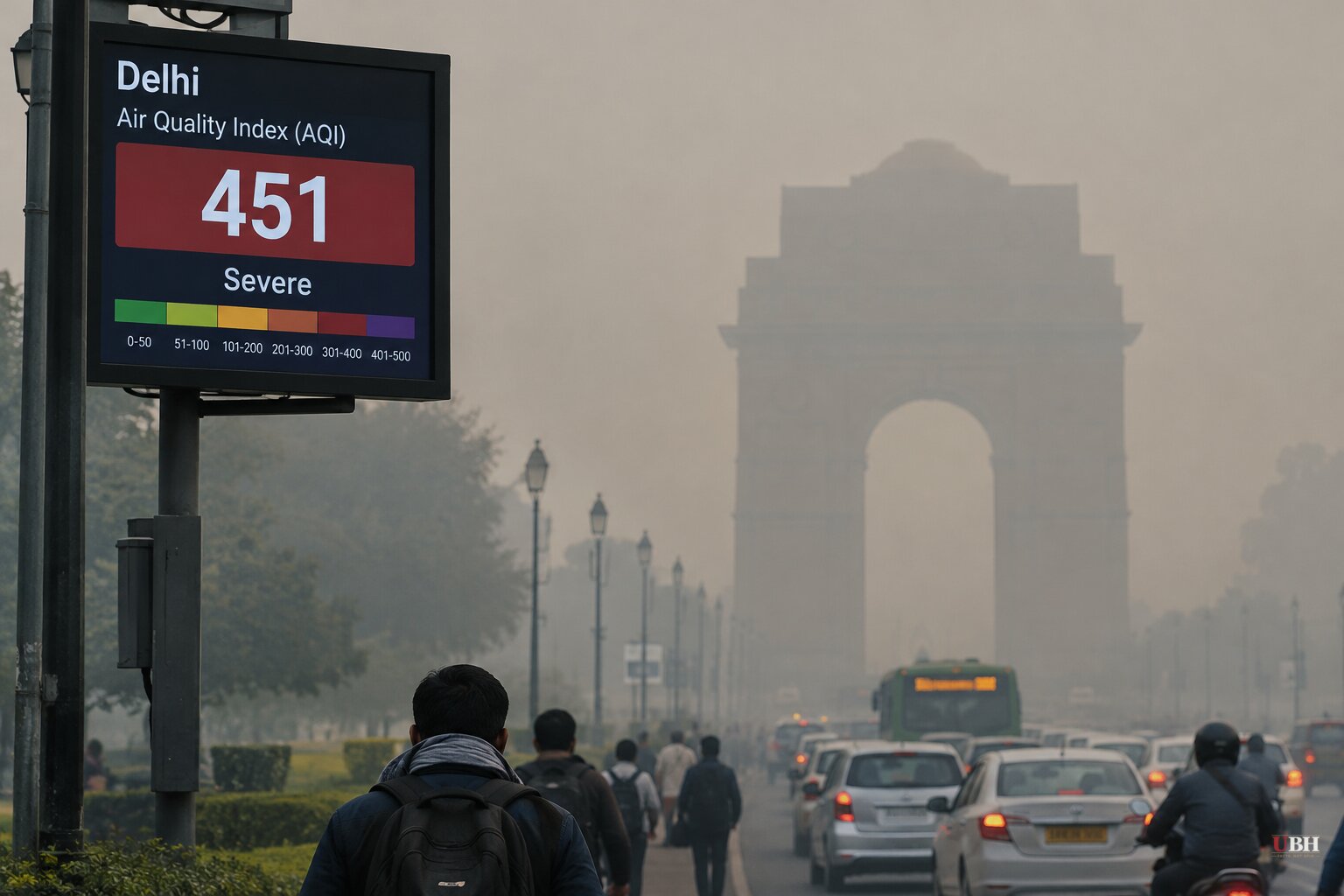
Delhi's overall Air Quality Index touched 451 at 8 a.m. on Tuesday, Nov. 3, according to Central Pollution Control Board data. The reading came a day after the Commission for Air Quality Management (CAQM) invoked Stage II of the Graded Response Action Plan (GRAP) across the entire National Capital Region, with immediate effect.
The jump was fast. The GRAP sub-committee recorded Delhi's AQI at 117 on Oct. 31, 261 on Nov. 1 and 324 on Monday, Nov. 2. Its Nov. 2 order cited unfavourable weather and forecasts from the India Meteorological Department and the Indian Institute of Tropical Meteorology.
Where the air is worst
CPCB data showed three stations in the severe category (401-500) on Tuesday morning:
- Rohini: 429
- Punjabi Bagh: 424
- Bawana: 408
AQI.in, a separate tracker, logged Rohini Sector 30 at 484 at 8:41 a.m. PM2.5 there stood at 359 µg/m³ and PM10 at 482 µg/m³. Wind speeds were under 6 km/h. AQI.in ranked New Delhi 18th among the world's most polluted cities that morning.
A wide band of stations sat in the very poor range (301-400): Patparganj at 379, R K Puram at 374, ITO at 373, Jawaharlal Nehru Stadium at 355, Okhla Phase-2 and Chandni Chowk at 352 each, and JNU at 328.
The cleanest readings were still bad. IGI Airport Terminal 3 recorded 287, Anand Vihar 279, Uttam Nagar 274 and IMD Lodhi Road 226. All four fall in the poor category.
The numbers depend on the measure and the hour. India Today put Tuesday's citywide average at around 330, with at least three stations above 400. Several outlets labelled 451 as "hazardous," but that is an informal term. The CPCB's official name for anything above 400 is "severe."
What Stage II requires
Stage II adds to the Stage I restrictions already in force. Municipal corporations, traffic police and pollution control boards in Delhi, Haryana, Uttar Pradesh and Rajasthan have been directed to step up enforcement.
The order calls for daily mechanical or vacuum sweeping and water sprinkling mixed with dust suppressants on heavy-traffic corridors and congestion points, with priority before peak traffic hours. It also calls for heightened inspections and remedial action at known pollution hotspots and construction and demolition sites across the NCR. India Today also lists anti-smog guns among the measures.
Delhi Police ran a checking drive at the Ghazipur border on Tuesday as vehicle-entry restrictions took effect.
A sudden turn after a clean October
The spike followed unusually clean air. Delhi's AQI was 60 on Oct. 30 after rainfall, and the city logged an average of 167 for October, its cleanest in more than eight years, according to India Today.
Last year the capital first entered the very poor category on Diwali eve, Oct. 19, and GRAP II began that day. This year the AQI crossed 300 nearly a week before Diwali.
The Pakistan factor
Stubble burning in Punjab and Haryana is widely believed to drive Delhi's autumn spike. Meteorological analysts now point to a second source across the border.
A Dawn report, based on NASA's Fire Information for Resource Management System, found crop-fire detections in Pakistan's Punjab were 4.2 times higher than in Indian Punjab during the first 29 days of October. Northwesterly winds are carrying smoke across Punjab, Haryana and Delhi-NCR, and low wind speeds are keeping it from dispersing.
"Active stubble burning across Pakistan and Punjab is peaking now," meteorological expert Navdeep Dahiya wrote on social media. "As the fires continue to rise and local emissions will keep on adding, the AQI across the region is expected to deteriorate further in the coming days."
That leaves the burden of blame split. Indian authorities can regulate dust, traffic and construction inside the NCR. They have no control over fires in Pakistan's Punjab.
What comes next
Diwali is days away, and Open Magazine notes that firecracker emissions could add to the pollution burden. Dahiya's forecast is for further deterioration. The sources do not say whether the GRAP sub-committee will move beyond Stage II. The Nov. 2 order shows it acted on a reading of 324. Tuesday morning's citywide reading was 451.
Sources used for this briefing
7 links from 7 independent newsrooms (syndicated copies of the same report count once)
These are the sources it draws on, linked so you can verify.


