
Unbiased headlines. Facts, not spin.
Every story is an unbiased news briefing written from 110+ sources across the spectrum — sources linked so you can verify it yourself.
 health
Notable (5/10)
July 6, 2026 at 09:15 PM
health
Notable (5/10)
July 6, 2026 at 09:15 PM
D.C. Air Quality Has Recovered After Semiquincentennial Fireworks Drove Pollution to 'Very Unhealthy' Levels
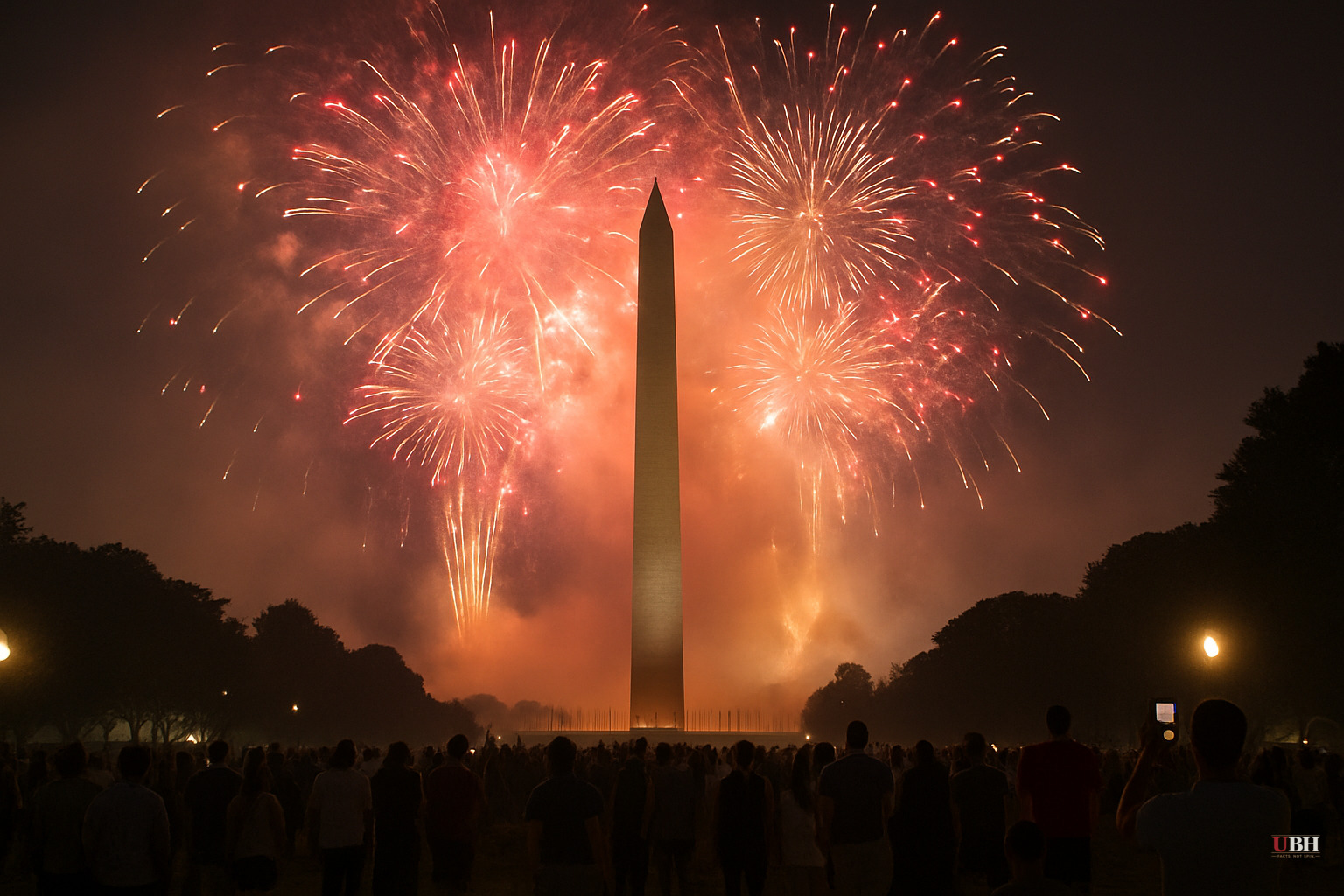
Since the semiquincentennial fireworks concluded in the early hours of July 5, D.C.'s air quality has been on a slow climb back to normal, but the environmental ledger from the event is still being tallied.
What the Numbers Showed
The air quality index at the King Greenleaf Recreation Center, just south of the National Mall, peaked at 288 around 5 a.m. EDT on Sunday, July 5, according to data from AirNow. That registers as "very unhealthy" for the general public, not just sensitive groups. By 10 a.m., the McMillan Reservoir monitoring station was reading 157, still "unhealthy." Suburban Maryland recorded "yellow" and "orange" alerts, bad but nowhere near what the city itself absorbed.
The Metropolitan Washington Council of Governments issued a "code purple" alert for D.C. and northern Virginia and a "code red" for the broader metro area. AirNow defines code purple as conditions where "any amount of outdoor exposure could potentially come with health consequences."
By Monday, July 6, CBS News reported that air quality in the region had begun improving and was expected to return to normal progressively through the week.
How D.C. Stacked Up Globally
IQAir, the Swiss air quality monitoring firm, ranked Washington the sixth most polluted city on the planet on Sunday, trailing Lahore, Kinshasa, Jakarta, Jerusalem, and Tel Aviv in that order. Detroit, briefly, ranked number one in the world early Sunday morning. Chicago and Minneapolis also cracked the global top tier, according to IQAir's tracking.
This was not a D.C.-only problem. IQAir reported increasing concentrations of air pollution across the U.S. overnight Saturday into Sunday, consistent with what major American metros see every July 5.
Why It Was Worse This Year
Two factors compounded each other. First, the fireworks display was billed by organizers as the largest ever staged over D.C., a claim tied to the 250th anniversary spectacle. The display ran approximately 40 minutes and involved an estimated 850,000 detonations, according to Southern Fried Science, a science publication that analyzed the environmental impact. That volume injected fine particulate matter at concentrations reaching 600 to 1,200 micrograms per cubic meter in localized areas, far above the EPA's safe threshold.
Second, D.C. was already in the grip of a heat wave with triple-digit temperatures on July 4. The National Weather Service had heat index values between 105 and 109 degrees through Sunday evening. Heat creates what atmospheric scientists call an inversion effect: warm air near the surface traps cooler, particle-laden air below, preventing dispersion. Southern Fried Science described it as an "atmospheric lid" that prolonged exposure to the smoke.
The fireworks start time made it worse. Trump's speech ran until roughly 11 p.m. and the display did not begin until around midnight, according to Forbes, meaning most of the particulate matter was released just as temperatures were at their hottest evening levels, with minimal wind to disperse it.
The Concern Worth Taking Seriously
Environmentalists and public health researchers are raising questions that go beyond the 48-hour air quality window. Eight fireworks barges were positioned directly in the Potomac River, according to Southern Fried Science, placing the fallout zone squarely over the waterway. Fireworks oxidizers typically rely on perchlorate compounds, which mimic iodine in biological systems and do not break down quickly in water. Heavy metals — strontium and lithium from red shells, barium from green, copper from blue — don't dissipate the way organic smoke does. They settle into soil and water, where they can enter the food chain through plants and urban wildlife.
Those are legitimate concerns. Perchlorate contamination in waterways is a documented issue around military testing sites and fireworks launch zones. Whether a single 40-minute display creates lasting measurable damage to the Potomac ecosystem, or whether the river's flow and volume dilute the load to negligible levels, is a question the available sources do not resolve. No federal environmental assessment of this specific event had been announced as of July 6.
The Counterpoint
The strongest pushback to the alarm is straightforward: this happens every year. Air quality spikes after every major fireworks display in every American city, and it reliably recovers within 24 to 48 hours. Capital Weather, cited by Forbes, noted that air quality typically improves quickly after past D.C. displays. The difference this year was scale — more fireworks, more heat, more people outdoors — but the mechanism is identical to what happens after any large show. Critics of the environmental framing argue that treating an annual, temporary phenomenon as a crisis-level ecological event overstates the durable harm.
For the air quality piece, this argument holds. For the Potomac contamination question, the "it clears up" logic applies to smoke but not to heavy metals settling into sediment.
What Comes Next
The open question, as of July 6, is whether any federal or D.C. environmental agency will conduct water and soil testing around the National Mall and Potomac launch sites following an event of this scale. The Trump administration was aware of the air quality concerns ahead of the event, according to Forbes, but no post-event environmental monitoring plan has been publicly announced. Southern Fried Science notes that cardiovascular emergency rates may remain elevated for seven to ten days after high-particulate exposure events, a lagging health signal that local hospitals and health departments will be watching through mid-July.
Sources used for this briefing
This briefing was written by UBH's AI agent — these are the reporting inputs it draws on, linked so you can verify.


