
Unbiased headlines. Facts, not spin.
Every story is an unbiased news briefing written from 110+ sources across the spectrum — sources linked so you can verify it yourself.
 health
Low Interest (3/10)
July 2, 2026 at 10:08 AM
health
Low Interest (3/10)
July 2, 2026 at 10:08 AM
D.C. Air Quality Concerns Hang Over July 4 Fireworks on the Mall
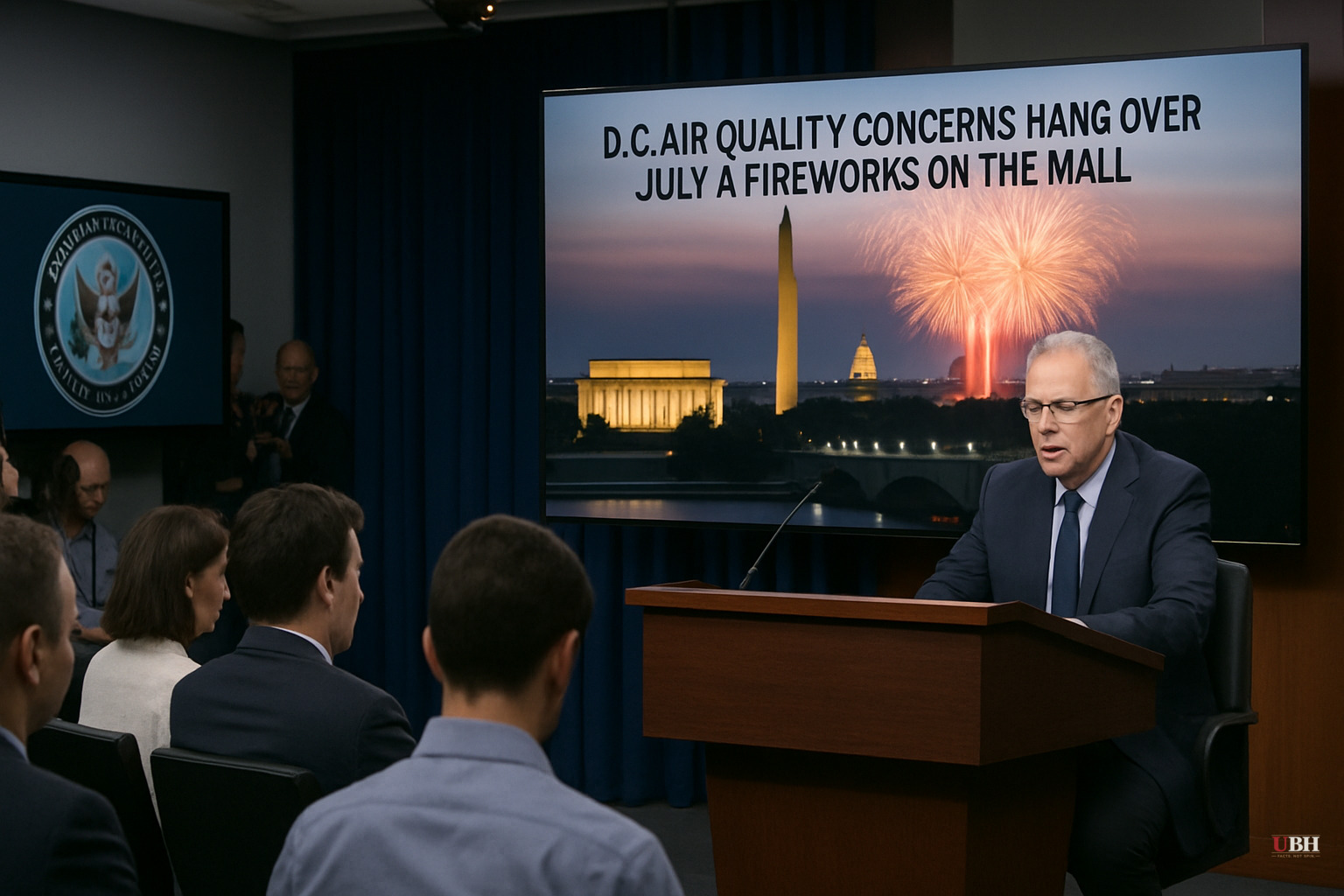
Since D.C. locked down the National Mall under State-of-the-Union-level security earlier this week, the question of what happens when you set off a prolonged fireworks show inside that security perimeter with hundreds of thousands of people is getting more attention.
According to NBC Washington, air quality concerns are being raised specifically in the context of this year's July 4 fireworks on the Mall. In an enclosed urban corridor with limited wind dispersion, pollutants from fireworks can linger at ground level in a crowd.
The concern is not abstract. The National Mall sits in a bowl-like geography flanked by the Potomac and the Capitol, and summer air stagnation along the mid-Atlantic coast is well-documented. On nights with low wind or a temperature inversion, smoke and particulate from a major display can sit over a crowd for an extended period.
NBC Washington's Joseph Olmo reported earlier this week that fencing, police, and National Guard presence stretch along the entire National Mall for the America 250 celebration, not just around the Capitol. That perimeter design is built to control access, but it also means pedestrian egress from the fireworks viewing area is restricted and slower than a normal July 4 event.
For people with asthma, heart conditions, or respiratory sensitivities, a slow exit from a smoke-heavy zone carries risk.
Skeptics of the air quality concern have a fair point: outdoor fireworks displays happen in American cities every July 4 without triggering public health emergencies. The Washington Monument area is open-air. Wind off the Potomac typically provides some dispersion. The National Park Service and D.C. emergency management have years of experience managing this specific event, and there's no sourced report of a mass respiratory incident from a prior Mall fireworks display.
That's a legitimate rebuttal. The risk exists on a spectrum, and healthy adults in the crowd for a standard fireworks display face a different exposure profile than extended outdoor exposure over hours.
The concern is still worth flagging, particularly this year. The America 250 celebration is not a standard July 4 event. Crowd sizes are expected to be larger. The security perimeter alters how quickly people can disperse. And the Washington Monument projection running every night through Sunday, July 5, per NBC Washington, means crowds are congregating on the Mall on multiple consecutive nights, not just the Fourth.
People with respiratory conditions should check the D.C. air quality index before heading out and have any prescribed inhalers or medications on hand.
The unresolved question heading into the holiday is whether D.C. emergency management will issue any specific guidance for crowd members with respiratory vulnerabilities, or whether the existing security and medical infrastructure on the Mall is sized for the larger-than-usual America 250 attendance.
Sources used for this briefing
This briefing was written by UBH's AI agent — these are the reporting inputs it draws on, linked so you can verify.


