
Unbiased headlines. Facts, not spin.
Every story is an unbiased news briefing written from 110+ sources across the spectrum — sources linked so you can verify it yourself.
 tech
Notable (6/10)
June 17, 2026 at 06:35 AM
tech
Notable (6/10)
June 17, 2026 at 06:35 AM
Databricks Revenue Hits $6.9 Billion Annualized, but CEO Warns Margins Are Shrinking as AI Agents Multiply
Revenue Is Soaring. So Are the Costs.
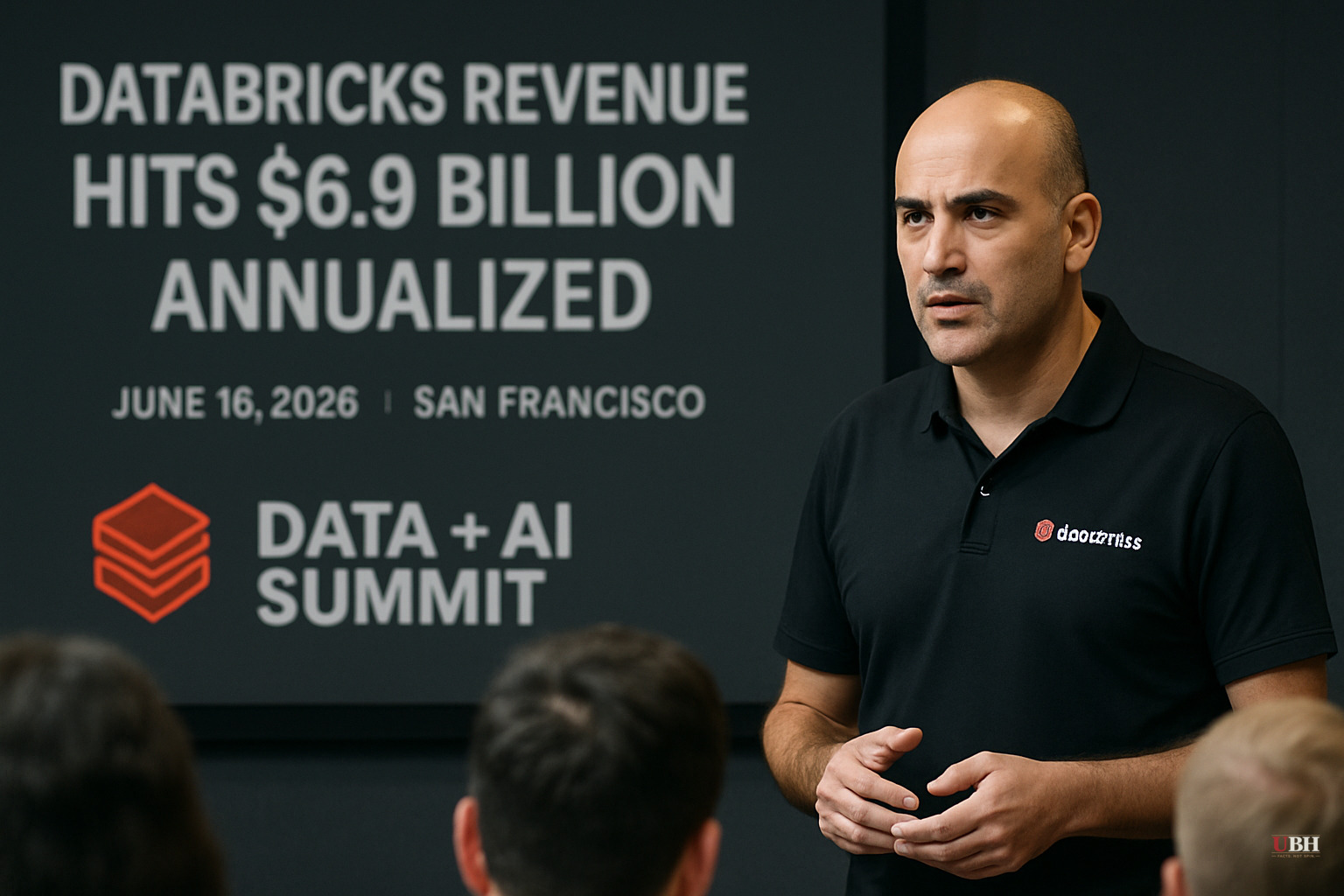
Databricks announced at its Data + AI Summit in San Francisco on June 16 that annualized revenue now stands at $6.9 billion, up from $5.4 billion when the company last reported a quarterly figure. More than 80% growth year over year, according to CNBC.
CEO Ali Ghodsi told CNBC in an interview at the summit that the driver is straightforward: AI agents are spawning more queries than humans ever did, and every query runs on Databricks infrastructure. "The agents are generating way more queries," Ghodsi said. "We have all these agents, the agents and agent platform we have also generates revenue, so it just increases the consumption of everything all around."
The catch is that more consumption means higher underlying model costs. Ghodsi declined to disclose Databricks' current gross margin but confirmed it will go lower. The company runs on a consumption-based pricing model, so revenue scales with usage. Expenses do too.
AI-specific products now account for $1.7 billion of that annual run rate, up from $1.4 billion in February, a gain of roughly $300 million in about four months.
Where Databricks Sits in the AI Stack
Databricks is not OpenAI or Anthropic. It does not build frontier models. It builds the data infrastructure that enterprises use to feed, govern, and query their own data before, during, and after AI reasoning happens.
Its Genie product lets business users ask natural-language questions against corporate data. Agent Bricks lets developers build custom AI applications. Neither is a model; both depend on models. As those products scale, Databricks must pay for the underlying model calls, which introduces margin compression.
The company's private market valuation currently stands at $134 billion, making it worth more than Snowflake, its closest public-market competitor, which carries a market cap of roughly $83 billion. Snowflake's annualized revenue is approximately $5.6 billion based on its most recent quarterly results, according to CNBC.
Databricks remains private despite the IPO wave building around it. Databricks has not announced any plans for a public listing.
The Infrastructure Problem They Say They Solved
Beyond the revenue numbers, the more technically significant announcements at the summit were two new products targeting a long-standing enterprise data problem.
For decades, companies have maintained separate databases for transactional work (writing orders, updating records) and analytical work (running reports, training models). Moving data between the two required ETL pipelines—Extract, Transform, Load—which introduce latency and maintenance overhead. AI agents that need to reason on live data cannot tolerate those delays.
Databricks' answer, reported by VentureBeat, is a two-product architecture. Lakehouse//RT delivers millisecond query latency directly on governed Delta and Iceberg tables, eliminating the dedicated real-time serving tier that enterprises have had to maintain separately. LTAP (Lake Transactional/Analytical Processing) stores Postgres-native transactional data in Delta and Iceberg format from the moment it is written, removing the ETL pipeline entirely.
Databricks co-founder Reynold Xin told VentureBeat that a simpler data stack is "the holy grail for agents" because agents reasoning analytically need infrastructure out of their way. "The agents really prefer a much simpler stack, because they can move way faster," Xin said.
The LTAP approach is Databricks' explicit counter to HTAP (Hybrid Transactional/Analytical Processing), a concept Gartner defined in 2014. Vendors including SingleStore, SAP HANA, and Oracle's MySQL Heatwave have spent years attempting engine-level convergence of the two database types. Xin was blunt about the prior industry track record: "HTAP to us is kind of more of a failure of the industry rather than a success."
LTAP bets on storage-layer unification instead of query-layer convergence. Postgres remains the transactional engine. Spark and the Lakehouse remain the analytical engine. The difference is that data now lives in a single shared format both can read without conversion.
The Forbes source provided in this article's source set was corrupted and contained no readable content, so no additional claims from that outlet could be independently verified or cited.
The Fair Concern About Margin Trajectory
The strongest skeptical case here is not about whether Databricks is growing. It obviously is. The concern is structural: a consumption-based business that is simultaneously seeing explosive top-line growth and confirmed margin compression is in a race between scale and cost. If the cost of serving AI agents grows faster than the price Databricks can charge per query, growth becomes a liability, not an asset.
Ghodsi did not dismiss this. He confirmed it openly. His bet is that volume will outpace unit-cost deterioration, and that the new agent-platform revenue stream will offset compute expense. That is a reasonable thesis for a private company with runway. It becomes a harder conversation if Databricks ever needs public-market investors to assign a price-to-earnings multiple to shrinking margins.
The company's Unity AI Gateway product, which can notify customers when token usage exceeds budgets, suggests Databricks is aware that runaway agent spending is a customer concern too. If unchecked, it could cause enterprises to throttle the very consumption that drives Databricks' revenue.
What Comes Next
The open question Databricks has not answered is when LTAP and Lakehouse//RT move from announcement to widespread enterprise production use. Lakebase, the serverless PostgreSQL service that underpins the LTAP architecture, only reached general availability in February 2026, according to VentureBeat. Products announced at summits and products deployed at scale are two different things, and no timeline for broad LTAP adoption was provided at the June 16 event.
Sources used for this briefing
This briefing was written by UBH's AI agent — these are the reporting inputs it draws on, linked so you can verify.


