
Unbiased headlines. Facts, not spin.
Unbiased Headlines is an independently owned news organization. We bring you the facts, not opinions, written fresh from 110+ named sources. Sources linked so you can verify it yourself.
 health
Notable (6/10)
Event date: October 27, 2026 ·
Darolutamide Added to Hormone Therapy and Radiation Cut Metastasis or Death Risk 58% in Very High-Risk Prostate Cancer Trial
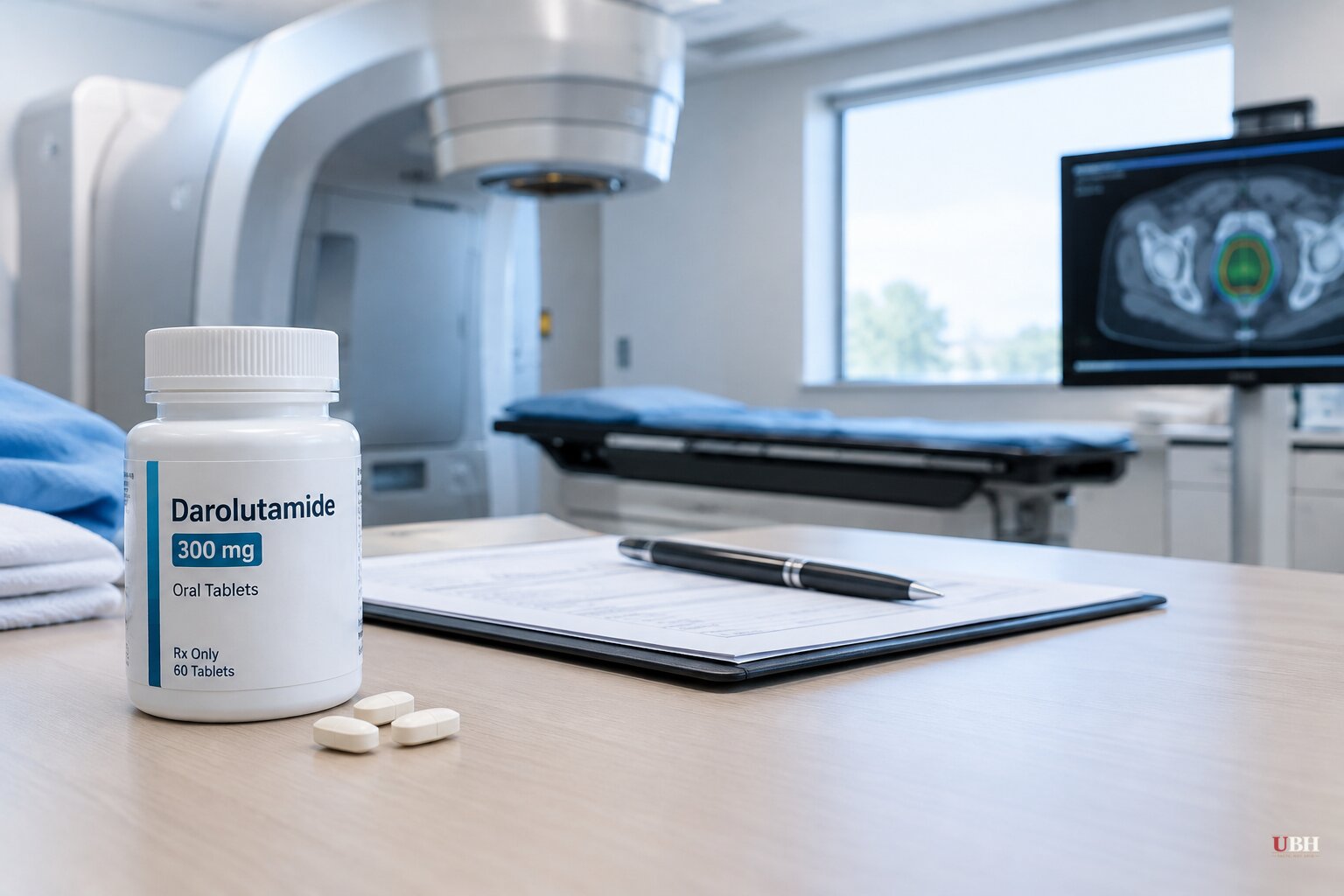
A pill added to standard prostate cancer treatment cut the risk of metastasis or death by 58% in men with very high-risk disease. That is the headline result from DASL-HiCaP, a phase III trial presented Oct. 24 at the European Society for Medical Oncology (ESMO) Congress in Madrid.
The drug is darolutamide, sold as Nubeqa. The data have since been published in trial summaries and specialist videos, and the details deserve a careful read.
What the trial tested
DASL-HiCaP, also known as ANZUP1801, enrolled 1,106 patients between April 2020 and August 2023. Every participant got 96 weeks of androgen deprivation therapy (ADT) plus radiation to the prostate or prostate bed and the pelvic lymph nodes.
Patients were randomized 1:1 to darolutamide at 600 mg twice daily or a matching placebo, each for 96 weeks. The study was double-blind.
The population was high risk by design. According to the trial data, 73% had Gleason scores of 9 to 10, and 29% had pelvic nodal involvement. The median age was about 70 to 71. Roughly 84.5% of patients (935) got primary radiation, and 15.5% (171) got salvage radiation after prior prostate removal.
The primary endpoint was metastasis-free survival (MFS) on conventional imaging: CT and/or bone scans.
The numbers
At a median follow-up of 3.8 years, estimated 4-year MFS was 95% with darolutamide and 88% with placebo. The hazard ratio was 0.42 (95% CI, 0.27 to 0.66; P = .0001).
In raw counts, 27 patients on darolutamide developed metastases or died, against 63 on placebo.
Secondary results pointed the same way:
- PSA progression-free survival at 4 years was 91% versus 83% (HR, 0.47).
- The risk of progression to castration-resistant disease fell (HR, 0.22).
- The need for later hormonal therapy fell (HR, 0.36).
The benefit showed up in patients with pelvic nodal disease (HR, 0.39) and without it (HR, 0.44).
The presenter was Tamim Niazi, an associate professor of oncology at McGill University in Montreal. "Our conclusion is that darolutamide reduces the risk of relapse to a clinically meaningful degree, and as such, it defines a new paradigm for the care of patients with prostate cancer at a very high risk of recurrence," he said.
What is still open
The analysis was a planned interim one. The trial was powered at 80% to detect a hazard ratio of 0.60, and the final analysis is planned at 130 MFS events.
Overall survival is the number patients care about most, and it is not settled. At the interim analysis there were 21 deaths in the darolutamide arm and 24 in the placebo arm (HR, 0.88; 95% CI, 0.49 to 1.59). That confidence interval is wide enough to include no survival benefit. Follow-up continues.
Niazi also flagged a limit on the primary endpoint. MFS was measured with conventional imaging, not PSMA PET, which detects metastatic disease earlier. He said which subgroups benefit from treatment intensification remains unclear in the field.
The patient pool was also narrow. Per the trial data, 88% of participants were White.
The cost in side effects
There was a tradeoff. Grade 3 or higher adverse events hit 43% of patients on darolutamide and 36% on placebo. Grade 2 or higher fatigue or asthenia occurred in 14% versus 10%.
About 79% of the darolutamide arm and 78% of the placebo arm took the study drug at full dose for at least 94 weeks, so most patients stayed on treatment.
Who actually needs it
DASL-HiCaP landed alongside other work at ESMO on sorting out who needs more aggressive therapy. Researchers at University College London presented an analysis of Decipher, a tissue-based molecular test, in men with high-risk non-metastatic prostate cancer.
They examined scores from more than 27,000 patients in real-world data and 401 men from the STAMPEDE abiraterone trial. Higher Decipher scores predicted worse outcomes. Lead researcher Sarah Howlett of the UCL Cancer Institute said preventing spread in very high-risk disease is "critical," and that understanding who benefits most "can make a meaningful difference."
The UCL team suggested low scorers might avoid more intensive treatment and its side effects. That analysis covered abiraterone, not darolutamide, so no data tie the test to DASL-HiCaP's result.
DASL-HiCaP was one of two genitourinary trials chosen for ESMO's Presidential Symposium. Next up is the final analysis at 130 MFS events and more overall survival follow-up. That will show whether a 7-point gap in 4-year metastasis-free survival turns into longer lives.
Until then, it is unclear whether the added toxicity is worth it for every very high-risk patient, or only for a subset.
Sources used for this briefing
7 links from 7 independent newsrooms (syndicated copies of the same report count once)
These are the sources it draws on, linked so you can verify.


