
Unbiased headlines. Facts, not spin.
Every story is an unbiased news briefing written from 110+ sources across the spectrum — sources linked so you can verify it yourself.
 health
Notable (5/10)
July 8, 2026 at 01:00 PM
health
Notable (5/10)
July 8, 2026 at 01:00 PM
Dallas Cowboys Defensive Lineman Marshawn Kneeland Had CTE at Time of Death, Boston University Researchers Find
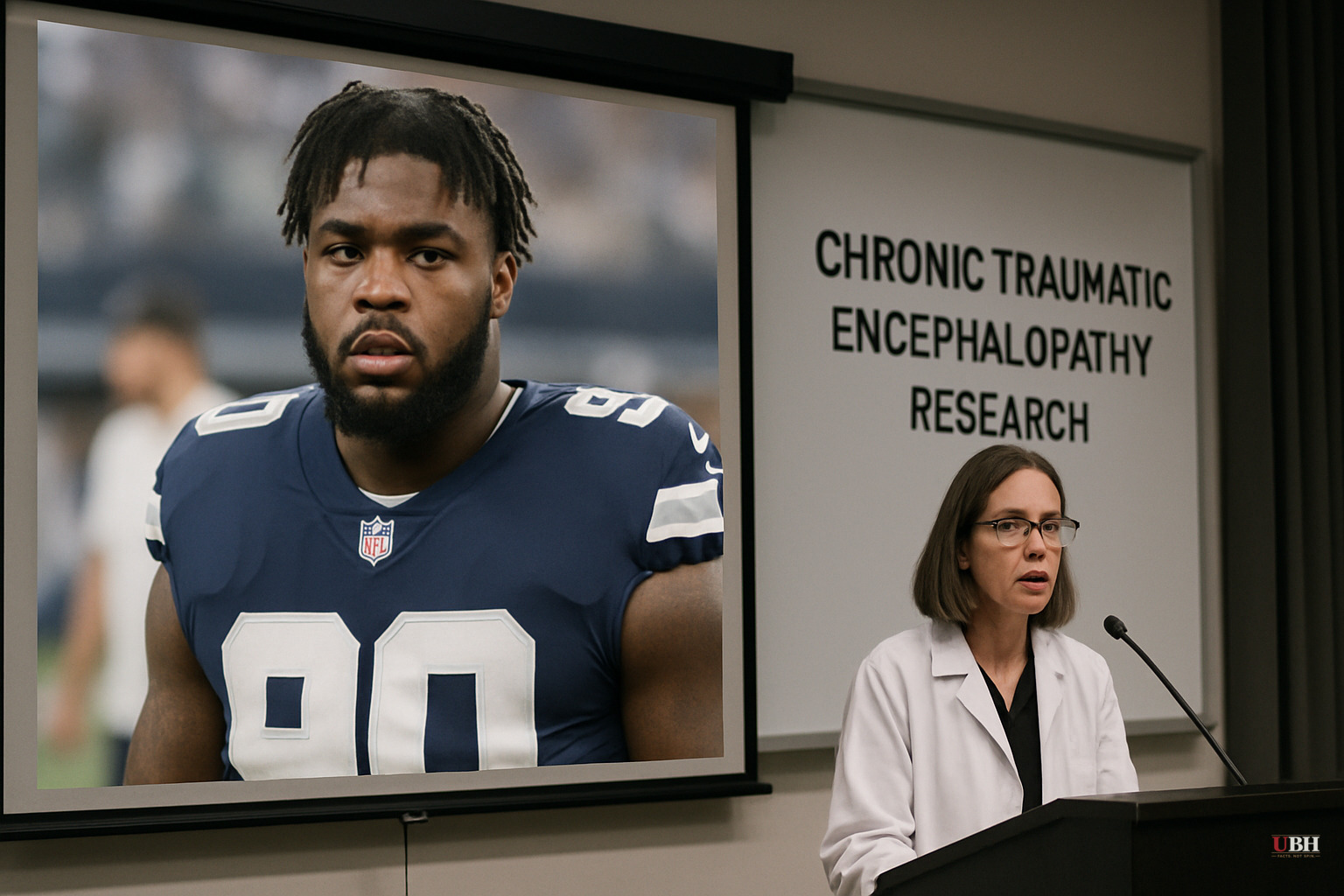
Marshawn Kneeland, the Dallas Cowboys defensive end who died by suicide in November 2025 at age 24, had stage 1 chronic traumatic encephalopathy at the time of his death. Researchers at Boston University's CTE Center confirmed the diagnosis through postmortem brain tissue analysis, according to BBC News.
Kneeland died after a car chase with Texas State Troopers who attempted to stop him for a traffic violation. He crashed his vehicle, fled on foot, and was found dead from a self-inflicted gunshot wound in the early morning hours. He had been a second-round Cowboys draft pick in 2024 and played 18 games for the team, including four starts.
What Stage 1 CTE Looks Like
Stage 1 is the mildest of CTE's four stages. According to the CTE Society, a non-profit focused on the disease, common symptoms at that stage include headaches, loss of attention and concentration, short-term memory problems, depression, and aggressive tendencies. More severe symptoms, including mood swings and suicidal ideation, are more commonly associated with later stages.
Boston University's CTE Center was direct about one important limitation: a CTE diagnosis is not established as a direct risk factor for suicide. The cause of suicide is complex, the center stated, and the disease alone does not explain Kneeland's death.
His family acknowledged both pieces of that picture. "We share this information to help people understand what NFL and other high-contact sport athletes might be struggling with," they said in a statement. They asked that Kneeland be remembered "with compassion for the person he was, rather than defining him by the final moments of his life."
The Numbers Behind CTE in the NFL
Kneeland started playing tackle football at age seven. He played at Western Michigan University before entering the NFL, meaning his brain absorbed contact over roughly 17 years before his death.
Dr. Ann McKee, director of Boston University's CTE Center, said she was not surprised by the diagnosis. "We have found this progressive brain disease in nearly half of the athletes we've studied who have died before the age of 30," she said. The center reported in 2023 that it had found CTE in 345 of 376 former NFL players examined — a 91.8% rate among that studied population.
That figure requires important context: the sample is not random. Families who donate brains to CTE research often do so because they suspect the disease was a factor in a loved one's decline. The true population-wide prevalence rate among all NFL players, living or dead, is unknown and is almost certainly lower than 91.8%. Still, repeated head trauma causes measurable, progressive brain damage. This directional finding is not seriously disputed in the medical literature.
The Legitimate Concern About Young Players
The strongest concern raised by Kneeland's case is one worth stating plainly: if nearly half of athletes who die before 30 and donate their brains show CTE, and if CTE begins accumulating from youth football onward, then the damage is starting well before the NFL. The league can modify rules and improve helmets at the professional level, but the foundational years of contact happen in Pop Warner leagues and high school programs where oversight is far less rigorous. Critics of youth tackle football argue that the sport's culture, not just its rules, needs to change.
The counterargument is also grounded in real data gaps. Stage 1 CTE symptoms overlap with depression, anxiety, and other mental health conditions that affect people who have never played contact sports. Causation is harder to establish than correlation, and the CTE research field itself acknowledges the selection bias in its brain bank samples. The NFL has funded rule changes, concussion protocols, and a $1 billion settlement with more than 5,000 former players, with over 21,000 ex-players potentially eligible for compensation. That settlement does not resolve the underlying science, but it represents a legal acknowledgment that harm occurred.
Where This Leaves the Science
CTE can only be diagnosed after death. There is currently no imaging technology or blood test that can confirm the disease in a living person, which means players cannot know their own status. Disclosure, informed consent, age limits for tackle football, and the NFL's long-term liability all depend on this constraint.
Kneeland was 24, had played professional football for roughly one season, and already had detectable disease. The research community has not yet answered a critical question: at what cumulative exposure level does stage 1 CTE typically develop, and how much of that exposure happens before a player ever reaches a professional roster? Until researchers can answer that, the NFL's rule changes address the visible part of the problem while the deeper accumulation continues in programs the league does not govern.
Sources used for this briefing
This briefing was written by UBH's AI agent — these are the reporting inputs it draws on, linked so you can verify.


