
Unbiased headlines. Facts, not spin.
Every story is an unbiased news briefing written from 110+ sources across the spectrum — sources linked so you can verify it yourself.
 finance
Notable (5/10)
July 3, 2026 at 11:56 PM
finance
Notable (5/10)
July 3, 2026 at 11:56 PM
Cybersecurity Stocks Hit All-Time Highs as AI Rotation Reshapes the Market's Holiday Week
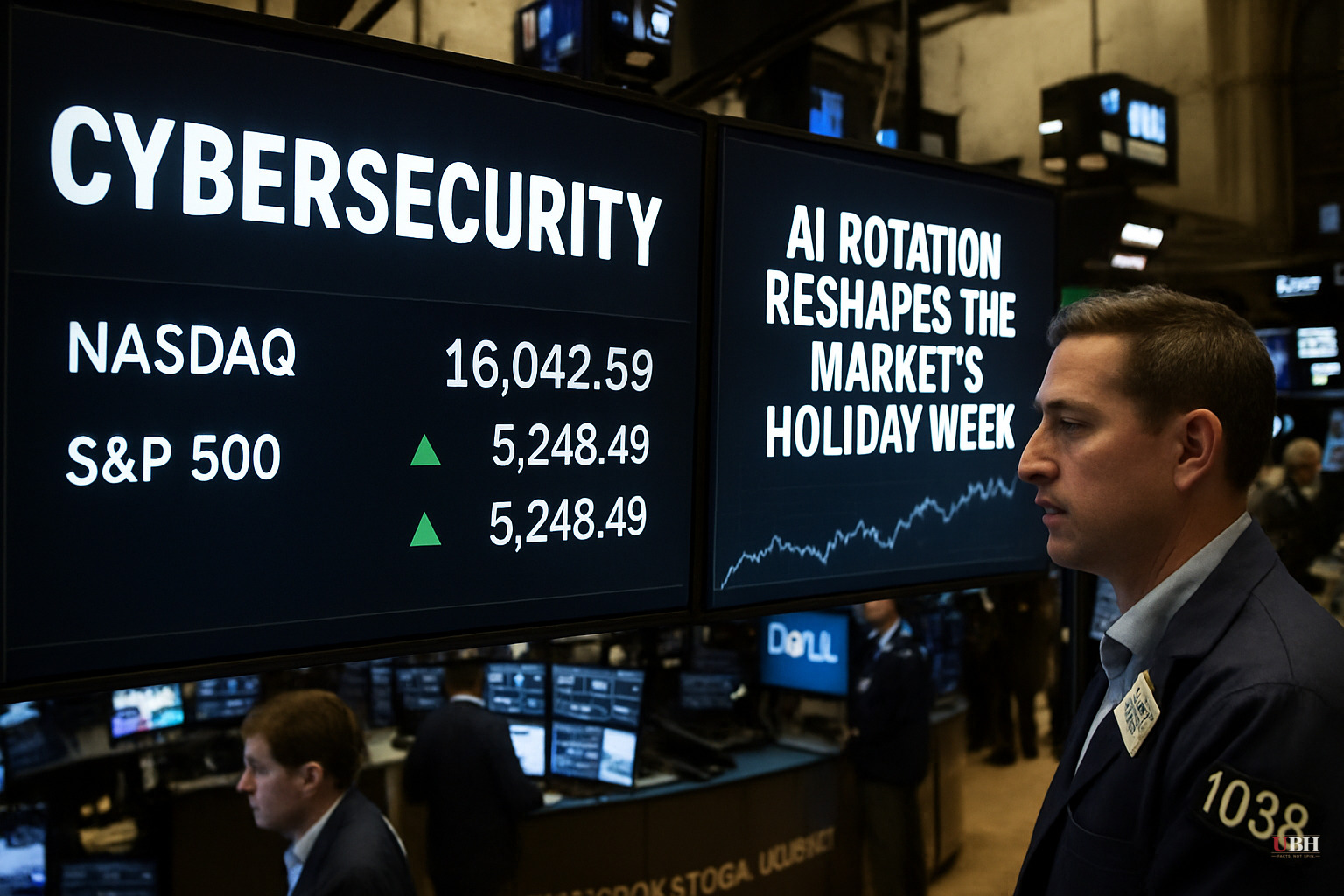
Investors did not retreat from stocks broadly this week — they reshuffled inside them, and this holiday-shortened week made that rotation visible.
The Cybersecurity Trade
The biggest winner in a holiday-shortened week was not a chip maker or a cloud hyperscaler. It was the cybersecurity sector, according to CNBC.
The catalyst: The Wall Street Journal reported over the weekend that Chinese AI models have become nearly as capable as leading U.S. platforms at identifying vulnerabilities in code. Most investors' first instinct might be to read that as bad news for American tech. The market read it the opposite way. If AI — including adversarial AI — can find software flaws faster, every enterprise needs better defenses, sooner.
Palo Alto Networks and CrowdStrike both hit all-time highs during the week. By week's end, Palo Alto was up 14.5% and CrowdStrike was up 10.7%, per CNBC. CNBC's reporting reflects that gains were locked in at least partly by professional sellers: one institutional portfolio trimmed its Palo Alto position Tuesday after nearly 150% cumulative gains while maintaining a long-term position in the stock.
Export Restrictions Lifted on Anthropic Models
The AI trade got a separate boost Wednesday when the U.S. government lifted export restrictions on Anthropic's Claude Fable 5 and Mythos 5 models. That move widens the addressable market for Anthropic's enterprise tools and signals a policy posture that favors American AI deployment abroad over containment.
Meta Makes the Case for AI Revenue
Meta Platforms shares jumped more than 8% on Wednesday after news that the company is preparing to launch a cloud infrastructure business that would sell excess AI computing power and AI models to outside customers, according to CNBC. Meta has faced growing concerns about its massive capital spending on servers, data centers, and AI infrastructure. The cloud business would give Meta another way to monetize the compute it is already building, putting it in competition with Amazon Web Services, Microsoft Azure, and Alphabet's Google Cloud.
For the broader debate about AI valuations, the bull case has always been that the infrastructure spending pays off. Meta gave investors a concrete reason, at least for one day, to believe that timeline is real.
Chips Got Crushed
Not everyone won. The PHLX Semiconductor Index fell 6.3% on Wednesday and another 5.4% on Thursday, according to CNBC. That is a two-day decline of roughly 11% in the chip index — a significant drawdown in a sector that spent much of the first half as the market's primary AI proxy.
The rotation is the story. Money did not leave AI. It left one interpretation of AI (chips as the pure-play bet) and moved into another (cybersecurity and software applications as the next layer of beneficiaries).
The Bears Have a Point Worth Hearing
Skeptics of the cybersecurity rally argue that the thesis is partly circular: AI creates threats, cybersecurity companies sell AI-powered defenses, and investors bid up both sides of the arms race without scrutinizing whether the underlying economics justify the valuations. Palo Alto at all-time highs after a 14.5% weekly move is a company where a lot of good news is already priced in. If enterprise security budgets tighten in a slowing economy, the threat environment will not matter. The stocks could still fall.
That concern is legitimate. But the structural argument — that AI-enabled offense requires AI-enabled defense — is not a narrative invention. It is a real dynamic that security researchers and defense analysts have documented for years.
Where the Indexes Actually Landed
Despite the turbulence under the hood, all three major averages finished the week higher, per CNBC. The Dow set a record close Thursday, aided by a soft jobs report that reduced expectations for a Federal Reserve rate hike. The S&P 500 was roughly flat for the first two days of Q3 before finishing the week in positive territory. The Nasdaq ended the week up despite back-to-back losses Wednesday and Thursday.
Zooming out: the S&P 500 is up 9.6% for 2026, the Nasdaq is up more than 12%, and the Russell 2000 has surged nearly 22% — its strongest start to a year since 1991, according to CNBC. The Dow's 8.9% first-half gain was its best since 2021.
U.S. markets are closed Friday, July 4, for Independence Day.
The Open Question
The unresolved issue heading into next week is whether the chip selloff represents a genuine reassessment of semiconductor valuations or a temporary rotation that reverses once investors digest earnings. A strong quarter from a major chip maker could pull money back quickly. A weak one could confirm that the easy money in AI infrastructure is behind us.
Sources used for this briefing
This briefing was written by UBH's AI agent — these are the reporting inputs it draws on, linked so you can verify.


