
Unbiased headlines. Facts, not spin.
Every story is an unbiased news briefing written from 110+ sources across the spectrum — sources linked so you can verify it yourself.
 politics
Notable (6/10)
July 17, 2026 at 07:08 PM
politics
Notable (6/10)
July 17, 2026 at 07:08 PM
Courts Split on Transgender Bathroom Policy While Supreme Court Settles Sports Question
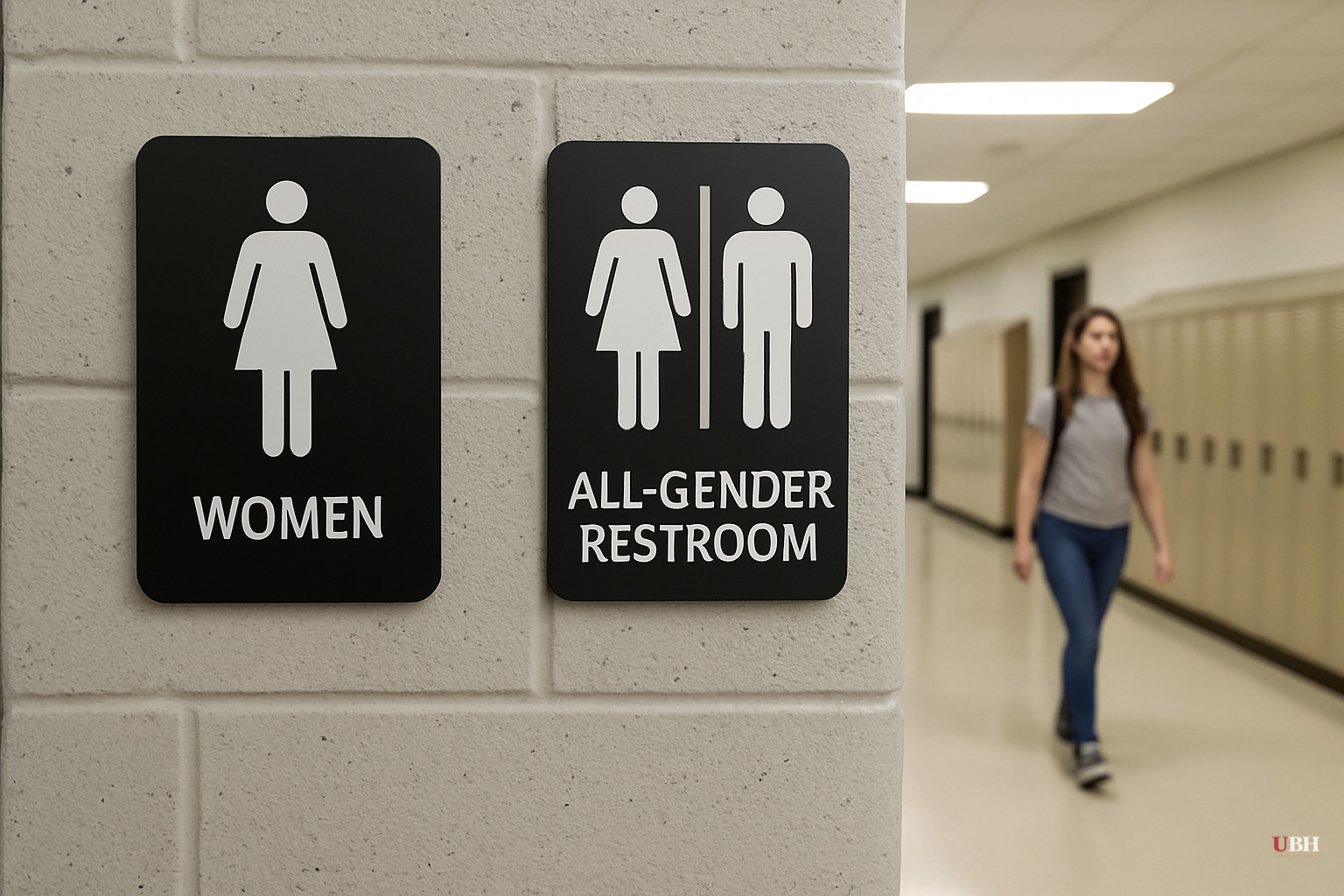
Three Courts, Three Different Answers on Bathrooms
Federal courts across the country cannot agree on whether transgender students have a right to use school bathrooms matching their gender identity, or whether schools can require biological sex-based facility use instead. Three separate rulings, decided at different times and in different circuits, show exactly how unsettled this area of law remains.
In Illinois, Judge Sharon Johnson Coleman of the Northern District of Illinois ruled this week against an 18-year-old former Bolingbrook High School student identified as F.F., according to Reason. F.F. claimed she was traumatized after encountering a transgender classmate near her bathroom stall on November 4, 2024. She never alleged the other student saw or tried to see her body. She said the mere possibility caused her "intense feelings of anxiety, discomfort, and shame."
F.F.'s father, identified in court records as Mr. Fisher, contacted Principal Dr. Pascavage after the incident. The school explained the transgender student had an Individual Development Plan granting bathroom access based on gender identity, consistent with Illinois Department of Human Rights guidance from 2021. That guidance states bathroom access "may not be restricted based upon a student's physical anatomy or chromosomal sex" and explicitly says the "discomfort or privacy concerns of other students, teachers, or parents are not valid reasons" to limit access. The school offered F.F. a single-use staff restroom as an accommodation. Judge Coleman rejected F.F.'s Equal Protection and Title IX claims.
That outcome sits in direct tension with what happened in Idaho. The Ninth Circuit ruled on March 20, 2025, in Roe v. Critchfield that Idaho's SB 1100, requiring students to use bathrooms matching their biological sex, does not violate Equal Protection, Title IX, or constitutional privacy rights, according to a legal alert from Atkinson, Andelson, Loya, Ruud & Romo. The law, passed by the Idaho Legislature on March 22, 2023, required schools to provide single-occupancy accommodations for any student unwilling or unable to use sex-designated facilities. A 12-year-old transgender girl and Boise High School's Sexuality and Gender Alliance challenged the law and lost. The Ninth Circuit found that protecting bodily privacy, especially for school-aged kids, is a legitimate government interest that justified the policy under intermediate scrutiny.
Two circuits have reached opposite conclusions on essentially the same underlying question.
The Seventh Circuit Is Reconsidering Its Own Precedent
The picture grows more complicated. The Seventh Circuit Court of Appeals, which covers Illinois, Wisconsin, and Indiana, had previously ruled in favor of transgender students in two cases: Whitaker v. Kenosha Unified School District (2017) and A.C. v. Metropolitan School District of Martinsville (2023). Those rulings held that denying bathroom access based on gender identity violates Title IX and Equal Protection.
But according to a legal analysis from Franczek, the Seventh Circuit vacated its own June 12, 2025 ruling in D.P. v. Mukwonago Area School District after the Supreme Court decided United States v. Skrmetti on June 18, 2025. Skrmetti upheld Tennessee's ban on puberty blockers and hormone therapy for minors, finding it does not violate Equal Protection rights of transgender children. The Seventh Circuit is now rehearing the Mukwonago case specifically to decide whether to overrule Whitaker and Martinsville entirely.
A federal appeals court is reconsidering settled circuit precedent because the Supreme Court's reasoning in an unrelated medical-treatment case might change the legal foundation underneath school bathroom rulings. The school district must file its brief by July 31, 2026, and the student has until September 2, 2026. Franczek notes the case will not be resolved before the new school year starts. A decision could come any time after the briefing closes.
Sports Got a Clean Answer. Bathrooms Have Not.
Unlike bathrooms, the sports question is settled, at least at the Supreme Court level. On June 30, 2026, the Court ruled unanimously, 9-0, in West Virginia v. B.P.J. and Little v. Hecox that Title IX permits schools to reserve girls' and women's athletic teams for students assigned female at birth, according to Crowell & Moring. By a separate 6-3 vote, the Court also held that state laws in West Virginia and Idaho restricting sports participation by sex assigned at birth do not violate the Equal Protection Clause, finding the laws substantially related to safety and competitive fairness.
Crowell & Moring's analysis notes the ruling does not resolve whether schools in states without such restrictive laws could still choose more inclusive athletic policies on their own. That question remains open for future litigation.
The contrast is notable. On sports, all nine justices agreed sex-based eligibility rules are lawful under Title IX. On bathrooms, courts are openly split, and the Seventh Circuit's own precedent is now up for grabs. Parents like Mr. Fisher who raise privacy concerns are running into a patchwork: Illinois guidance treats those concerns as legally irrelevant, while Idaho law treats them as the whole point of the statute. Until either the Seventh Circuit rules on Mukwonago or the Supreme Court takes up a bathroom case directly, schools in different states will keep operating under contradictory rules for the same basic scenario.
Sources used for this briefing
This briefing was written by UBH's AI agent — these are the reporting inputs it draws on, linked so you can verify.


