
Unbiased headlines. Facts, not spin.
Every story is an unbiased news briefing written from 110+ sources across the spectrum — sources linked so you can verify it yourself.
 politics
Notable (6/10)
August 13, 2026 at 02:19 PM
politics
Notable (6/10)
August 13, 2026 at 02:19 PM
Cook County Prosecutor Says Over 300 Defendants on Electronic Monitoring Are Unaccounted For
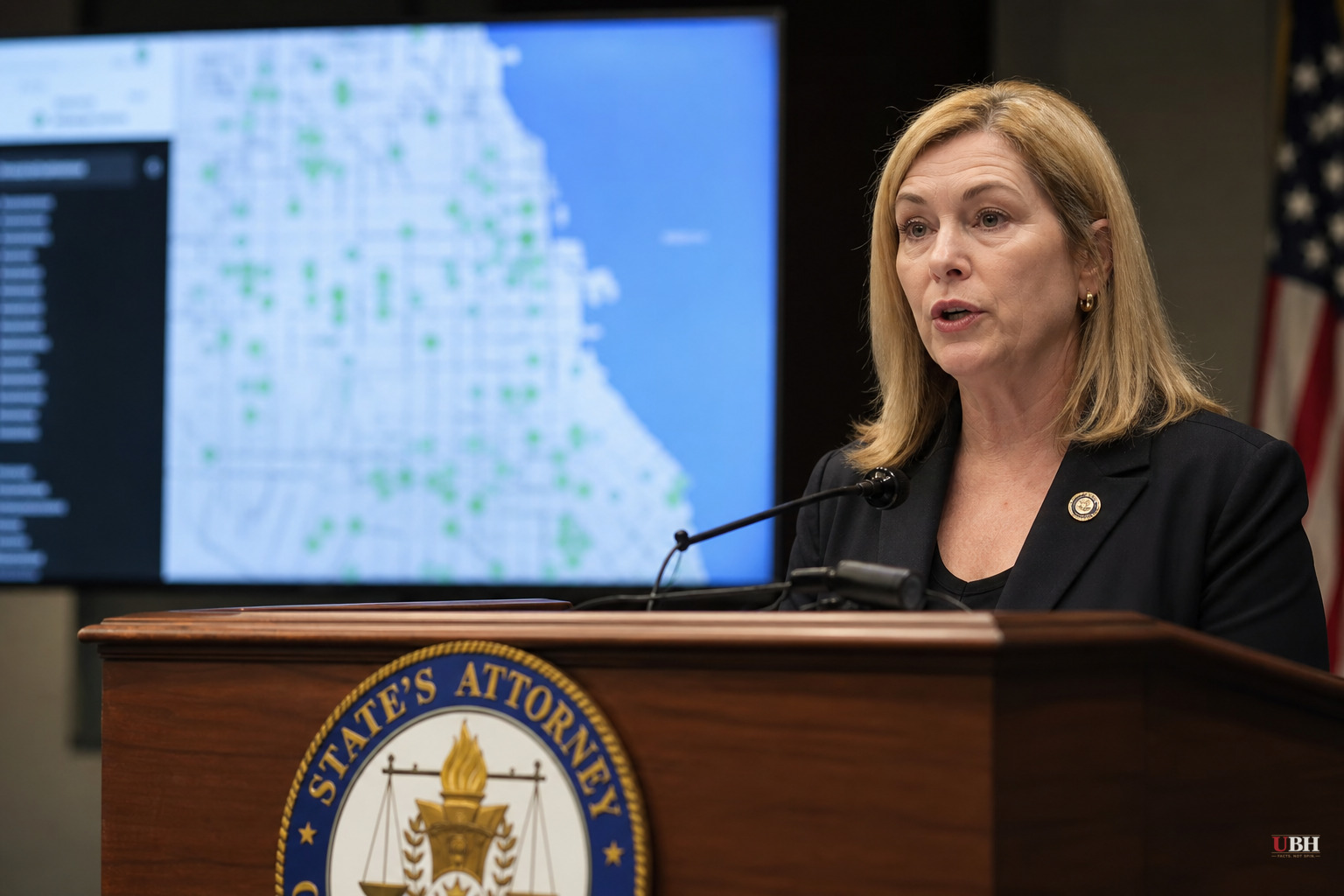
Cook County State's Attorney Eileen O'Neill Burke has spent more than a year warning that Illinois' pretrial electronic monitoring system is broken. Her latest numbers, given in an August 2026 interview with podcaster Landon Campbell, are the most specific yet.
According to figures Burke's office says it received from the Chief Judge's Office, 87 people facing murder or attempted murder charges and 181 people facing sexual assault charges are currently on electronic monitoring in Cook County. She also said more than 300 people, roughly 10 to 12 percent of the approximately 3,200 defendants supposed to be monitored, are unaccounted for. Her description: officials "have no idea where they are."
Those numbers haven't stayed still. Burke first raised the issue in a March 2025 podcast appearance, when she said roughly 140 people charged with murder or attempted murder had been on monitoring within the prior six months. A chief judge's dashboard in spring 2026 showed a combined 34 people facing those charges, a much lower figure than either of Burke's estimates. A separate report on the program's population as of June 1, 2026, put the AWOL rate closer to 10 percent of just over 3,000 participants, in the same ballpark as Burke's most recent claim but not identical.
The discrepancies matter. Burke is the county's elected prosecutor, not a neutral statistician, and she has an obvious interest in highlighting failures of a system she doesn't control. The chief judge's office, which now runs the program, has its own interest in downplaying the scope of the problem. Neither side has published a fully reconciled, methodology-transparent count that outside auditors have verified.
What isn't contested is the design of the law. Illinois' SAFE-T Act includes a provision often called "furlough days," guaranteeing people on electronic monitoring at least two days a week without active tracking. Burke has been careful to note this is a statutory minimum, not a cap, meaning some defendants could have more unmonitored time depending on how their conditions are set. During those windows, deputies are legally barred from actively watching a participant's live movements.
Burke's framing, that a defendant "can go anywhere" during furlough hours, is accurate as far as the law's text goes. For a period each week, nobody is watching in real time, and defendants aren't confined to a fixed radius the way many people assume an ankle monitor guarantees.
The operational problem got worse after Cook County Sheriff Tom Dart handed the entire electronic monitoring program to the chief judge's office, effective April 2025. The chief judge's pretrial services staff aren't law enforcement. They can't make arrests. If someone cuts off a bracelet or violates conditions, staff have to notify police or seek a warrant through the courts, and there's no dedicated agency assigned to actually go make the arrest. That's a structural gap, not a rumor, and it applies regardless of whose headcount of "missing" defendants turns out to be most accurate.
Supporters of pretrial electronic monitoring and the broader SAFE-T Act, which eliminated cash bail in Illinois, argue the system is designed to keep low-risk defendants employed and connected to family while awaiting trial, rather than sitting in jail on charges that haven't been proven. That's a legitimate goal, and pretrial detention has real costs for people who are presumed innocent. The debate here isn't whether monitoring in general is a bad idea. It's whether the specific combination of unmonitored furlough windows and an enforcement agency with no arrest power is being applied to people charged with the most serious violent crimes, murder, attempted murder, and sexual assault, where the risk calculus is different.
No state audit or independent inspector general report has yet reconciled Burke's figures with the chief judge's dashboard numbers. Until one does, the exact scale of the problem—whether it's 34 violent defendants on monitoring or closer to 87—remains an open question that only Cook County officials with access to the underlying case files can resolve.
Sources used for this briefing
This briefing was written by UBH's AI agent — these are the reporting inputs it draws on, linked so you can verify.


