
Unbiased headlines. Facts, not spin.
Unbiased Headlines is an independently owned news organization. We bring you the facts, not opinions, written fresh from 110+ named sources. Sources linked so you can verify it yourself.
 health
Major Story (7/10)
health
Major Story (7/10)
Consumer Reports Presses FDA on Cyclospora Response as Two Salad-Related Recalls Reach Top Risk Class
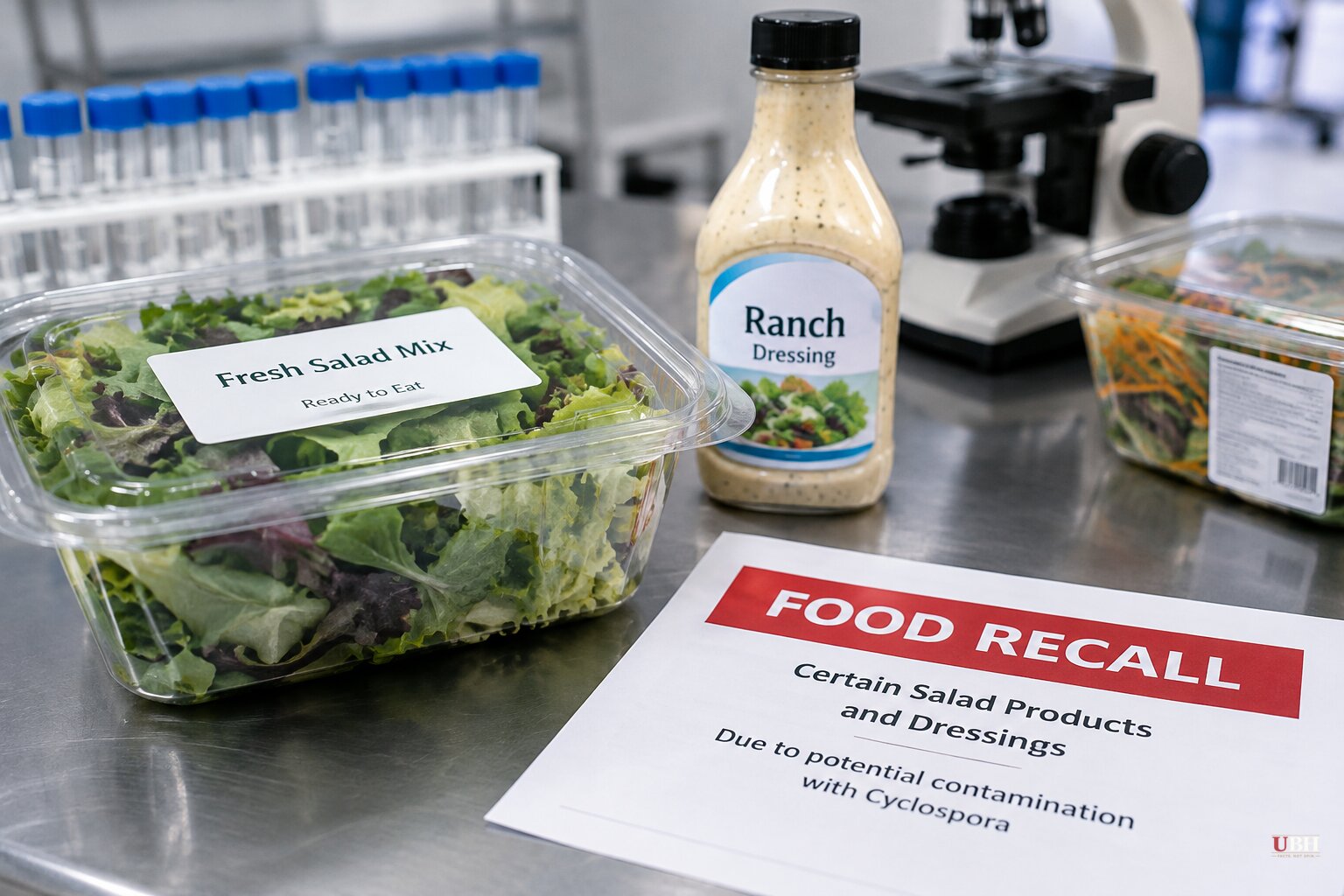
The FDA says its investigation into a summer Cyclospora outbreak is finished. Consumer Reports says the questions are not.
On Oct. 2, the FDA announced it had concluded its probe of Cyclospora infections tied to iceberg lettuce from central Mexico, recalled by Taylor Farms de Mexico. The CDC had declared the outbreak over on Sept. 11. The FDA said it will continue post-outbreak response work with the CDC and state, local and international partners.
What the FDA found
Taylor Farms de Mexico announced on July 17, 2026 that it was pulling all iceberg lettuce sourced from central Mexico from the U.S. market. The recall covered Marketside-brand products sold at Walmart, including 12-oz and 24-oz iceberg salad and 8-oz and 16-oz shredded lettuce, with best-by dates from July 18 to Aug. 3. Foodservice products were also included. Taco Bell said it stopped using lettuce from Taylor Farms de Mexico as of July 17.
The FDA's traceback identified several farms and a processing facility in Mexico. Investigators inspected multiple growers and the facility in coordination with Mexican officials, and sampled water, soil, sediment and lettuce. Two samples tested positive for Cyclospora. One came from a tank that held outgoing wastewater from the processing facility; the other came from a drainage ditch at a grower identified in the traceback.
The FDA's outbreak page lists 12,883 total illnesses, 570 hospitalizations and 2 deaths, with the last illness onset on Aug. 17, 2026. Consumer Reports, in its letter, describes the outbreak as having sickened almost 13,000 people, hospitalized 560 and killed two. The FDA's tally is the agency's official count.
Consumer Reports' letter
Consumer Reports sent a letter to FDA Deputy Commissioner Donald Prater and asked for a response by Nov. 6. The letter cites "critical vulnerabilities" in federal food safety oversight. It says the FDA's response was "hindered by notable delays and a lack of transparency."
Specifically, the group says that although early evidence pointed to shredded iceberg from Taylor Farms de Mexico, investigators "took nearly a month to launch environmental sampling and on-site inspections in Mexico." It also says the recall classification was delayed for more than a month, "creating widespread public confusion."
Consumer Reports adds that inconsistent public messaging led to financial losses and food waste for U.S.-grown fresh produce. It faults the agency for not disclosing when foreign inspections happened or when and where samples were collected.
The FDA's outbreak page describes the traceback, inspections and sampling it carried out.
The traceability rule
Consumer Reports points to a deeper problem: tracing the lettuce. Craig Hedberg, a University of Minnesota professor who studies outbreak investigations, told the group that "a fair amount of additional work" remains to give a more complete picture of what happened.
The Food Safety Modernization Act of 2011 called for a traceability rule. It requires companies handling high-risk foods such as leafy greens, fresh-cut fruit and raw cheese to keep detailed records of how those foods move and hand them to the FDA within 24 hours of a request. The rule was supposed to take effect in January 2026, but in March 2025 the FDA pushed the deadline back two and a half years to July 2028, saying it wanted to give companies more time to comply. Congress later codified the delay.
Brian Ronholm, Consumer Reports' director of food policy, said the rule would have made it easier to trace the outbreak back to the source more quickly. He said FMI, a trade group representing the consumer food supply chain, lobbied Congress to delay implementation.
So the delay that Consumer Reports cites traces back to Congress, not just the agency. Cyclospora symptoms often do not appear until two weeks after consumption, which leaves investigators chasing product that has already left restaurant kitchens.
A proposal to narrow the rule
According to Restaurant Business Magazine, the FDA is now proposing to exempt food businesses with between $250,000 and $1 million in annual food sales from detailed supply-chain tracking. That would relieve many independent operators of the cost and labor of logging high-risk inventory such as leafy greens, soft cheeses, eggs and nut butters.
Agency officials said the proposed flexibility is not final and that additional adjustments remain under consideration.
The tradeoff is real on both sides. Small restaurants carry compliance costs that larger chains absorb more easily, and cutting paperwork for them is a standard small-government instinct. But the recordkeeping is what lets investigators find the source of an outbreak quickly, and this summer's outbreak is the case in point.
Two more recalls at the top risk tier
Separately, two other recalls have reached the FDA's Class I category, reserved for cases with a "reasonable probability" of serious adverse health consequences or death.
New York-based Made Fresh Salads recalled all of its ready-to-eat deli-style salads, assorted cream cheese products and half-size aluminum pans in September over possible Listeria monocytogenes contamination. The FDA has now classified 61 products as Class I. They were delivered directly to retail stores and distributors in Brooklyn, Queens, the Bronx and New York City.
Salata Dressings of Houston began a voluntary recall of its Salata Salad Kitchen Jalapeño Avocado Dressing on Aug. 6 and announced it Aug. 11. The FDA designated it Class I on Sept. 29. The company said its jalapeño supplier warned that the diced jalapeños could be contaminated with Salmonella and could be linked to a multistate Salmonella outbreak the FDA is investigating.
The recall covers 1,724 cases of 12.5-ounce bottles and one-gallon jugs distributed in Georgia, North Carolina and Texas. Four jalapeño lots went into the dressing between July 8 and July 29. No illnesses had been reported tied to the dressing when it was first announced.
What comes next
Prater's Nov. 6 deadline is the next concrete marker. The FDA's answer on why sampling and recall classification took as long as they did, and whether the traceability exemption moves forward, will show how the agency plans to handle the next produce outbreak.
Sources used for this briefing
7 links from 6 independent newsrooms (syndicated copies of the same report count once)
These are the sources it draws on, linked so you can verify.


