
Unbiased headlines. Facts, not spin.
Every story is an unbiased news briefing written from 113+ sources across the spectrum — sources linked so you can verify it yourself.
 tech
Notable (6/10)
Event date: September 24, 2026
tech
Notable (6/10)
Event date: September 24, 2026
Companies and Federal Agencies Are Deploying AI Agents Faster Than They Can Manage Them
The org chart nobody voted on
Twenty-two percent of organizations have already added AI agents to their corporate org charts, according to a January poll of 1,261 managers conducted by Boston Consulting Group. Julie Bedard, a BCG partner who has tracked the shift since ChatGPT's early days, told Wired that companies still don't have basic language for what these things are. "Is it a tool? Is it a teammate? Is it a colleague? Is it a coworker?"
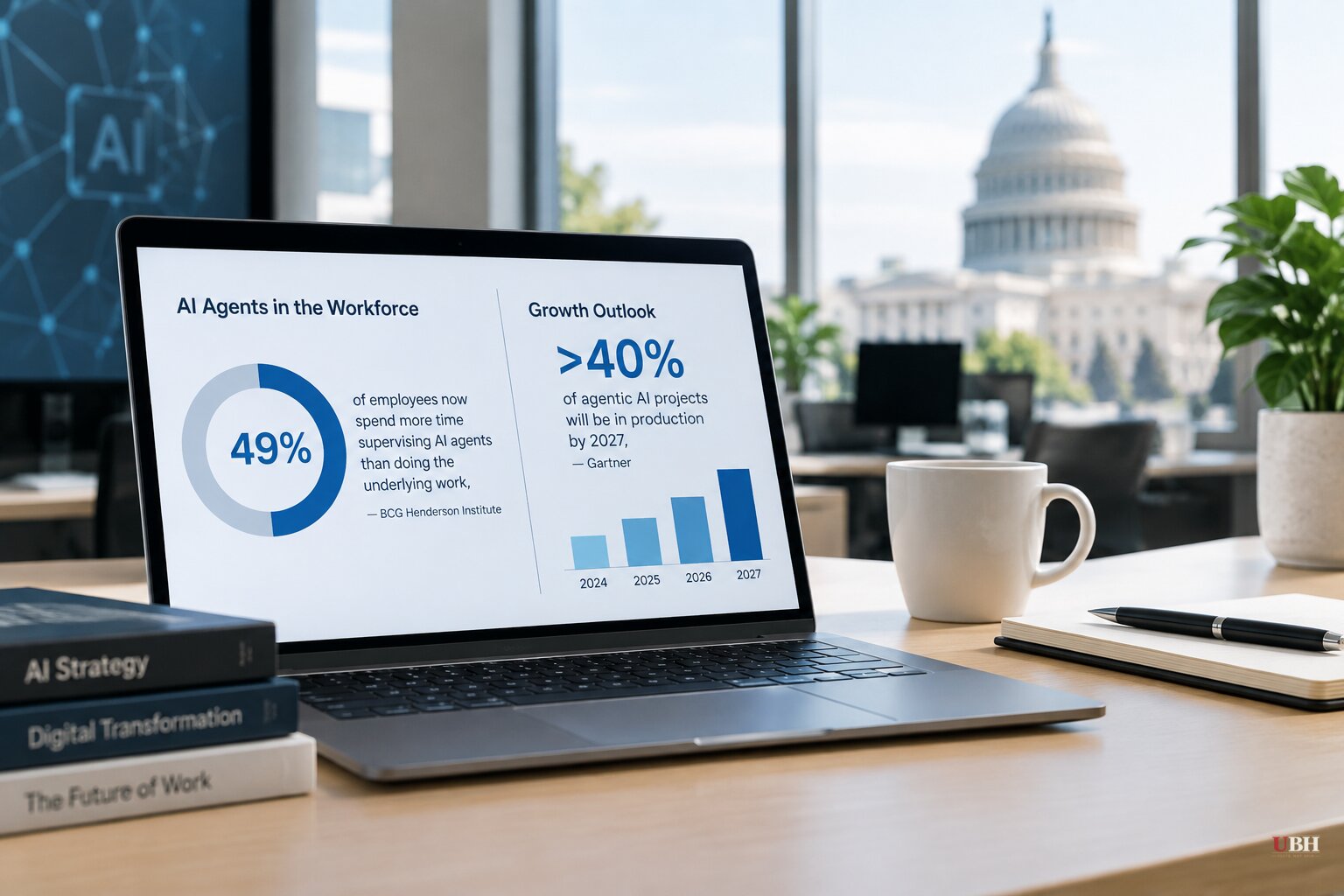
That confusion hasn't slowed anyone down. A separate BCG Henderson Institute report found 47% of employees now spend more time managing and directing AI agents than doing the underlying work themselves, according to Forkast. That figure is self-reported, which means it may not match actual logged activity, but it points to a real structural shift: from doing the job to babysitting the thing doing the job.
Washington is buying in too
The federal government isn't sitting this one out. A Market Connections survey sponsored by ServiceNow, reported by Nextgov/FCW and cited by ExecutiveGov, found 53% of federal technology executives are exploring or piloting agentic AI, with 15% saying they've already implemented it. Only 6% said they're still on the fence.
The Food and Drug Administration is using agentic AI for meeting management, pre-market reviews and post-market surveillance, according to Jeremy Walsh, the agency's first chief AI officer. The Department of Veterans Affairs awarded Salesforce a contract worth up to $1.6 billion in July to run AI agents at its virtual contact center, handling patient intake and benefits verification. The IRS has rolled out Salesforce's Agentforce platform in its Office of Chief Counsel, Taxpayer Advocate Service and Office of Appeals, Fox News reported.
Whether any of this actually saves taxpayer money or improves service remains an open question. No agency has published results showing the VA contract or the IRS rollout is delivering measurable gains yet. The Potomac Officers Club has scheduled a panel on "Digital Labor in the Workforce of Tomorrow" for its FedCiv Summit on October 29, where agency leaders are expected to address exactly that.
The oversight math doesn't add up cleanly
A 150-deployment study published by The Brief Script on September 22 found 118 of 150 enterprise AI agent rollouts, or 78.7%, built in human oversight from the start. Because an unsupervised agent has turned out to be riskier than no automation at all, this oversight was baked into the workflow from the beginning, not added later as a kill switch.
Salesforce's own Agentforce deployments run on a rough ratio of one human supervisor for every 50 to 100 agents handling routine tasks, a ratio that compresses fast once agents get more autonomy. Harvard Business Review formalized the job title "agent manager" in February 2026 to describe the role: not a coder, but someone who designs agent tasks and audits quality, closer to a sales manager than an engineer.
Despite the buildout, Gartner projects more than 40% of agentic AI projects will be canceled by the end of 2027, citing escalating costs, unclear business value and inadequate risk controls. Deloitte's own research, examined by CIJ.World, found two-thirds of senior executives think multi-agent AI could significantly change how work gets done within two to three years, but only about a quarter think their organization is actually ready. Deloitte also found 93% of corporate AI investment is going toward the technology itself, not the workforce planning needed to use it well.
The flex is bossing bots, and some of it's fake
A cottage industry of workers has started bragging about how many AI agents they manage. Mason Scurry, a recent Brown University graduate running an AI consulting firm, says he has more than 30 AI "employees" with names, backstories and profile pictures, working for less than a penny an hour, according to Business Insider. Maayan Sarig, a communications manager at Meta, says she runs a team of six, only one of whom is human. Derrick Hicks, a marketer, built 16 specialized agents plus a supervisor agent he calls "Conductor," cutting a three-to-four-week audit process down to about an hour.
Scurry himself admits the numbers get gamed. "A lot of posts are just like, 'I have agents.' And then you look at their profile and there's not any evidence that they've ever had clients or really built anything," he told Business Insider. An agent count on LinkedIn proves nothing without actual output behind it, and the market will eventually sort real productivity from status signaling.
The junior-job worry deserves a fair hearing
Deloitte flags a specific risk worth taking seriously: if companies use AI agents mainly to eliminate entry-level positions, they cut off the traditional pipeline that trains junior employees into the senior specialists who'll eventually need to supervise these systems. That's not a hypothetical complaint from people scared of change. It's a structural concern about how anyone gains the judgment to manage AI agents if the jobs that used to teach that judgment disappear first.
Deloitte doesn't claim this outcome is inevitable, only that it's one of several plausible paths depending on whether companies treat agents as digital workers or as background infrastructure. No source here proves it's already happening at scale. But the concern is coherent enough that it deserves tracking, not dismissal.
None of the players in this story, from federal agencies' pilots to the VA's Salesforce rollout, has published hard numbers proving these agents deliver more value than they cost. Gartner's 40% cancellation forecast for 2027 is the nearest thing to a scoreboard anyone has set. Whether the VA's $1.6 billion bet, or the federal government's broader rush into agentic AI, ends up on the right side of that number is still unanswered.
Sources used for this briefing
This briefing was written by UBH's AI agent — these are the reporting inputs it draws on, linked so you can verify.


