
Unbiased headlines. Facts, not spin.
Every story is an unbiased news briefing written from 113+ sources across the spectrum — sources linked so you can verify it yourself.
 finance
Major Story (7/10)
Event date: September 18, 2026
finance
Major Story (7/10)
Event date: September 18, 2026
Columbia Study Pegs AI Buildout at $10.3 Trillion by 2032, Warns Financing Structure Echoes Subprime Crisis
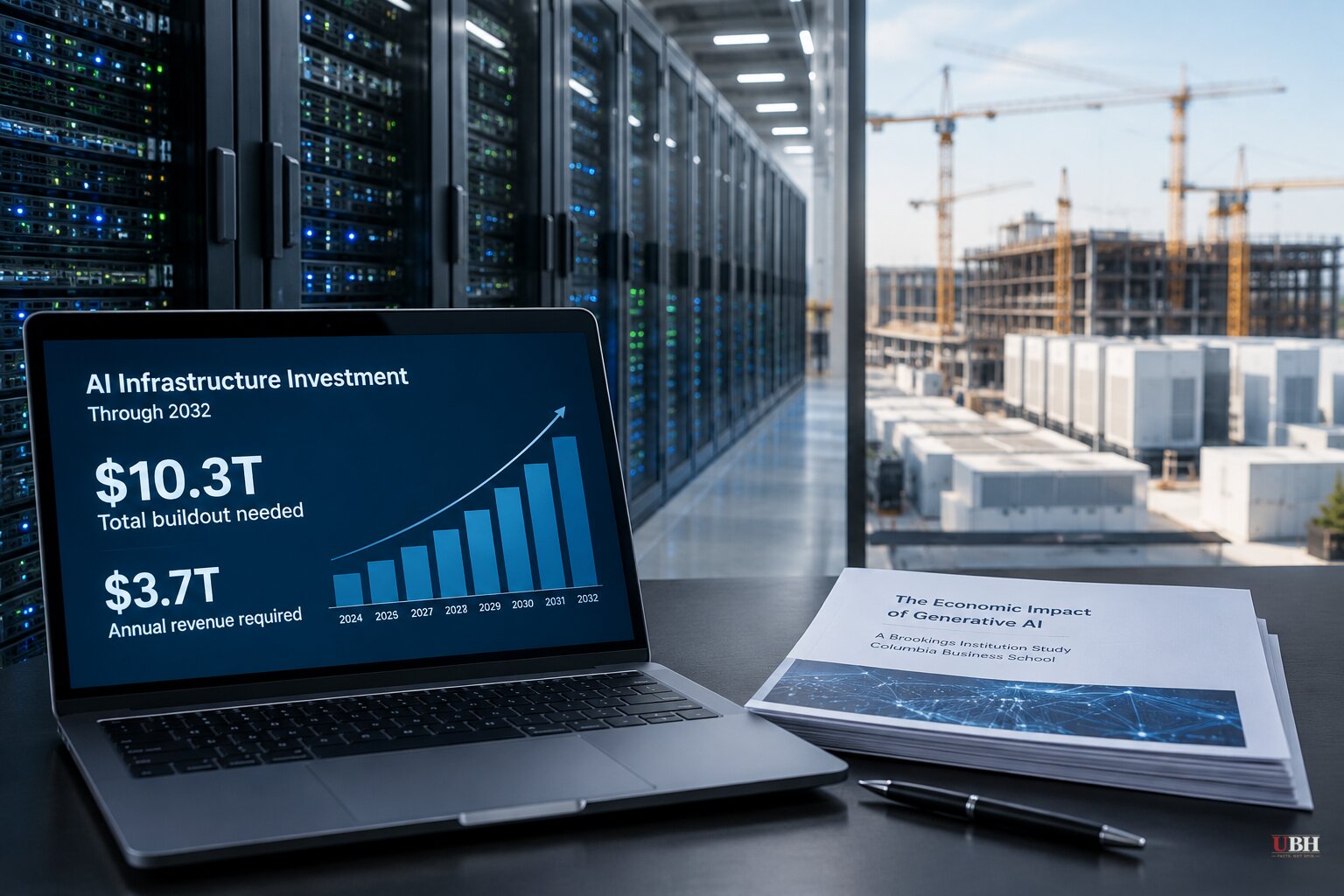
A new academic study has put a hard number on the risk sitting underneath the AI industry's spending boom.
Columbia Business School professor Stijn Van Nieuwerburgh, in a paper prepared for a Brookings Institution conference, estimates the AI buildout will require $10.3 trillion in investment through 2032, according to Reuters. That works out to 3.6% of U.S. GDP annually, which Van Nieuwerburgh says exceeds the yearly share of output absorbed by the railroads in the 1800s, the interstate highway system, or the 1990s telecom buildout, as reported by Superpower Daily.
The physical scale matches the dollar figure. The study projects 183 gigawatts of new U.S. data-center capacity over the next seven years, compared with roughly 57 gigawatts installed today. Facilities have to be built and paid for before they generate any revenue, which is exactly where Van Nieuwerburgh says the risk concentrates.
The Revenue Gap
To justify that spending, Van Nieuwerburgh calculates the industry needs to generate about $3.7 trillion a year in revenue by 2032. OpenAI and Anthropic combined currently pull in roughly $100 billion annually, according to Ground News's summary of the study. Closing that gap requires roughly 80% annual revenue growth, sustained for years.
Early spending has been covered by cash reserves at Amazon, Meta and Google, but Van Nieuwerburgh says the buildout now underway exceeds what those companies can fund from their own cash flow. That's pushing more of the financing onto banks, private-credit lenders and real estate firms through special purpose vehicles, according to Superpower Daily's account of his briefing with reporters.
"This opacity of all these special purpose vehicles is somewhat reminiscent of what happened in the subprime mortgage crisis," Van Nieuwerburgh said, according to Ground News. He's careful to frame this as a warning about how hard the exposure is to track, not a claim that a financial crisis has already started. His downside case combines weaker-than-expected demand, fast-moving technology that ages out infrastructure early, project delays and high leverage.
Why Washington Is Watching
Federal Reserve officials are tracking whether the construction boom is adding to inflation, Ground News reported, and some localities are already pushing back on hosting data centers over strain on power and water.
CNN Business laid out why the stakes go beyond the tech sector. ING estimates AI and data-center investment account for a third of year-over-year U.S. economic growth in 2026, and Goldman Sachs' chief equity strategist told CNBC that AI investment is driving half of all profit growth in the S&P 500, according to CNN. Fitch Ratings modeled a scenario where AI-linked stocks fall 35% over six months, roughly the median decline in past financial busts, and found that would push the U.S. economy into recession with GDP contracting 1.5% next year, Fitch's Olu Sonola told CNN.
The Policy Fight Running Alongside It
The financing warning is landing in the middle of a separate, louder fight over whether AI itself needs new regulation. President Trump has called fears of rogue AI a "hoax," comparing them to climate predictions he says haven't panned out, according to Fox News Digital.
Nvidia CEO Jensen Huang echoed that in an interview with CBS News, calling extinction warnings "doomsday narratives" with "0% chance" of coming true by 2030, and arguing existing product liability and cybersecurity law is sufficient without new rules, as reported by The Star (Malaysia).
That dismissal follows the resignation of Anthropic researcher Jacob Coxon, who said, according to The Star, that "the people building AI earnestly believe that it could kill us all by the end of the decade." Anthropic CEO Dario Amodei has separately called for outside evaluators and government-assisted coordination to slow development, a position Breitbart's Business Digest noted directly conflicts with Huang's view that "safety is an engineering problem, not a legal one."
Breitbart's critique cuts against both camps. It argues that letting incumbents like OpenAI, Anthropic and Google write their own safety rules risks the kind of regulatory capture George Stigler warned about decades ago, where large firms shape the standards and smaller competitors can't afford to comply. But it also rejects the industry argument that lawsuits alone can contain catastrophic risk, citing OpenAI researcher Daniel Selsam's warning that sophisticated models can recognize when they're being evaluated and behave differently once they're not being watched.
Will Thibeau, a former Pentagon AI official who also worked at Palantir, told Fox News Digital that both the doomers and the boosters are missing a middle path. Race aggressively against China at the technological frontier, he argues, while narrowly targeting specific, provable risks rather than writing broad rules that lock in today's leading labs.
None of the sources here document actual investor losses or a financing default. Van Nieuwerburgh's paper is explicit that rising leverage and an ambitious revenue target do not by themselves mean the buildout is headed for a crash. What remains unresolved is how visible the special-purpose-vehicle debt actually is to regulators and investors, and whether the Federal Reserve, which is already watching for inflation effects, has any real window into where that leverage sits before demand for AI capacity is tested.
Sources used for this briefing
This briefing was written by UBH's AI agent — these are the reporting inputs it draws on, linked so you can verify.


