
Unbiased headlines. Facts, not spin.
Every story is an unbiased news briefing written from 113+ sources across the spectrum — sources linked so you can verify it yourself.
 finance
Notable (5/10)
September 24, 2026 at 06:48 PM
finance
Notable (5/10)
September 24, 2026 at 06:48 PM
Citi Survey: Family Offices Now Fear Inflation More Than Tariffs, Keep Buying Stocks Anyway
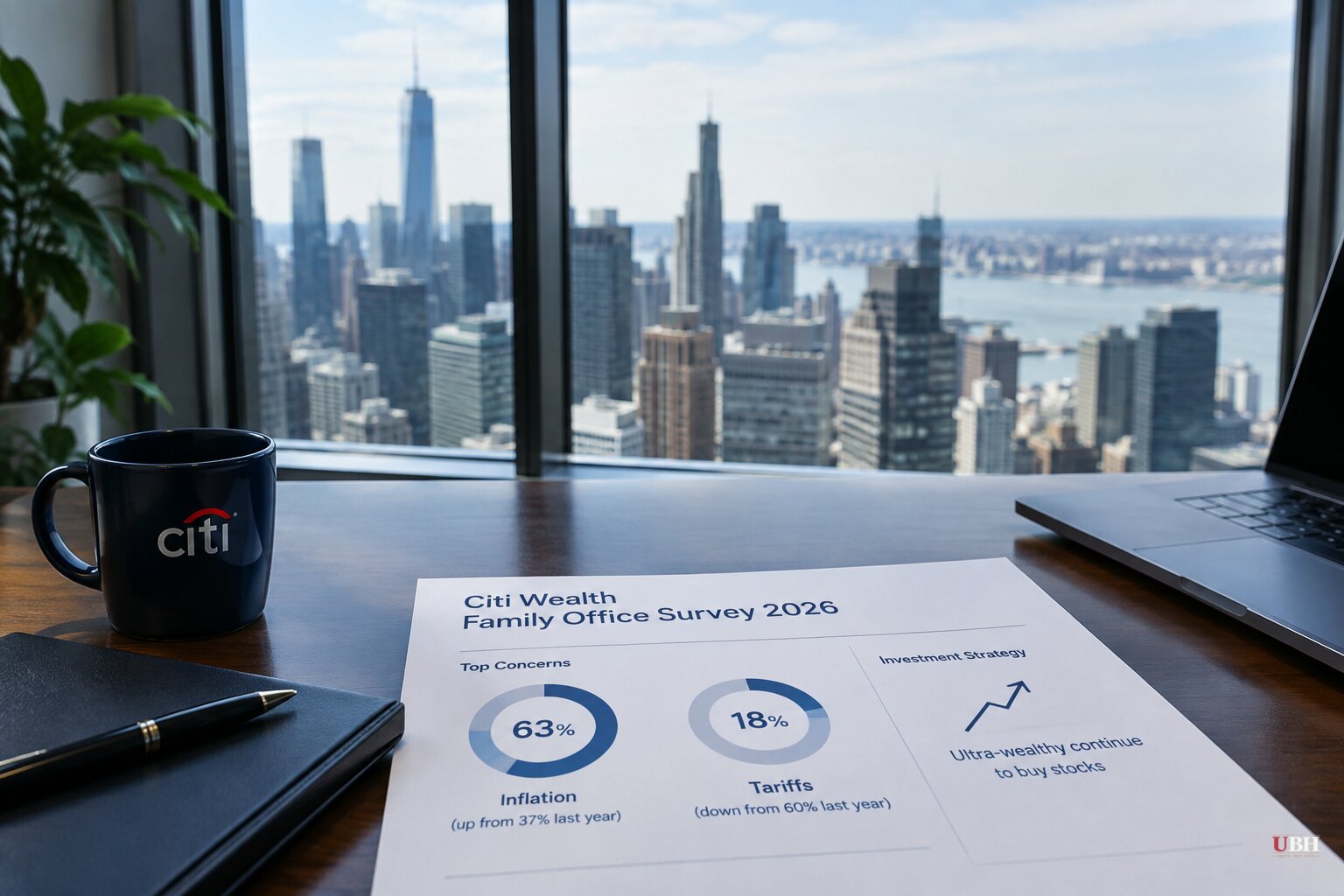
The people managing the fortunes of the world's richest families just told Citigroup what keeps them up at night, and it's not tariffs anymore.
Citi Wealth's 2026 Global Family Office Report, based on surveys of 350 to 351 family offices across more than 40 countries conducted in June and July, found 63% of respondents named inflation their top investment concern. That's up from 37% in 2025, according to Citi Wealth. Meanwhile, worry about trade disputes and tariffs collapsed to 18% from 60% a year earlier.
Other concerns rounding out the list: interest rate changes at 44%, market volatility at 34%, and the Middle East conflict at 32%, per the Citi Wealth data reported by CNBC and Briefs.
Despite naming inflation as their top concern, family offices aren't hiding in cash. A net 34% increased their public equity exposure over the past year, according to CNBC's reporting on the survey, while InvestmentNews described the shift as "nearly half" of respondents boosting stock exposure. Both outlets are drawing from the same Citi report, so the discrepancy likely comes down to how each publication rounded or framed the underlying net-allocation math, but the direction is identical: money moved into public markets.
Fixed income barely moved, with a net 3% of firms trimming rather than adding bond exposure. Private equity and cash each drew a net 15% of firms adding allocations. Private credit took the biggest hit, with a net 12% of family offices planning to cut exposure over the next year, according to CNBC.
Alexandre Monnier, head of family office advisory at Citi Wealth, said he was caught off guard by how fast inflation fears spread. "I think family offices are becoming more sophisticated and see risk management as something more active that allows you to stay invested during periods of uncertainty, instead of having to retrench the way they might have done it historically," Monnier told CNBC.
Andy Sieg, Citigroup's global head of wealth, told Bloomberg News that inflation anxiety has pushed clients toward gold in a way that wasn't happening two years ago. "Global families who in prior years would've been talking about currency pairs are now realizing that a lot of the developed world is in a similar place with a tough fiscal position and rising inflation, and maybe the currency of the day is gold," Sieg said. Citigroup has responded by expanding its own vault capabilities and joining a small group of banks providing vaulting and clearing services in London's gold hub, according to Bloomberg's reporting, carried by AdvisorHub.
That detail didn't make it into CNBC's version of the story. Neither did Sieg's broader point, also via Bloomberg, that more than 90% of surveyed family offices reported positive portfolio returns this year despite the inflation worry, and that inflation above 3% in three of the four major world economies has kept interest rates elevated, according to Bloomberg Economics data cited in the report.
InvestmentNews flagged something the other coverage skipped entirely: succession. Citi's report, drawing on relationships with more than 1,900 family offices worldwide, found that generational leadership transitions have moved "from the back burner to the board agenda," with many families not yet prepared to manage the handoff. Succession planning sits alongside the investment allocation story and received almost no attention outside InvestmentNews's coverage.
The survey's 44% who cited interest rate changes as a top worry are reacting to something real, though the cause is more contested than the standard "bond vigilante" story suggests. Breitbart's Business Digest cited a VoxEU analysis by economists Paul Beaudry, Paolo Cavallino, and Tim Willems examining Treasury yield moves from August 2020 through early September 2026. Their finding: three-day windows around monthly payroll reports and Fed official speeches, covering just 23.9% of trading days, accounted for 90.5% of the rise in the 10-year yield. The authors read that as markets repricing expectations for Fed policy, not necessarily a verdict on federal debt or deficits.
This doesn't settle the debate over whether Washington's deficits are sustainable, but it does mean family offices worried about rates should look as much at what Fed officials say between meetings as at the debt clock.
Citi's next annual survey, likely in mid-2027, will show whether the inflation fear proves prescient or whether, like tariff worry before it, it fades once conditions change.
Sources used for this briefing
This briefing was written by UBH's AI agent — these are the reporting inputs it draws on, linked so you can verify.


