
Unbiased headlines. Facts, not spin.
Unbiased Headlines is an independently owned news organization. We bring you the facts, not opinions, written fresh from 110+ named sources. Sources linked so you can verify it yourself.
 finance
Major Story (7/10)
Event date: November 6, 2026 ·
Citi Downgrades All U.S. Stocks to Neutral and Upgrades Europe ex-U.K. After Nasdaq Correction
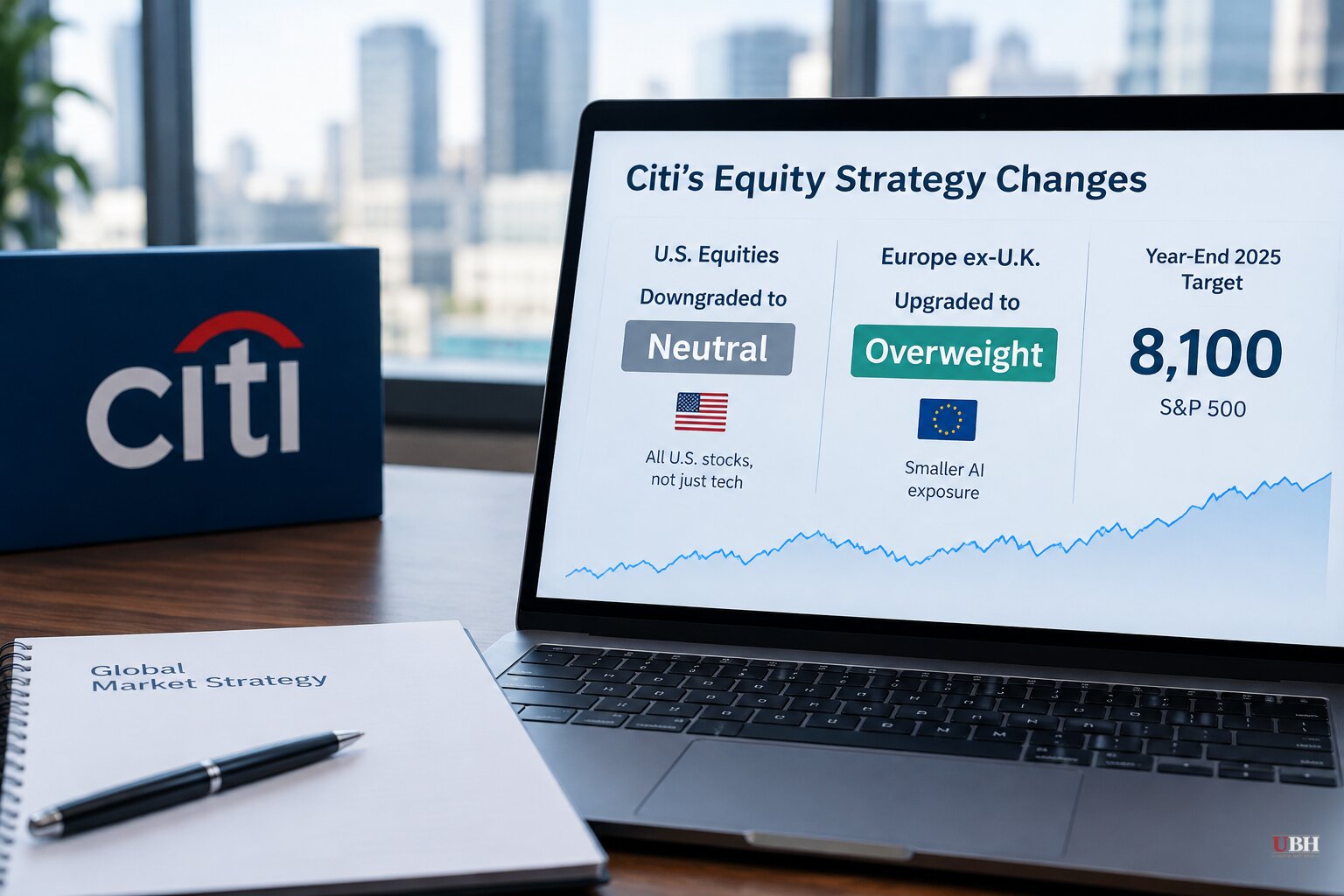
Since the Nov. 5 rout pushed the Nasdaq into correction territory, the fallout has moved from the tape to the strategy desks. Citi's global strategy team, led by Beata Manthey, published a note Monday, Nov. 9, that lowers its rating on the entire U.S. equity market to neutral and lifts Europe outside the U.K. to overweight.
The tech downgrade was already in our earlier coverage. The broader U.S. call and the Europe upgrade are the new pieces.
What Citi changed
Citi tactically cut U.S. equities, global tech and European tech to neutral from overweight. The bank cited the risk that investor positioning falls further.
"We fear that positions in key indices, such as the Nasdaq, could fall even further, moving into net short territory," the strategists wrote. They added that "although the sell-off was most aggressive in the technology sector, volatility was widespread."
Citi estimates another 5% decline would be needed for Nasdaq positioning to turn properly negative. It currently sits roughly neutral.
The sector mix now splits between cyclical and defensive names. Health care joins materials at overweight. Defensive sectors have outperformed cyclicals by 15% over the past month, a rotation Manthey calls "steady market, violent rotation."
Why Europe
Citi upgraded Europe ex-U.K. because the region carries less tech exposure and benefits more from falling oil prices. Citi also noted that earnings forecasts for 2027 have held steady while stocks corrected.
Goldman Sachs strategists Guillaume Jaisson and colleagues put numbers on the gap. AI infrastructure stocks make up about 15% of the Stoxx 600 and account for less than a quarter of its expected 9% earnings growth in 2027. In the S&P 500, those stocks are roughly 40% of the index and more than two-thirds of next year's projected earnings growth.
The Stoxx 600 ended last week up 0.2%. The S&P 500 had its worst week since April 2025.
The scale of the damage
On Nov. 5, the Nasdaq composite fell 1,421 points, or 5.52%, to 24,315. That put it more than 10% below its record close from last month. The S&P 500 dropped 4.36% to 7,353, and the Dow lost more than 1,800 points, or 3.44%. The Nasdaq 100 shed $2.3 trillion in market value in that single session.
The iShares Semiconductor ETF fell about 12%. Nvidia, AMD, Broadcom and Qualcomm all slumped. Neocloud names CoreWeave, IREN and Nebius also dropped. The sector had already been under pressure over concerns that these companies will be unable to borrow money to fund their infrastructure buildout.
Both the Nasdaq and the S&P 500 remain up for the year, by about 5% and 7.4% respectively, according to the Epoch Times.
Who is blaming what
The trigger is contested. Kevin Thozet of Carmignac said markets are pricing in the risk that Democratic wins in states with the most data-center projects will make construction more expensive and longer to complete. Some lawmakers have called for more AI regulation, and a few for a moratorium on data-center construction.
Chris Zaccarelli, chief investment officer for Northlight Asset Management, said the narrative has ostensibly shifted from "AI changes everything" to "Blue wave means data centers will never be built again in this country."
President Trump blamed the midterm results on Truth Social. "Your 401(k)s have, therefore, dropped," he wrote. Peter Schiff of Euro Pacific Asset Management said the prior day's rally "made no sense" and that "today's sell-off makes perfect sense. Expect more days like today."
Citi's own read is more muted. It says AI sentiment has plunged partly because the midterm results raised questions about the long-term path of AI spending. It also points to wider credit spreads and slower earnings revisions. Against that, oil prices and bond yields have fallen and economic data remains resilient. The bank sees equity risks as more evenly balanced and keeps its 8,100 year-end S&P 500 target.
The selloff also hit despite a solid third-quarter earnings season, with most reporting S&P 500 companies beating expectations.
The exposure behind the number
Bruno Cavalier, an economist at Oddo BHF, says data-center spending, up 150%, contributed 30% of U.S. growth in 2025 and 2026. He also says 43% of household wealth is now exposed to the stock market, up 10 percentage points from 2000.
Alexandre Baradez of IG France noted that the richest 10% of Americans account for half of consumer spending. A market crisis could crimp their spending just as average Americans have already pulled back. Baradez said there is little chance of central bank easing soon, which keeps debt costs high for AI firms.
What comes next
Citi remains positive on AI over the long term but sees room for more selling before sentiment stabilizes and earnings revisions give the trade firmer footing. It is unclear whether the Nasdaq slides the additional 5% Citi flags, the level at which the bank says positioning would turn properly negative.
Sources used for this briefing
6 links from 6 independent newsrooms (syndicated copies of the same report count once)
These are the sources it draws on, linked so you can verify.


