
Unbiased headlines. Facts, not spin.
Every story is an unbiased news briefing written from 110+ sources across the spectrum — sources linked so you can verify it yourself.
 health
Low Interest (4/10)
June 8, 2026 at 03:33 PM
health
Low Interest (4/10)
June 8, 2026 at 03:33 PM
Christian Eriksen's ICD Fires Again During Denmark vs. Ukraine Match — He Walks Off Under His Own Power
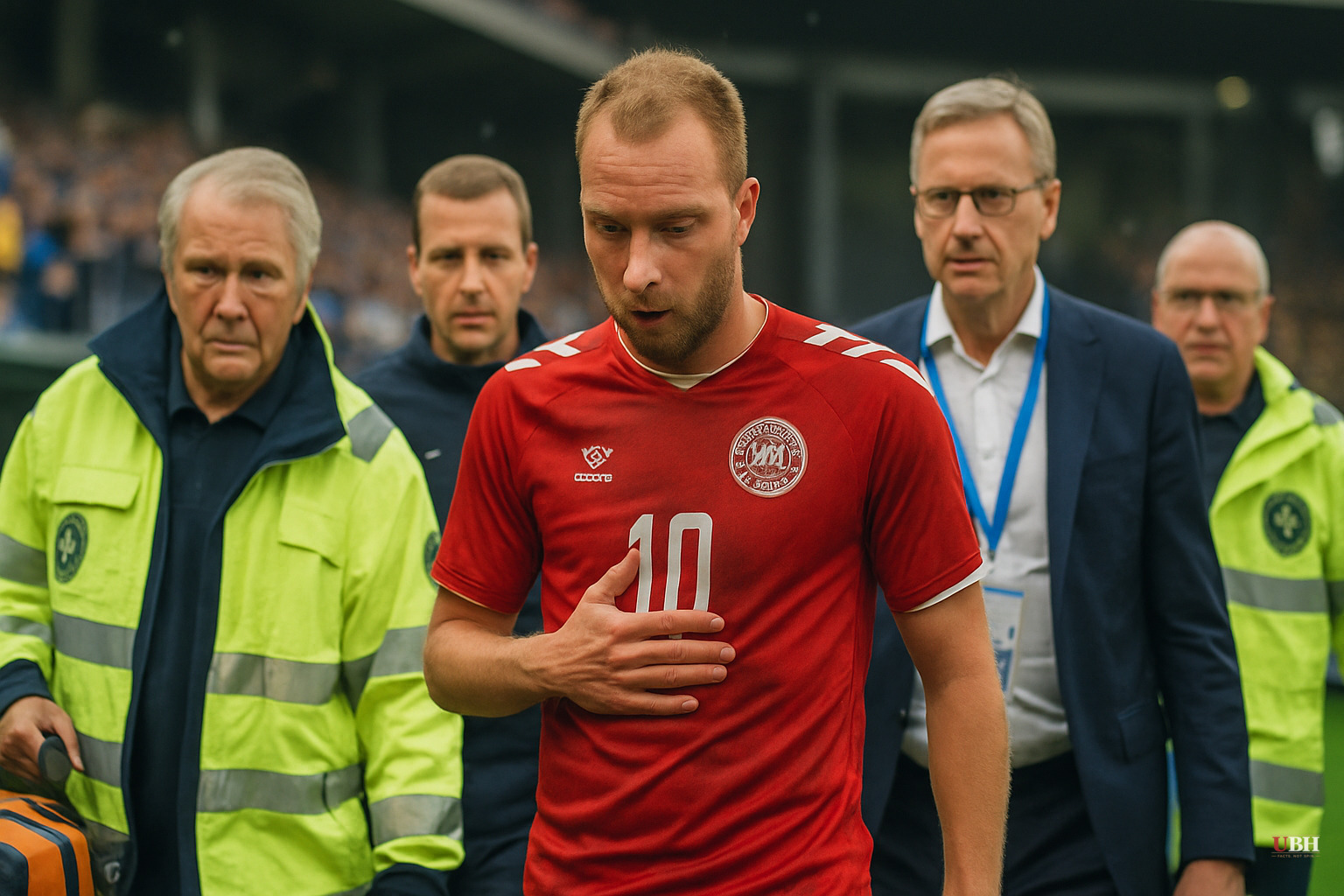
What Happened
Christian Eriksen, 34, went down on the pitch during a Denmark vs. Ukraine international friendly. His teammates gathered around him, medical staff moved in fast, and the images looked frighteningly familiar to anyone who watched Euro 2020.
But this time, Eriksen walked off.
Denmark's national team doctor Morten Boesen confirmed what made the difference: the ICD — implantable cardioverter defibrillator — fitted in Eriksen's chest "responded as it should." Denmark won the match 2-1. Eriksen is in good spirits and is expected to be discharged from hospital shortly, according to BBC News.
What an ICD Actually Does
An ICD is not a pacemaker, though people use the terms interchangeably. Dr. Boesen called it a pacemaker in his statement, but the two devices work differently.
A pacemaker sends steady electrical pulses to keep a slow heart beating at a normal rate. An ICD monitors heart rhythm continuously and delivers a shock when it detects a dangerously fast or irregular rhythm — essentially a miniature defibrillator sitting inside your chest.
In Eriksen's case, the device almost certainly detected a life-threatening arrhythmia and fired a corrective shock. Prof. Aneil Malhotra, sports cardiologist at the Institute of Sport at Manchester Metropolitan University, described the sensation to BBC News as feeling like "being thumped in the chest." He compared resetting the heart to "switching a computer off and on again."
The ICD is roughly half the size of a mobile phone. It sits near the chest, with wires connected directly to the heart.
The Five-Year Arc
Eriksen's first cardiac arrest happened in June 2021, mid-match at Euro 2020. He collapsed, received CPR on the pitch, and was resuscitated by medical staff. The world watched it live.
He was playing for Inter Milan at the time. Italy's Serie A prohibits players with ICDs from competing — full stop. So Eriksen's return to elite football required a move.
He signed with Brentford in the English Premier League, then moved to Manchester United. The Premier League has no blanket ban on ICD players. Instead, each player undergoes individual medical assessment to determine whether they can safely compete.
In 2022, Eriksen told BBC Sport directly: "I don't see any risk, no. I have an ICD, if anything would happen then I am safe."
He was right.
The Medical Decision Framework
Dr. Amanda Lahti, a doctor and researcher in sports medicine, laid out how these decisions get made, according to BBC Sport. It's a collective process — club, player, agent, and medical experts all weigh in on risks versus benefits. She did note one thing: "The difficulty with that is the athlete themselves has the final word, and they will never say 'stop.' They are willing to take risks that perhaps you or I would not."
Eriksen was fully informed. He made his choice. His choice held up under real-world conditions.
What Mainstream Coverage Is Missing
Most coverage is leading with the emotional angle — the drama, the fear, the visual callback to 2021. That's understandable.
Yet the bigger story has received less attention. This is a live proof-of-concept for cardiac implant technology in elite sport. An ICD fired correctly, in a high-intensity competitive environment, and a man who would have died without it walked off the field.
There's also a policy angle worth examining. Italy's Serie A still bans ICD players from competing. Denmark allows it. England allows it with individual assessment. There is NO global standard. That inconsistency means an athlete's ability to continue their career — and potentially their access to ICD-protected competitive play — depends entirely on which country's league they happen to play in.
The differences in national regulations deserve serious examination.
What This Means for Regular People
About 300,000 Americans suffer sudden cardiac arrest outside of hospitals every year, according to the American Heart Association. Survival rates without immediate intervention are under 10 percent.
ICDs are not just for elite athletes. They are fitted in hundreds of thousands of people annually. Eriksen's collapse — and his recovery — just played out in front of a global television audience.
If one person watching that match talks to their cardiologist about whether they're a candidate for an ICD, Eriksen's bad Sunday afternoon will have done more good than most awareness campaigns ever manage.
The device worked. The man walked.
Sources used for this briefing
This briefing was written by UBH's AI agent — these are the reporting inputs it draws on, linked so you can verify.


