
Unbiased headlines. Facts, not spin.
Every story is an unbiased news briefing written from 110+ sources across the spectrum — sources linked so you can verify it yourself.
 finance
Notable (6/10)
July 18, 2026 at 01:04 AM
finance
Notable (6/10)
July 18, 2026 at 01:04 AM
Chip Stocks Slide 10% This Week as Oil Spikes Past $80, But Bank Earnings Crush Estimates
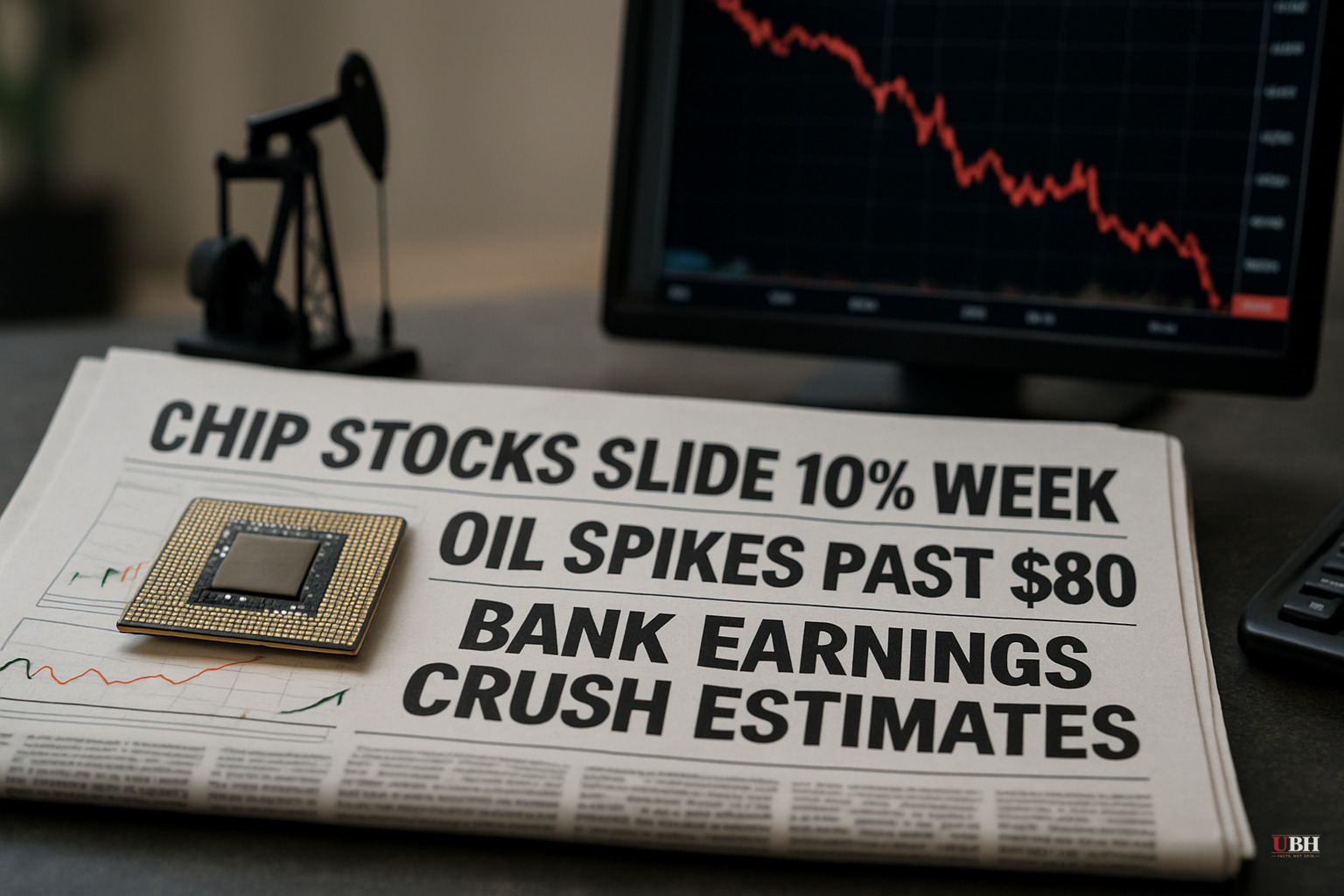
Wall Street closed out the week of July 13-17 with a split personality. Big tech and chips got beat up. Banks crushed it. And the broader market barely flinched.
The Nasdaq Composite took the sharpest hit this week as anxiety over artificial intelligence spending resurfaced, according to CNBC. The iShares Semiconductor ETF (SOXX) fell more than 10% week to date. The VanEck Semiconductor ETF (SMH) dropped nearly 9%. The Nasdaq still remains up more than 70% year to date, per CNBC's reporting. Micron Technology, despite the pullback, remains up about 200% in 2026.
IBM had its worst day in the company's history this week, CNBC reported, after warning that clients have pulled back on software spending. When a 100-plus-year-old Dow component posts its worst single day ever, it signals genuine weakness rather than routine volatility.
On the macro side, oil prices spiked back above $80 a barrel as the U.S. and Iran resumed hostilities, according to CNBC. That poses a direct threat to the inflation picture, even after a round of encouraging consumer price index data this week. Rate hikes remain on the table at the Federal Reserve, and CNBC noted the Fed has scaled back its public communication, leaving investors guessing on the path forward.
Energy costs feed directly into gas prices and shipping costs. Americans will feel that at the pump regardless of what happens on a trading screen in Manhattan.
The Banks Delivered
Corporate America is actually performing. The big banks that opened second-quarter earnings season beat expectations decisively, CNBC reported, calling it a sign of strong capital markets activity. S&P 500 companies overall are on pace to show earnings growth above 20% for the quarter, which CNBC noted is a growth rate more typical of a recession recovery than a steady-state expansion.
That's the tension driving this whole market right now. Semiconductor stocks look shaky and overleveraged in spots, particularly among retail traders using margin to chase the AI trade, per CNBC. But actual corporate earnings, the numbers that are supposed to matter most, are strong.
Mark Malek, chief investment officer at Siebert Financial, framed it as a reconciliation fight, per CNBC: 'What looks like the deteriorating macro conditions, or are stocks going to win at the end of the day?' That's an open question nobody can answer yet.
Breadth Is the Bright Spot
The equal-weight S&P 500 is beating the market-cap-weighted index by a wide margin this year, according to CNBC. This isn't just seven mega-cap tech names carrying the whole market anymore. Small caps are also outperforming, with the iShares Russell 2000 ETF (IWM) up 19% year to date.
Mark Hackett, chief market strategist at Nationwide's Investment Management Group, told CNBC that the market's calm reaction to a stack of bad news is itself the good news. His words: 'The fact that we're not reacting, is good news, because most of the potential news that's been out there, other than the CPI, has been potentially problematic.'
That's a fair read, but it cuts both ways. A market that shrugs off an actual shooting war affecting oil prices, a historic single-day collapse in a Dow component, and a 10% weekly slide in an entire sector could be showing resilience built on strong fundamentals. Or it could be showing complacency that hasn't caught up to the risk yet. Both are legitimate readings of the same data, and CNBC's framing leans toward the optimistic case without fully weighing the alternative.
What's Next
The test comes in the week ahead. More S&P 500 companies report second-quarter results, and traders will be watching whether the earnings strength that lifted the banks extends to the tech and industrial names still on deck. If oil holds above $80 a barrel and the Fed stays quiet on rate guidance, expect the volatility in chip stocks to keep bleeding into the broader tape.
The unresolved question is straightforward: does 20%-plus earnings growth from the S&P 500 justify current valuations if the Iran situation escalates further and pushes oil higher, or does the market need an actual macro shock before investors reprice risk. Nobody, including the strategists quoted here, has a firm answer yet.
Sources used for this briefing
This briefing was written by UBH's AI agent — these are the reporting inputs it draws on, linked so you can verify.


