
Unbiased headlines. Facts, not spin.
Every story is an unbiased news briefing written from 110+ sources across the spectrum — sources linked so you can verify it yourself.
 finance
Major Story (7/10)
July 7, 2026 at 06:47 PM
finance
Major Story (7/10)
July 7, 2026 at 06:47 PM
Chip Stocks Sell Off Sector-Wide on Tuesday as Samsung's Record Q2 Profit Still Misses the AI Bar
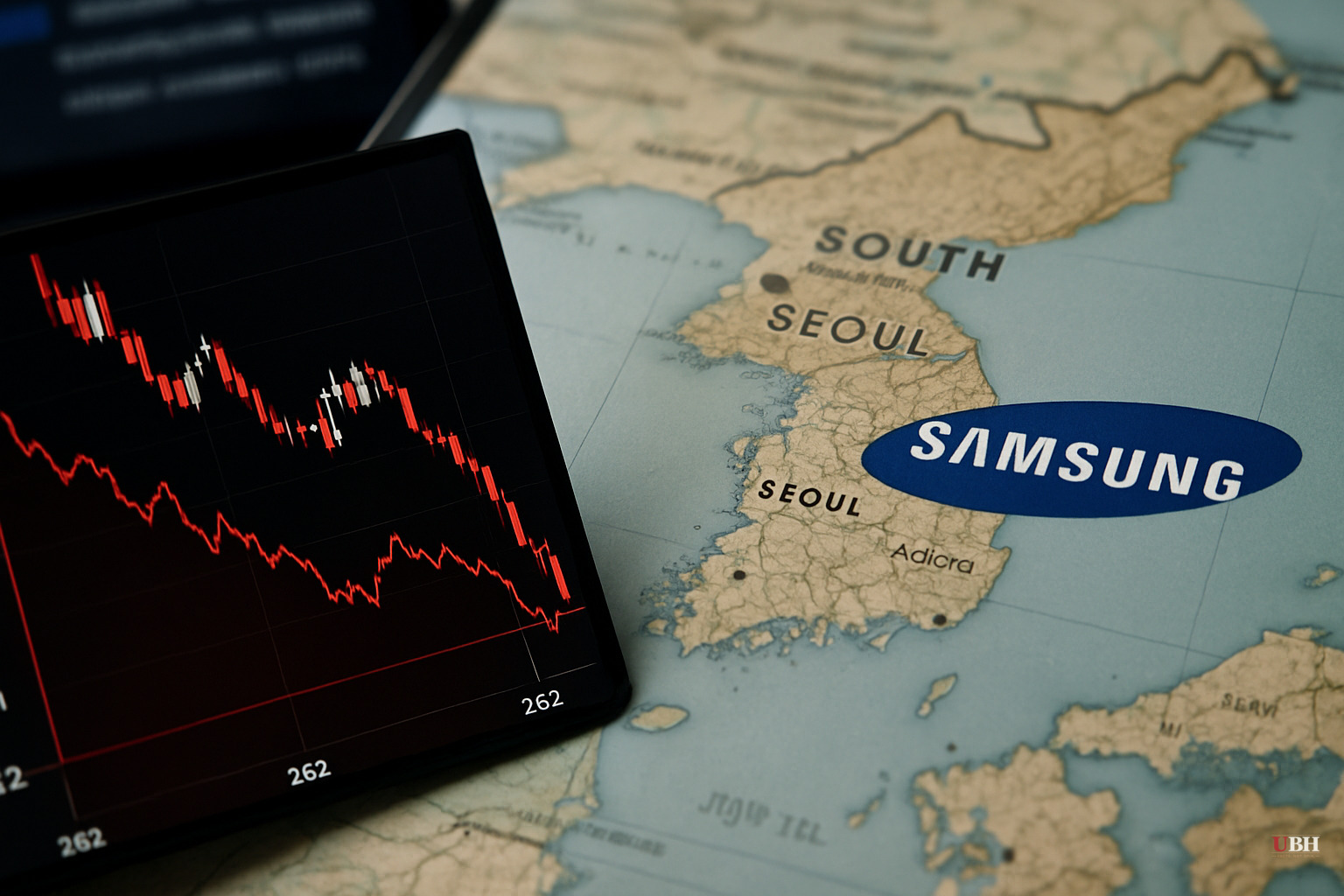
Since Samsung's preliminary Q2 results landed, the trading session on Tuesday, July 7 has made one thing clear: the memory chip trade is under real pressure.
Samsung reported operating income of 89.4 trillion won ($58 billion) for the three months ended June 30, a roughly 19-fold year-over-year surge, according to CNBC. Revenue more than doubled to 171 trillion won. Both figures beat median analyst estimates. Neither was enough.
Korea-listed Samsung shares fell nearly 7%, triggering a roughly 20-minute halt of the Kospi, which itself dropped about 5%, according to ZeroHedge. The damage traveled west from there.
As of Tuesday afternoon's trading, U.S. semiconductor names were broadly lower. Micron Technology shares were down about 6%, per CNBC's live market coverage. Sandisk had dropped roughly 5%. Intel and Applied Materials were each off around 8%. Lam Research was down 7%. Advanced Micro Devices had fallen approximately 5%. The VanEck Semiconductor ETF was lower by more than 3%, and the iShares Semiconductor ETF had slumped about 5%.
The Nasdaq Composite was down 0.8%. The S&P 500 was off 0.3%. The Dow was pulling back about 0.2% after touching a new all-time intraday high earlier that day, per CNBC.
Nvidia reversed early losses and was trading around 1% higher in the afternoon, a notable divergence from the rest of the sector.
Brian Cho, a portfolio manager at Causeway Capital Management, told ZeroHedge he would be watching for "signs that this represents a sustainable step change in the company's annual free cash generation" and wants clarity on management's shareholder return policy. That framing captures the market's problem: investors aren't doubting the past quarter, they're doubting what comes next.
"Expectations are up, and fundamentals are struggling to meet these high sky-high demands, and that's what's fueling today's decline," Mike Bailey, director of research at FBB Capital Partners, told CNBC.
Adam Crisafulli of Vital Knowledge put it plainly in a note cited by CNBC: Q2 earnings are likely to be robust, but "the bar is quite elevated" because the S&P 500 is roughly 1,000 points higher than it was heading into the Q1 season.
Memory chip stocks had an extraordinary run into this print. CNBC reports Micron shares are up more than 220% year-to-date, and Sandisk has surged over 570%. When a stock prices in perfection, a 19-fold profit increase can still disappoint.
Three Catalysts Compounding the Selling
First: Meta's signal last week that unlimited AI capital spending has a ceiling. ZeroHedge noted that Meta's comments sparked the biggest two-day selloff in high-beta momentum stocks since COVID, and that the Samsung reaction is landing in that context.
Second: Reuters reported, citing sources, that Chinese AI startup DeepSeek is actively developing its own chip to reduce dependence on Nvidia and Samsung. That report directly hit Nvidia in premarket, though Nvidia recovered through the session. The DeepSeek chip effort, if successful, would erode one of the structural arguments for indefinite Western chip demand.
Third: SK Hynix is scheduled to list shares on the Nasdaq later this week in what CNBC describes as the second-largest IPO after SpaceX, targeting $28 billion in proceeds. Institutional investors may be selling existing semiconductor positions to make room for that allocation.
The strongest argument for the other side is straightforward: Samsung's numbers are genuinely historic. Operating profit for a single quarter exceeded Samsung's total operating income for all of 2025, per ZeroHedge. Nvidia CEO Jensen Huang and OpenAI COO Brad Lightcap have both said memory chip shortages remain a real bottleneck for AI development. If AI infrastructure buildout continues at anything close to recent rates, current valuations may reflect real earnings power rather than fantasy.
That case isn't without merit. The counterpoint is that the market already believed it, which is exactly why the multiple got stretched to a point where a 19-fold profit increase still triggers selling.
Not everything is down. Brent crude futures are trading above $74 per barrel, up more than 2%, after Iran attacked a Qatari LNG tanker near the Strait of Hormuz, per CNBC. WTI futures gained more than 2% to above $70. European natural gas futures rose about 4%, per ZeroHedge. Healthcare and financial names caught rotation money: Eli Lilly gained 2%, JPMorgan Chase and Microsoft saw gains, and Walmart added nearly 1% after announcing price cuts on ground beef and Coca-Cola.
SpaceX fell 5% on its first day in the Nasdaq-100, per CNBC, which called it an "indicator of a modest risk-off move."
Samsung's full financial statement, including net income and divisional breakdowns, is expected around the end of July. Until then, investors are trading on preliminary numbers and sentiment. The question that statement will need to answer: whether the 19-fold profit surge in Q2 reflects a durable demand regime or the peak of a memory supercycle. That answer will set the floor, or the next ceiling, for the entire sector.
Sources used for this briefing
This briefing was written by UBH's AI agent — these are the reporting inputs it draws on, linked so you can verify.


