
Unbiased headlines. Facts, not spin.
Every story is an unbiased news briefing written from 110+ sources across the spectrum — sources linked so you can verify it yourself.
 finance
Notable (6/10)
July 2, 2026 at 04:54 AM
finance
Notable (6/10)
July 2, 2026 at 04:54 AM
Chip Stocks Open Q3 with a Brutal Selloff, Dragging Asian Markets Down with Them
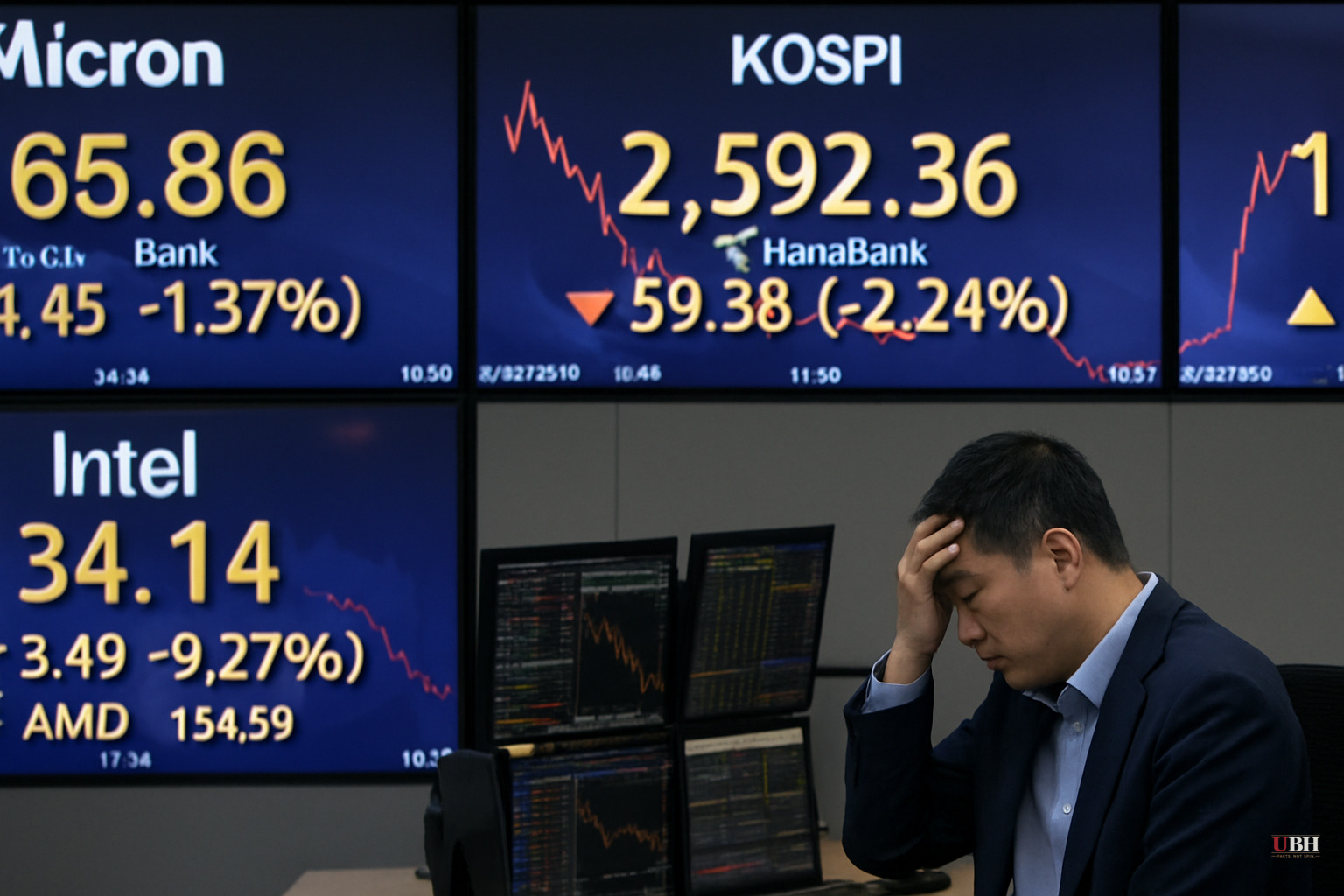
Since the chip sector's record-setting second quarter closed on June 30, the reversal has been swift and wide.
Wednesday's Wall Street session hit memory and equipment makers hardest. Micron Technology fell 11%, erasing $138 billion in market capitalization, according to CNBC. This came despite a 260% gain year-to-date heading into Q3. Intel dropped 9%, AMD shed 7%, and equipment names Lam Research, KLA Corp., and Applied Materials all fell at least 10%. The VanEck Semiconductor ETF (SMH) closed down more than 5%, one day after posting its best quarter ever — a 71% gain from April through June.
Nvidia and Broadcom were not spared, each falling between 1% and 2%.
What Spooked the Market
One concrete catalyst, reported by CNBC, was a report that Meta may be looking to rent out excess AI computing capacity to third parties. That raised a pointed question across trading desks: is AI infrastructure supply starting to catch up to demand?
The market's reaction to Meta itself was the opposite. Meta's stock rose more than 9% on Wednesday. Analysts at KeyBanc Capital Markets wrote in a client note that the move positions Meta "more into the enterprise side of the market, which could provide more immediate" return on investment.
Richard Saperstein, chief investment officer at Treasury Partners, told CNBC's "Closing Bell" that he would "stick with the hyperscalers," arguing that "earnings are accelerating, yet multiples are compressing." He attributes this dynamic to the market re-rating AI infrastructure companies as capital-intensive and asset-heavy rather than asset-light.
Micron's most recent quarterly results, reported last week, showed revenue more than quadrupling year-over-year, with gross margins improving sharply from the same quarter a year prior. The fundamentals did not crack. What cracked was the multiple investors were willing to pay on top of those fundamentals.
The Seoul Ripple
Overnight, the selloff crossed the Pacific. Samsung Electronics fell more than 7% at Thursday's open in Seoul, and SK Hynix dropped over 9%, according to CNBC. SK Square, SK Hynix's largest shareholder, lost more than 10%. South Korea's benchmark Kospi index was dragged lower across the board.
The timing is notable. SK Hynix CEO Kwak Noh-jung held a public briefing in Asan on Thursday morning, announcing a 100 trillion Korean won ($64.37 billion) domestic investment plan. The bulk — 80 trillion won — goes toward the M17 advanced memory fabrication plant, with construction beginning next year and operations targeted for the first half of 2029 in the Chungcheong region. Another 20 trillion won is earmarked for the P&T7 facility to expand advanced chip packaging capabilities.
Kwak also outlined plans to build AI data centers across South Korea, starting at 5 gigawatts of capacity and scaling to 15 GW. This announcement comes days after the South Korean government unveiled national semiconductor initiatives calling for Samsung and SK Hynix to invest a combined 800 trillion won in the country's chip ecosystem.
SK Hynix announced one of the largest domestic industrial commitments in South Korean history on the same morning its stock was selling off sharply. The market, at least for now, was not in a mood to reward the news.
SK Hynix is also scheduled to begin trading American depositary receipts on the Nasdaq on July 10.
The Bear Case Deserves a Fair Hearing
Chip valuations heading into Q3 had priced in a near-flawless execution of the AI buildout for years to come. Any signal — even a secondary one like Meta renting out spare compute — that the demand curve might flatten sooner than expected is enough to trigger repricing at these multiples. When a stock like Micron is up 260% in a single year, there is almost no earnings beat large enough to justify the valuation if forward demand softens even modestly.
That concern is legitimate and it has not been resolved by Wednesday's session alone.
What the fundamentals do argue is that the underlying business remained strong through Q2. Micron's sharply improved gross margins and quadrupled revenue aren't phantom numbers. The question isn't whether the business is healthy today. It's whether the capital pouring into AI data centers sustains the kind of demand that justifies building a new $64 billion fab in South Korea right now.
The Open Question
SK Hynix's M17 plant won't produce chips until the first half of 2029. That is a three-year bet that AI-driven memory demand will remain robust enough to absorb a massive new supply wave. If Meta's move to monetize idle compute turns out to be an early signal of softening hyperscaler demand rather than a one-off business pivot, that timeline could look very uncomfortable by the time the first wafer comes off the line.
Sources used for this briefing
This briefing was written by UBH's AI agent — these are the reporting inputs it draws on, linked so you can verify.


