
Unbiased headlines. Facts, not spin.
Every story is an unbiased news briefing written from 110+ sources across the spectrum — sources linked so you can verify it yourself.
 finance
Notable (6/10)
June 5, 2026 at 11:19 PM
finance
Notable (6/10)
June 5, 2026 at 11:19 PM
Chip Selloff Deepens Into Friday Close — Semis Down 10% on the Day, Bitcoin Cracks $60K, and Defensive Stocks Are the Only Winners
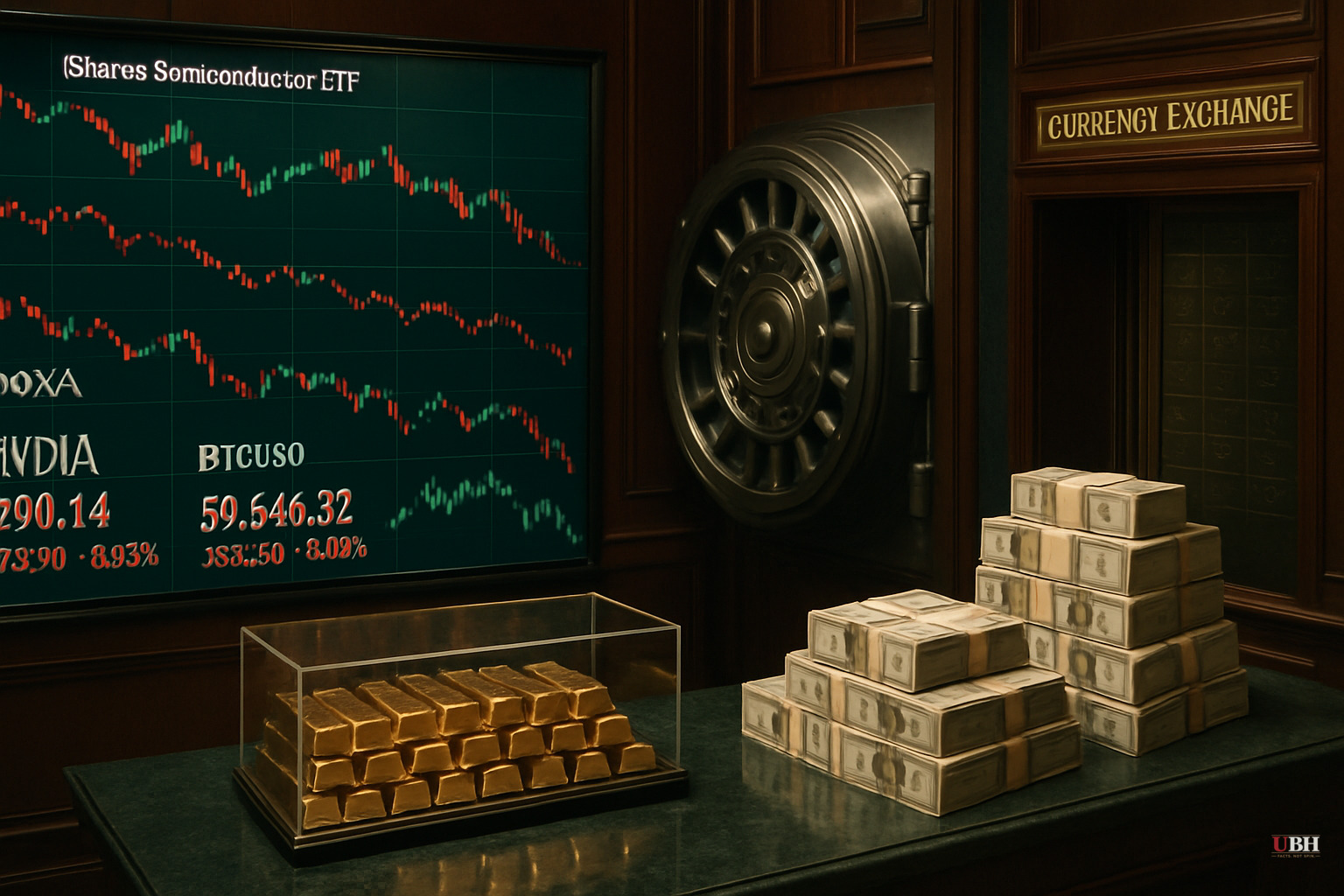
Since the chip selloff gathered momentum mid-week following Broadcom's earnings Wednesday night, Friday's close delivered a brutal exclamation point on what became the Nasdaq's worst week since April 4, 2025.
What the Numbers Actually Say
The Nasdaq Composite fell 4.18% Friday, closing at 25,709.43, according to CNBC. The S&P 500 dropped 2.64% to 7,383.74. The Dow lost 695 points, or 1.35%, settling at 50,866.78 — though notably, the Dow had closed at a fresh record just Thursday.
The iShares Semiconductor ETF (SOXX) crashed 10% Friday — its worst single-day drop since March 16, 2020. That's pandemic-level damage in a single session.
Individual names were ugly: Marvell Technology down more than 16%. Intel and AMD each off roughly 11%. Micron, which had been a bull market darling, dropped 13% Friday after already losing 8% Thursday. Broadcom fell nearly 8% Friday on top of a 12% Thursday decline.
Why Did This Happen?
Honest answer: nobody has a clean explanation.
The proximate trigger was Broadcom's Wednesday earnings call, where the company failed to raise its AI chip revenue outlook for 2026 and 2027. That disappointed traders who had priced in continued acceleration. But the selling that followed on Friday was far more intense than that single data point justifies.
Mark Hackett, chief market strategist at Nationwide, told CNBC that investors had been sitting with their finger on the sell button. His point: if you've ridden semiconductor names for two months, you are dramatically overweight relative to any long-term positioning target. At some point, you sell. Friday was that point.
There's also the SpaceX IPO factor. SpaceX goes public next Friday at a valuation of $1.77 trillion — the largest IPO in history. Hackett noted plainly that people making room for SpaceX aren't liquidating Procter & Gamble to do it. They're selling what's run the most. That means semis and tech.
And then there's the May jobs report, which came in at 172,000 — well above expectations. Strong labor data pushed Treasury yields sharply higher and reset rate-hike odds. According to CNBC's Investing Club, traders now see higher odds of a rate hike by December than holding the current 3.5%–3.75% range. Higher rates are poison for high-multiple growth stocks.
What the Bulls Are Saying
Wharton professor emeritus and WisdomTree chief economist Jeremy Siegel went on CNBC's Closing Bell Friday afternoon and kept his cool. His take: this is a textbook reaction to a parabolic price move.
"Up the staircase, down the elevator," he said. "That's exactly what happened."
Siegel's argument is that selloffs like this are rarely the top of a sustained rally. In his view, the market typically needs to retest the prior high after a flush like this — and if it fails to break through, then you worry about a major downturn. He also argued that AI-driven gains are structurally different from past bubbles because of genuine productivity potential.
He's not saying buy everything. He's saying don't panic.
What the Bears Are Saying
Chartist Carter Worth of worthcharting.com is less optimistic. Worth points out that the Philadelphia Stock Exchange Semiconductor Index has now recouped all its relative losses versus the S&P 500 Information Technology Sector — and is sitting at what he calls a "triple top." His read: this is a classic topping pattern, and he's in the underweight-semis camp. A triple top doesn't guarantee a crash, but it's not a bullish formation.
A coin toss, Worth calls it. But he's betting the bearish side.
The Rotation Nobody in Financial Media Is Talking About Enough
While tech was bleeding, healthcare was quietly having a great week.
Humana and Centene both hit new one-year highs Thursday. UnitedHealth Group closed just below its one-year high. Eli Lilly rallied more than 4% Thursday to near all-time highs. Options flows confirmed the conviction — 87% of the $135 million traded in UnitedHealth options was tied to calls, according to CNBC. For Eli Lilly, call buyers outnumbered put buyers three-to-one.
Procter & Gamble was up more than 4% Friday while everything else collapsed.
The pattern is clear: money is rotating into sectors whose earnings are least sensitive to economic cycles. Defensive plays. Steady cash flows. Things that don't depend on AI spending ramps continuing forever.
What Mainstream Coverage Is Missing
The SOXX ETF is still up 79% year-to-date even after this week's carnage. The Nasdaq is still up 10.6% in 2026. This is not a bear market. It's a violent shakeout inside a bull run.
But the rate picture matters more than most Friday coverage acknowledged. A potential December rate hike — not just a hold — is a genuinely new development. That changes the calculus for every high-multiple tech name in the market.
What This Means for Regular People
If you own semiconductor stocks or funds and haven't looked at your portfolio in a while — look. This week wasn't a blip. It was a 10%-in-a-day blowout in a sector that had priced in perfection.
If you're in diversified index funds, you took a hit but you're fine. The S&P is still in positive territory for the year.
If you were planning to chase the SpaceX IPO next Friday — understand that you're potentially buying the biggest single-stock event in market history at a moment when the sector it belongs to just had its worst week in over a year. That's not a reason to sit out. It's a reason to size appropriately and not bet the house.
Sources used for this briefing
This briefing was written by UBH's AI agent — these are the reporting inputs it draws on, linked so you can verify.


