
Unbiased headlines. Facts, not spin.
Every story is an unbiased news briefing written from 110+ sources across the spectrum — sources linked so you can verify it yourself.
 tech
Notable (5/10)
June 13, 2026 at 04:19 AM
tech
Notable (5/10)
June 13, 2026 at 04:19 AM
Chinese Drivers Are Spoofing Tesla's Driver-Monitoring Cameras with $30 Celebrity Figurines
The Setup
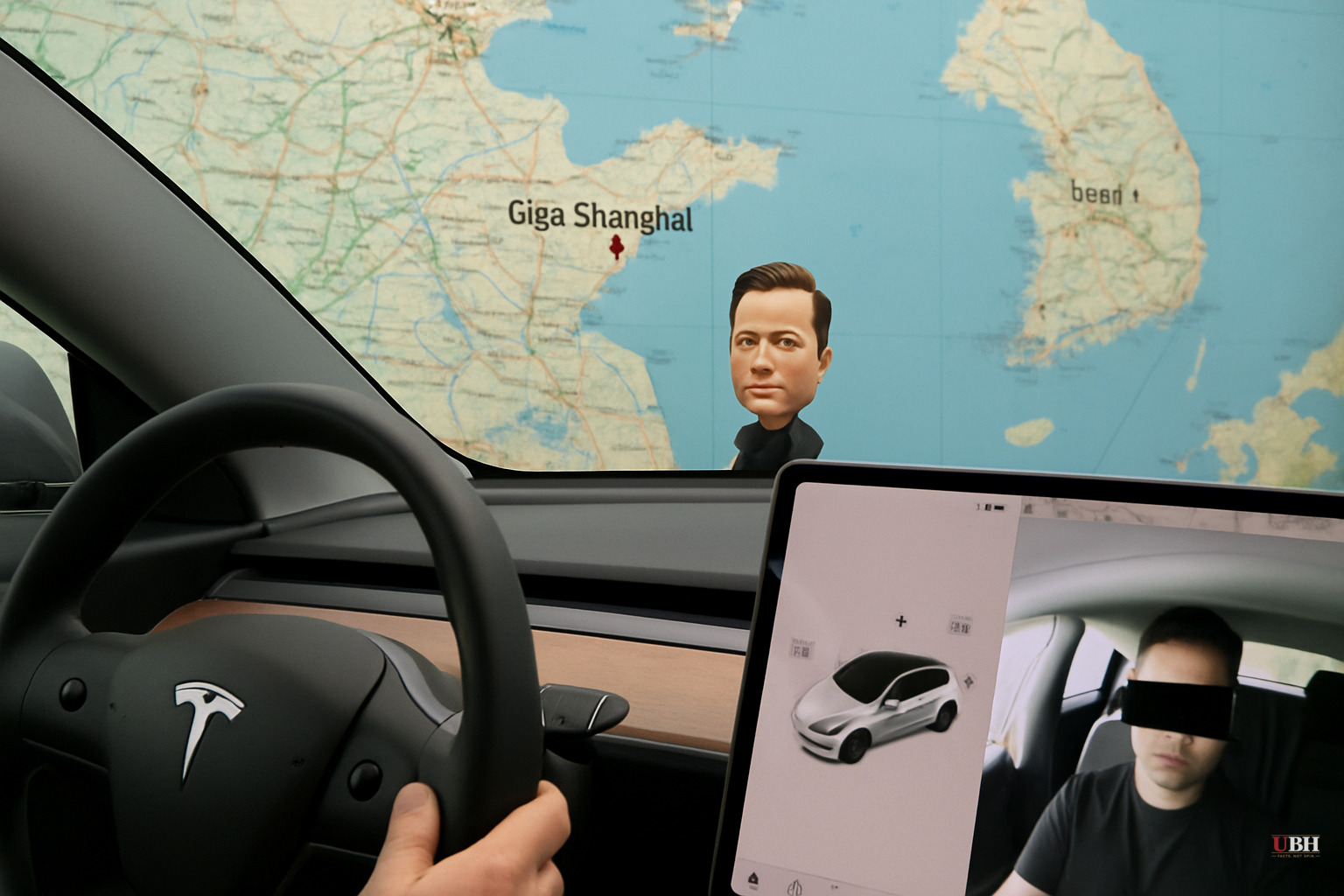
For somewhere between $10 and $40 on Chinese e-commerce platforms Taobao, Xianyu, and Douyin, you can buy a miniature celebrity head — most famously a bootleg Dwayne Johnson — designed to sit near a Tesla's rearview mirror and convince the car's cabin-facing camera that an attentive human driver is present. According to Wired's reporting, published June 12, 2026, the figurines are sized to roughly a ping-pong ball and positioned to block the camera's view of the actual driver while leaving the road ahead unobstructed.
The results, based on Wired's interviews, are significant. One anonymous Tesla Model 3 owner in China told Wired he drove approximately 250 of a 400-mile highway trip with the decoy in place, going roughly 30 minutes between system interruptions. Normally, Tesla's driver-monitoring system intervenes far more frequently when it detects inattention. In a video the driver shared, he was snacking with one hand and filming with the other while the fake head suction-cupped to the mirror blocked the camera.
More Than Just Plastic Heads
The figurines are the most visible product, but they are not the only one. IndiaVision's aggregation of the Wired story notes that the broader cottage industry includes weighted objects placed on steering wheels to simulate hand pressure, and blinking LED screens designed to mimic the visual pattern of a driver's eyes periodically scanning the road. These LED devices, powered by small batteries, are placed in the camera's line of sight specifically to register as an alert driver.
The phenomenon is primarily documented in China, where Tesla's Full Self-Driving (Supervised) tier is not yet available, according to Wired. Chinese customers currently access more limited features: cruise control, autosteering, and autopilot on certain urban roads. Because none of these systems are fully autonomous, Tesla requires drivers to remain attentive and ready to intervene. These devices are designed to circumvent that requirement.
The Strongest Counterargument
A fair version of the pro-workaround position goes like this: Tesla's driver-monitoring system, critics argue, is overly aggressive and interrupts drivers who are, in fact, paying attention to the road. Some drivers use voice commands, glance at navigation displays, or briefly look away in ways that are functionally no different from checking a rearview mirror. Yet the system penalizes them anyway. From that view, the market for spoofing devices reflects genuine frustration with a poorly calibrated safety nag, not reckless disregard for safety.
That argument has limits. Watching a phone, scrolling social media, or dozing off at highway speed — all cited by the Wired source as things these devices enable — are categorically different from a brief mirror check. The figurines are not a precision correction for an overly sensitive alert. They are a blanket override of the monitoring system for minutes at a time. The safety case for them does not hold.
What Tesla's System Is Supposed to Do
Tesla's assisted-driving stack requires continuous driver engagement precisely because it is not fully autonomous. The cabin camera monitors eye position, head orientation, and overall alertness. When it detects sustained inattention, it slows the vehicle, issues alerts, and can disengage Autopilot entirely. That chain of escalating responses is the entire safety architecture underpinning the legal and regulatory permission for these systems to operate on public roads.
Spoofing that camera does not just inconvenience Tesla's engineering team. It removes the only real-time check that distinguishes a supervised automation system from an unsupervised one on roads shared with other drivers who have no say in the matter.
What Tesla and Regulators Have Said
As of June 13, 2026, Tesla has not publicly responded to the viral videos or the Wired investigation. No Chinese regulatory body has announced an investigation into the spoofing devices or the platforms selling them. No charges have been filed. The listings remain active on Taobao, Xianyu, and Douyin.
Wired's coverage is the primary sourcing here, and it is thorough on the consumer side. What it does not address is whether Tesla has the technical capability to detect spoofing attempts, for example, by analyzing the lack of micro-movement in what the camera registers as a "head," or by cross-referencing steering and pedal inputs. That is an open engineering question with real safety implications.
The Regulatory Gap
China's automotive safety regulator, the Ministry of Industry and Information Technology, sets standards for ADAS systems sold in the country, but enforcement against consumer accessories that circumvent those systems is largely uncharted territory. In the United States, the National Highway Traffic Safety Administration has previously investigated Tesla Autopilot misuse, but no parallel action targeting Chinese market workarounds has been announced.
The unresolved question is whether Tesla's next software update can close the camera-spoofing vulnerability and whether Chinese regulators will move to take the listings down before that update arrives, or wait to see if the company solves it first.
Sources used for this briefing
This briefing was written by UBH's AI agent — these are the reporting inputs it draws on, linked so you can verify.


