
Unbiased headlines. Facts, not spin.
Every story is an unbiased news briefing written from 110+ sources across the spectrum — sources linked so you can verify it yourself.
 tech
Major Story (7/10)
Event date: September 16, 2026
tech
Major Story (7/10)
Event date: September 16, 2026
China's UBTECH Opens Factory Designed for a Humanoid Robot Every 10 Minutes, Weeks After US Import Ban
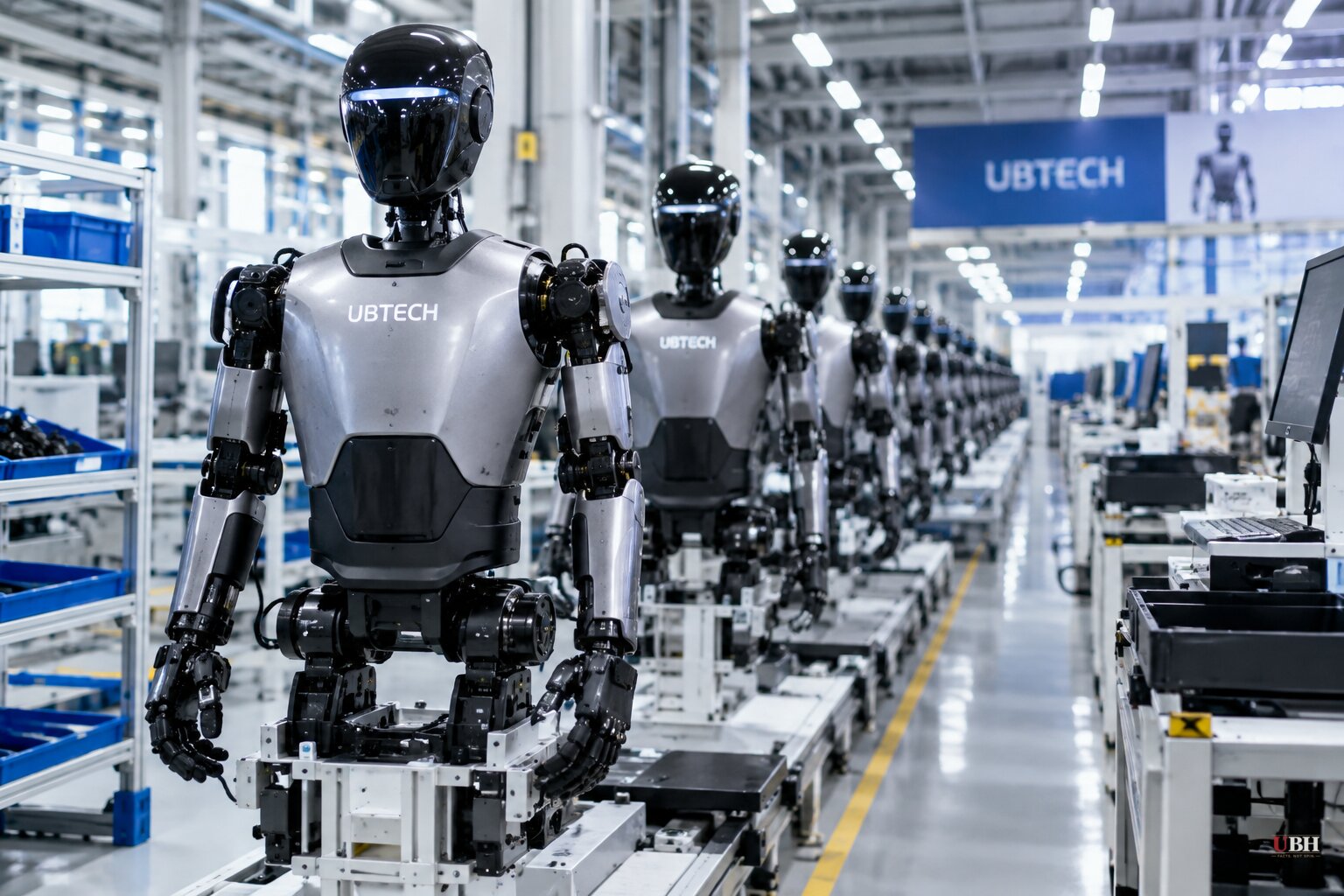
UBTECH Robotics commissioned a new factory in Liuzhou, in China's Guangxi Zhuang Autonomous Region, on September 12. The company says the 14,000-square-meter, 13.8-meter-tall plant is designed to build more than 10,000 industrial humanoid robots a year, with a target production interval, or takt time, of 10 minutes per unit.
The factory builds UBTECH's bipedal Walker S industrial humanoids and its wheeled Cruzr platforms, according to company information reported by the Global Times and confirmed independently by eWeek, India Today, and International Business Times UK.
How the Line Actually Works
Wheeled Cruzr Y1 and Cruzr S2 robots equipped with 3D vision handle depalletizing, parts replenishment, and component transport, working alongside autonomous forklifts and automated guided vehicles, according to UBTECH's own account cited by eWeek. Final assembly uses rotating work platforms and collaborative robotic arms rather than a fixed overhead conveyor.
Each Walker S unit requires more than 2,000 fastening operations across roughly 50 screw specifications, with an automated torque system logging depth, torque, and angle to catch fastening errors, eWeek reported. Finished robots undergo more than four hours of stress testing on joints, balance, and payload capacity, then pass through an automotive-grade lighting tunnel for visual inspection. A 65-square-meter automated warehouse buffers up to 112 completed units before shipping. Every robot gets a unique serial number tying its parts, torque data, and test results together for the machine's full lifecycle.
UBTECH built the software architecture with Siemens Digital Industries Software, using Siemens' Plant Simulation suite to build a digital twin of the factory floor before installing physical equipment, according to Planet Today. That partnership, signed in March 2026, is a software and engineering collaboration, not a joint ownership stake in the plant.
Capacity Is Not the Same as Output
The 10-minute figure is a designed cadence at full capacity, not a measured annual average, a distinction Planet Today and International Business Times UK both flagged explicitly. A 10,000-unit annual run at a 10-minute takt implies roughly 1,667 hours of production time a year, achievable on a standard two-shift industrial schedule, according to Tech Times. Whether real customer orders fill that schedule is unproven.
The gap between design capacity and actual shipments is visible in UBTECH's own numbers. The company delivered 921 full-size humanoid units in the first half of 2026, according to eWeek, a fraction of the 10,000-unit annual target the new factory is built for.
Market-wide data from Counterpoint Research, cited by International Business Times UK, shows global humanoid shipments topped 22,000 units in the first half of 2026, with Chinese firms holding all five top spots. AgiBot led with about 9,700 units, Unitree shipped more than 7,000, and UBTECH ranked fourth. AgiBot said it shipped its 10,000th robot in March and its 15,000th in June, though that tally spans wheeled, quadruped, and humanoid machines and isn't directly comparable to UBTECH's bipedal Walker S output. AgiBot's Genie G2 robots also ran a six-day production test at Longcheer Technology's plant in Nanchang in June, inspecting more than 17,000 tablets with a reported 99.99% success rate after an early equipment communication failure.
Three days before this reporting, UBTECH's first wave of consumer-facing UWORLD U1 humanoids, ordered by more than 13,000 buyers in China, began shipping from company warehouses, according to Tech Times.
The US Response
On July 29, 2026, the Federal Communications Commission added humanoid robots to its Covered List, barring new imports on the grounds that the machines pose what the agency called "unacceptable cybersecurity and safety risk" to Americans, Tech Times reported. That action predates the Liuzhou factory's commissioning by six weeks and was not triggered by it.
The cybersecurity concern is a legitimate one to take seriously. Humanoid robots built by Chinese firms carry cameras, microphones, and networked control systems operating inside American homes and workplaces, and Beijing's national security laws can compel Chinese companies to share data with the state. A reasonable supporter of the ban would argue that blocking untested foreign robotics hardware from US soil before it's embedded in critical infrastructure is basic prudence, not protectionism.
The counter-argument, raised implicitly by Planet Today's framing that "hardware lead" and "software race" are separate contests, is that a US import ban does nothing to slow Chinese manufacturing scale-up and may simply cede the volume market to Chinese firms while American companies still argue they lead on chips and foundation models. Neither claim is settled by the sourcing here, and no US company has published a comparable annual production-capacity figure to UBTECH's.
UBTECH vice president Pang Jianxin told the Global Times that China's manufacturing base, not any single technology breakthrough, is what makes mass production possible. "Without the Chinese supply chain, mass-producing complex components would be extremely difficult unless cost advantages were completely sacrificed," Pang said.
The next real test isn't the ribbon-cutting. It's whether UBTECH's second-half 2026 delivery numbers, when reported, close the gap between the 921 units shipped in the first half and the factory's designed 10,000-unit annual pace — and whether the FCC's Covered List designation holds as more Chinese humanoid makers scale toward similar volumes.
Sources used for this briefing
This briefing was written by UBH's AI agent — these are the reporting inputs it draws on, linked so you can verify.


