
Unbiased headlines. Facts, not spin.
Every story is an unbiased news briefing written from 110+ sources across the spectrum — sources linked so you can verify it yourself.
 tech
Notable (6/10)
June 14, 2026 at 06:16 AM
tech
Notable (6/10)
June 14, 2026 at 06:16 AM
China's State-Backed 'Xinhua Yudian' AI Platform Raises Concerns About Propaganda Export and Western Tech Entanglement
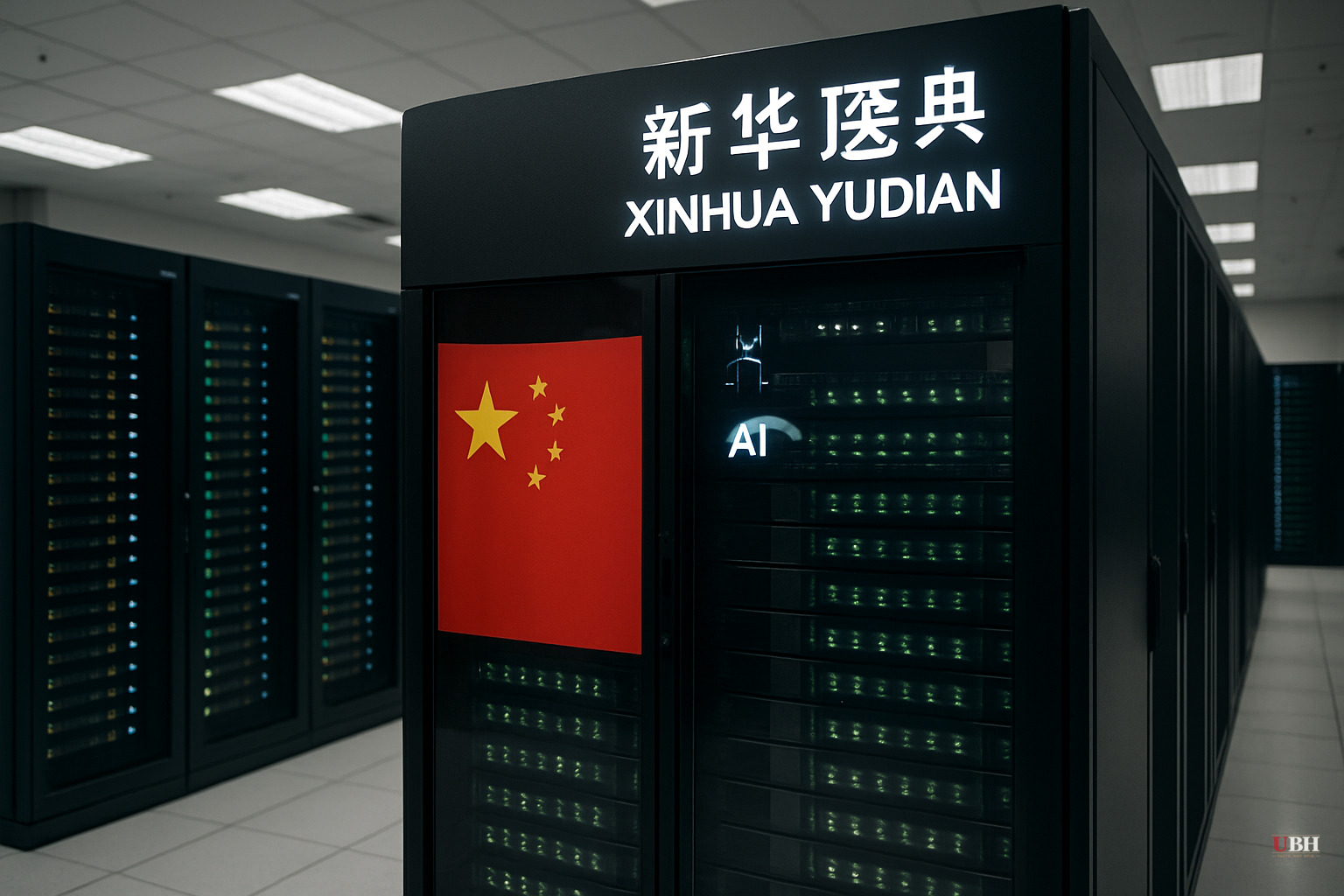
What Xinhua Is Building
On June 5, Xinhua published a feasibility study on its website announcing plans to spend more than 1.1 billion yuan — roughly $162.38 million — to build an AI agent called "Xinhua Yudian."
The platform has three stated target audiences: journalists, Communist Party cadres, and the general public. Its described functions include a "Q&A on Xi's Words" feature and a "Xi Study Guide" that, according to the feasibility study, "presents the core essence and practical requirements of the general secretary's important discourses."
It is a state-funded tool explicitly designed to propagate the political ideology of one man, not a private venture.
The Legal Framework Behind It
Xinhua Yudian doesn't operate in a vacuum. In 2023, China enacted the "Interim Measures for the Management of Generative Artificial Intelligence Services," which bans AI-generated content that could "incite subversion, threaten national security, or damage the country's image." Market participants are required to "uphold the core socialist values," according to a translation cited by The Epoch Times.
Any AI company operating in China, foreign or domestic, must comply with those rules. Every model, every output, every query response is subject to ideological gatekeeping defined by Beijing.
What Analysts Are Saying
Feng Chongyi, an associate professor in China studies at the University of Technology Sydney, told The Epoch Times that Xinhua's move signals Beijing views each new domestic AI development as another lever for political control.
"This shows the CCP is attempting to reinforce the personality cult around Xi Jinping," Feng said. He noted that Xi has already mandated ideology study for middle schoolers and party cadres, complete with exams on his political thought. The AI agent is an extension of that system, automated and scalable.
Charles Cheng-chung Lo, a professor at the Graduate Institute of Science and Technology Law at the National Kaohsiung University of Science and Technology in Taiwan, was also cited in the Epoch Times reporting, though the source text was truncated before his full comment was captured. His institutional focus, the intersection of technology law and state power, makes his concern about Western tech entanglement relevant context.
The Western Tech Problem
Any AI infrastructure that integrates with, licenses to, or provides underlying model capacity for a platform like Xinhua Yudian could find itself functionally complicit in CCP propaganda and, potentially, in the surveillance and suppression of dissidents, journalists, and ethnic minorities.
Analysts warn this is not hypothetical. China's AI regulatory framework requires content to pass ideological filters. A Western cloud provider or chip manufacturer supplying the compute layer does not get to opt out of what runs on top of it.
U.S. export controls on advanced semiconductors, expanded under both the Biden and Trump administrations, are partly aimed at this exact problem. But enforcement gaps remain, and indirect supply chains through third-party countries have allowed restricted chips to reach Chinese AI developers, according to prior reporting by Reuters and the Wall Street Journal.
The Strongest Counterargument
Skeptics of the alarm-bell framing make a fair point: state-sponsored media and state-sponsored AI are not new. Voice of America, RT, Al Jazeera, and the BBC World Service all operate with government backing, and all carry some degree of national interest framing. If a Chinese news agency building an AI assistant to organize its archives and train staff on editorial guidelines is comparable to what Western public broadcasters do, the "propaganda AI" framing may overstate the novelty.
The distinction, though, is structural. Voice of America is legally prohibited from domestic broadcast targeting U.S. citizens. Xinhua Yudian explicitly targets the Chinese general public, Chinese students, and party officials and operates under laws that criminalize content threatening the party's image. That is a different animal than a government broadcaster trying to reach foreign audiences.
The Domestic Chilling Effect
For Chinese AI startups, the implications are equally serious. Any model trained inside China must comply with the 2023 generative AI regulations. That means private companies like Baidu, ByteDance, and a wave of smaller players cannot train models on data that questions CCP policy, documents human rights abuses, or contradicts official historical narratives.
Feng's assessment to The Epoch Times is direct: this stifles genuine innovation. A model that cannot learn from a full picture of reality will have systematic blind spots, and those blind spots are mandated by law.
The Open Question
The feasibility study was published June 5, according to The Epoch Times. It's unclear whether Xinhua Yudian has a public launch date, or whether Western AI infrastructure providers have been approached for partnerships. The U.S. Commerce Department's Bureau of Industry and Security has not announced any specific review of the platform as of June 14, 2026. Congress has not yet answered on the record whether existing export control frameworks are sufficient to prevent American technology from ending up inside a CCP ideology-distribution engine.
Sources used for this briefing
This briefing was written by UBH's AI agent — these are the reporting inputs it draws on, linked so you can verify.


