
Unbiased headlines. Facts, not spin.
Every story is an unbiased news briefing written from 110+ sources across the spectrum — sources linked so you can verify it yourself.
 finance
Notable (6/10)
June 22, 2026 at 03:24 AM
finance
Notable (6/10)
June 22, 2026 at 03:24 AM
China's Shanghai Composite Slips 0.15% as PBOC Holds Rates Steady for 13th Straight Month
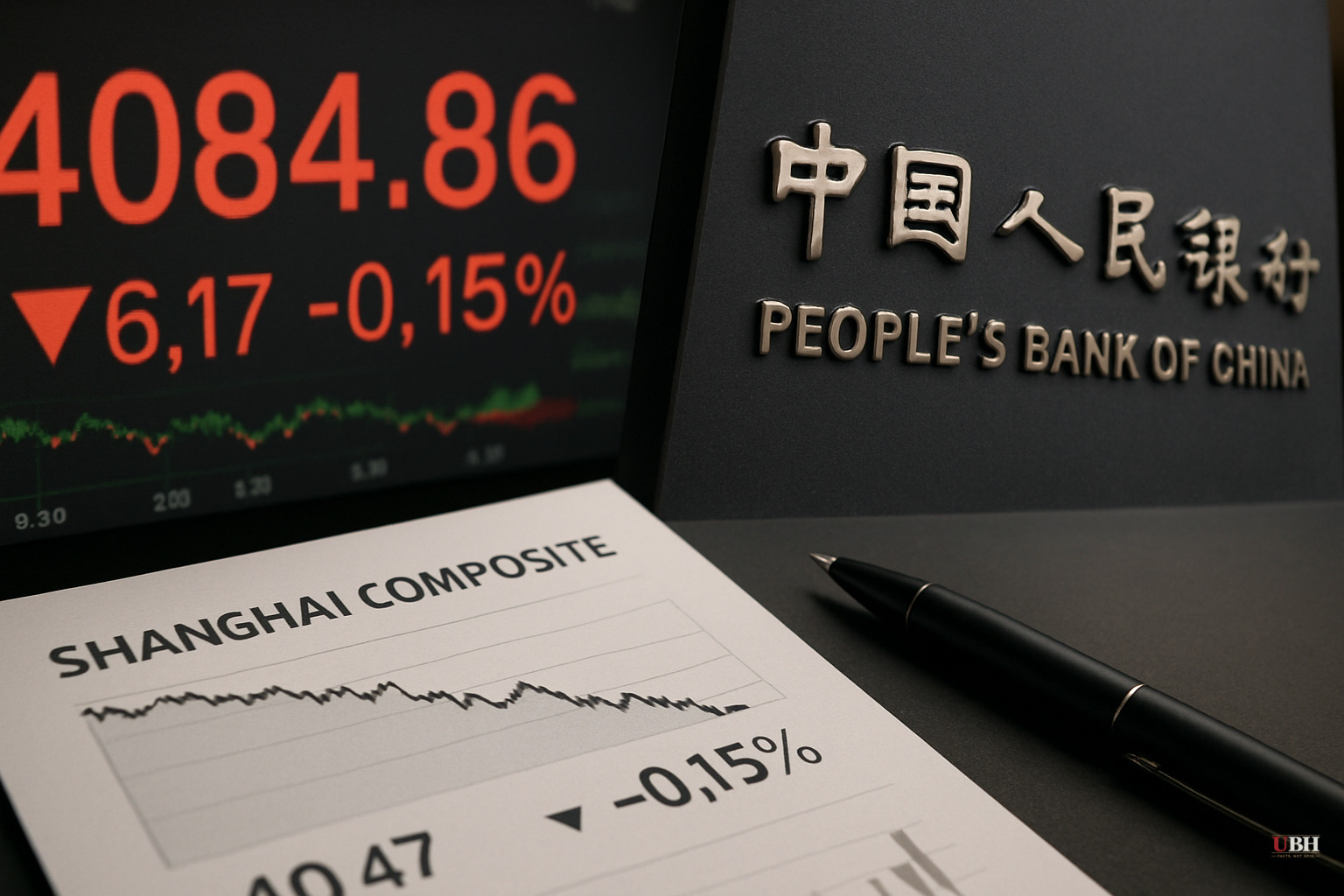
Where Chinese Markets Stand on June 22
The Shanghai Composite edged down 0.15% to 4,084 on Monday, June 22, according to Trading Economics data, while the Shenzhen Component gained 0.6% to 16,120 — a more than one-month high.
Investors returning from a holiday digested one piece of news above all others: the People's Bank of China held its key lending rates unchanged for the thirteenth consecutive month.
The one-year loan prime rate stayed at 3%. The five-year LPR — the benchmark that governs most mortgage pricing — remained at 3.5%. Both are at record lows.
What the PBOC Is Watching
Middle East tensions, including ongoing U.S.-Iran nuclear negotiations, are keeping energy markets volatile. Meanwhile, China's domestic economic data remains mixed, giving policymakers no clean signal to cut further.
According to Trading Economics, the Shanghai Composite has declined 1.58% over the past month but remains 20.86% higher than a year ago. That year-over-year number is the one Chinese officials are likely pointing to when defending the current stance.
Critics of the PBOC's hold position note that consumer confidence in China has not fully recovered, property sector stress persists, and holding rates at a nominal floor while real economic activity slows amounts to passive tightening relative to need. That perspective may explain any divergence between Shanghai and Shenzhen performance.
The PBOC's stated rationale, per Trading Economics, is caution in the face of external uncertainty — specifically Middle East tensions and mixed economic data.
Sectors to Watch
Chinese bank stocks underperformed. Industrial and Commercial Bank of China fell 0.4%, Agricultural Bank of China dropped 0.6%, and China Construction Bank lost 0.4%, amid margin concerns.
Tech and supply-chain names provided some offset. NAURA Technology advanced 2.6% and Luxshare Precision Industry — a major Apple supplier — gained 1.1%.
Hong Kong's Hang Seng 50 is also in focus. Hong Kong is reportedly in discussions with Chinese authorities to widen cross-border investment channels and let mainland investors participate in local IPOs. That follows Beijing's recent crackdown on unauthorized offshore trading and non-compliant retail accounts. The policy shift, if finalized, could be significant for Hong Kong's capital markets, but it remains in discussion, not implemented.
Oil Down on Iran Progress
The broader Asian market backdrop is being shaped by oil. Brent crude fell 1.9% to trade near $79 a barrel as the U.S. and Iran agreed to a roadmap toward reaching a final deal within 60 days, according to SWI swissinfo.ch's markets wrap. A rally in technology shares helped lift the MSCI Asia Pacific Index 0.8%. Lower oil prices cut into energy sector earnings expectations but ease inflationary pressure across the region.
What the 12-Month Forecast Says
Trading Economics' global macro models estimate the Shanghai Composite will trade at approximately 4,080 by the end of the current quarter and fall to around 3,753 in 12 months. Those are model outputs, not reported actuals — treat them as estimates.
The key variable is whether the PBOC eventually moves to cut rates as growth softens, or whether external shocks — oil, trade, U.S.-China relations — force a different calculus. The bank's next scheduled rate decision is the concrete next test of which way that calculus breaks.
Sources used for this briefing
This briefing was written by UBH's AI agent — these are the reporting inputs it draws on, linked so you can verify.


