
Original briefings. Zero spin.
Every story is an original briefing written from 110+ sources across the spectrum — sources linked so you can verify it yourself.
 finance
Notable (6/10)
Event date: September 9, 2026
finance
Notable (6/10)
Event date: September 9, 2026
China Stock Outflows Hit $3.5 Billion in August as Rest of Emerging Markets Draw Investors In
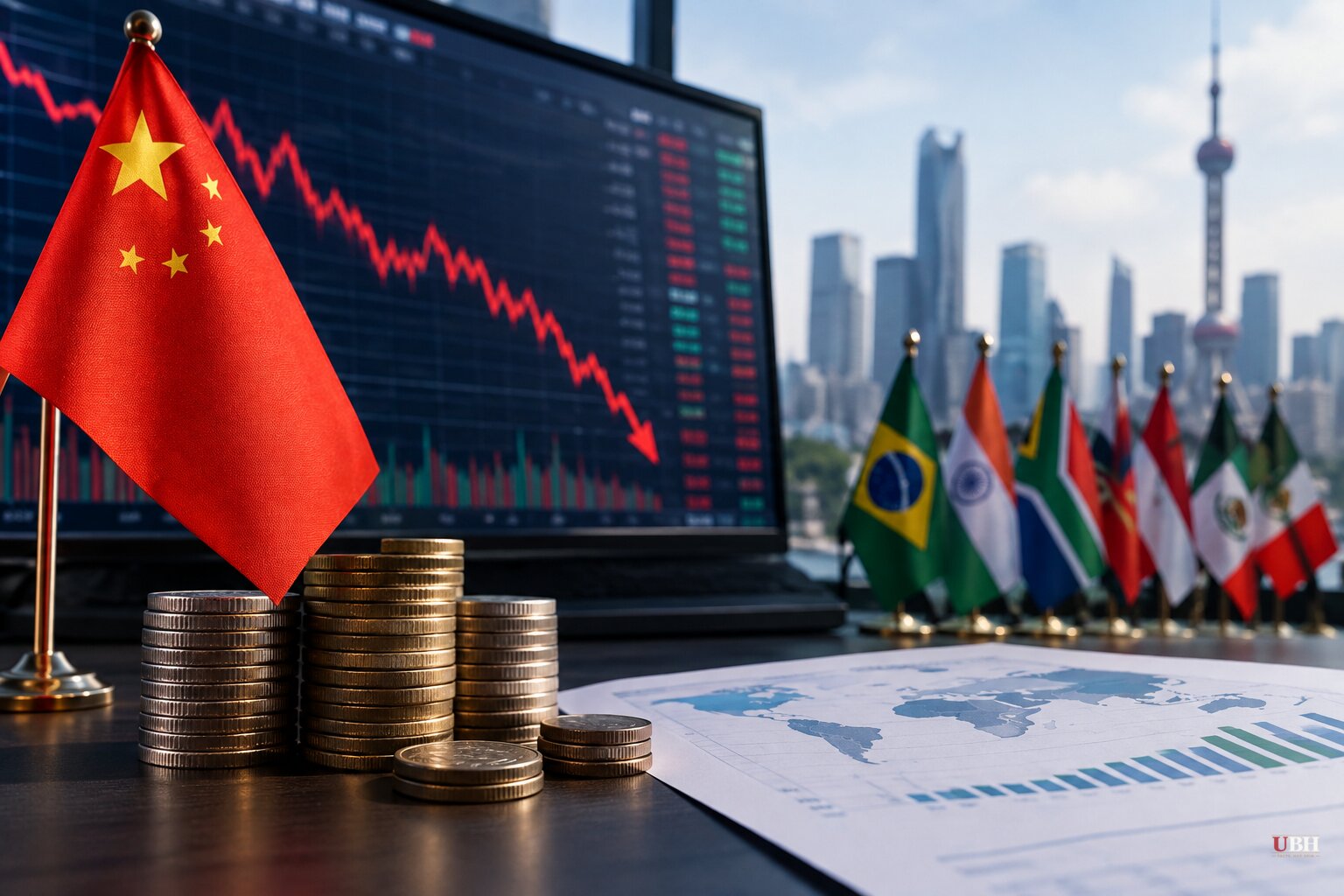
Foreign money keeps walking out of Chinese stock markets. According to the Institute of International Finance's Capital Flows Tracker released September 11, 2026, nonresident investors pulled roughly $3.5 billion out of Chinese equities in August. That's nearly identical to the $3.7 billion that left in July.
The rest of the emerging market world isn't seeing this. Total nonresident EM portfolio flows came in at $11.3 billion for August, down from $24.9 billion in July but still solidly positive, according to the IIF. That marks a second straight month of net inflows for EM overall, even as China gets left behind.
Chinese debt markets tell a slightly different story than equities. Debt instruments pulled in a small $0.2 billion inflow in August, a reversal from July's $3.4 billion outflow. Fixed income investors, who care mostly about yield and repayment odds, are marginally more willing to hold Chinese paper than Chinese stock.
China's Outsized Share of EM Pain
In July, overall EM equities saw $7.8 billion in outflows, according to the IIF's August tracker. China's $3.7 billion chunk of that means the country accounted for nearly half of all emerging market equity outflows that month, while debt inflows of $26.7 billion across EM propped up the aggregate numbers.
Asia as a region did show signs of calming down. Equity outflows from the continent dropped from $40.5 billion in June to $4.8 billion in July, per the IIF's data, suggesting the worst of the spring stress was easing before China's tech-stock slide reignited it in August.
Not Everyone Buys the "Capital Flight" Story
Baiguan, a China markets research outlet, argued in a September 2 analysis that the August decline in Chinese tech stocks "was not simply another case of 'foreign investors fleeing China.'" Baiguan's analyst, writing under the byline Aaron, said genuine foreign inflows into China's A-share market are already so limited that investors can't really be "leaving" a position they never re-entered after earlier retreats.
Baiguan's argument: second-quarter earnings from companies like Tencent, Alibaba, Meituan, Xiaomi, and Kuaishou weren't actually bad, they just matched already-low expectations. What spooked the market, according to Baiguan, was forward guidance and a shift in investor mood, from rewarding companies for AI capital spending to demanding proof of returns on that spending. That's a company-specific and sector-specific story, not necessarily a verdict on China's investability writ large.
If the sell-off is about corporate earnings discipline rather than a broader loss of confidence in China's economy or governance, it changes what the outflow data actually signals. But it doesn't change the fact that the money left, and it left for a second straight month at nearly the same pace.
The Inflation Backdrop
China's own economic data released this month gives outside investors more to chew on. The National Bureau of Statistics reported producer prices rose 3.8% year-over-year in August, up from 3.5% in July and above the 3.6% forecast in a Reuters poll of economists. Consumer prices rose 0.8% year-over-year, up from 0.5% in July.
NBS statistician Dong Lijuan attributed much of the increase to higher international crude oil and non-ferrous metal prices, which she said contributed roughly 0.28 percentage points to August's annual CPI increase. Non-ferrous metal smelting and processing prices jumped 20.8% year-over-year. Petroleum, coal and fuel processing prices rose 11.1%.
Nguyen Hoang Nam, an economist at Capital Economics, said he expects Chinese inflation to stay elevated as long as the conflict in the Middle East continues pushing energy costs up, but forecasts consumer inflation will fall sharply next year to average just 0.4%, with producer prices sliding back into deflation. Ding Meng, chief China economist at China CITIC Bank International, said low core inflation, up just 1% year-over-year in August, suggests price pressures should stay contained through year-end.
Underneath the energy-driven price spikes, domestic demand remains weak. Beijing's consumption stimulus measures have not yet produced a broader recovery, according to the IDN Financials report on the NBS data. That combination, rising input costs without a matching consumer rebound, is exactly the kind of macro backdrop that makes foreign equity investors cautious regardless of individual company earnings.
The next data point comes in October, when the IIF releases its next Capital Flows Tracker covering September. Whether Chinese equity outflows extend to a third straight month near $3.5 billion, or whether Baiguan's earnings-discipline theory proves right and the selling fades once AI capex expectations reset, remains unresolved.
Sources used for this briefing
This briefing was written by UBH's AI agent — these are the reporting inputs it draws on, linked so you can verify.


