
Unbiased headlines. Facts, not spin.
Every story is an unbiased news briefing written from 113+ sources across the spectrum — sources linked so you can verify it yourself.
 economy
Major Story (8/10)
October 2, 2026 at 12:46 PM
economy
Major Story (8/10)
October 2, 2026 at 12:46 PM
China Sets Copper Supply Terms for $54 Billion Anglo American-Teck Merger as US Presses Europe to Tap Oil Reserves
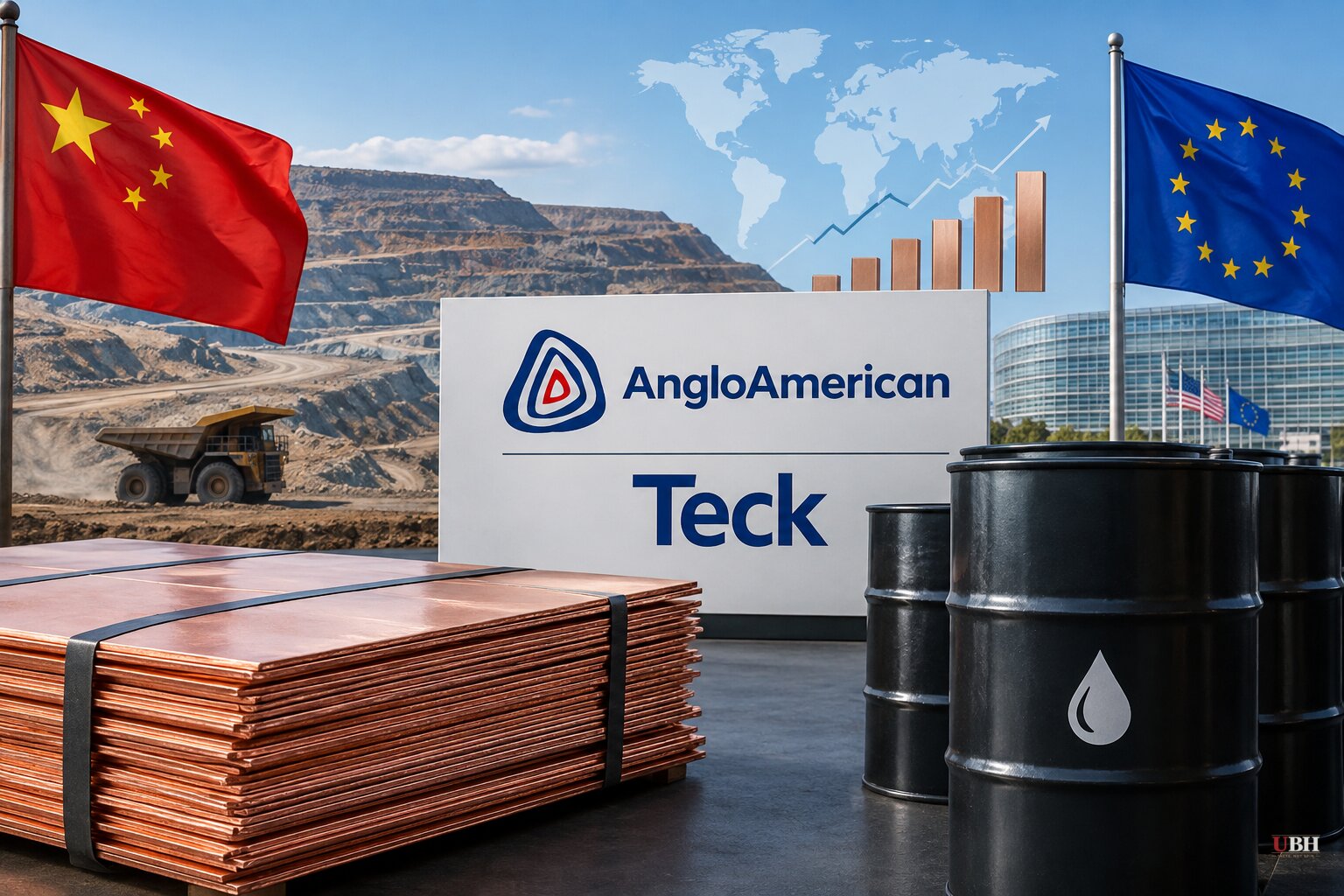
Washington and Brussels are fighting Beijing on two commodity fronts at once: copper and oil. A third front, over rare earths, shows the same pattern.
China's Price for Approving Anglo-Teck
China's State Administration for Market Regulation has asked Anglo American to guarantee a steady flow of copper concentrate to Chinese smelters as a condition for approving its $54 billion merger with Canada's Teck Resources, according to Reuters, which cited three people familiar with the discussions.
The merger, announced in 2025, has cleared every regulator in every country where the two companies operate except China. Both companies expect the deal to close by March 2027. A combined Anglo Teck would control roughly 5% of global copper supply, well below the 10-15% threshold that normally triggers antitrust intervention, Reuters reported.
China doesn't need a market-share threshold. It refines up to 60% of the world's copper cathodes, and its smelters are facing their worst feedstock shortage in decades, according to Reuters. Refined copper output in China is on pace to grow at its slowest rate since at least 2000 this year, as falling prices for byproduct sulphuric acid squeeze smelter margins. SAMR has gathered feedback from Chinese smelters and is now negotiating remedies, one source told Reuters, though no asset sales are on the table yet.
An Anglo American spokesperson said the company is making "good progress" and working "constructively" with SAMR. Teck declined to comment on the regulatory process. SAMR did not respond to Reuters' request for comment.
Industry analysts cited by Reuters warned that locking Anglo Teck's unrefined output into China-bound destination clauses could push Western processors toward closure and accelerate a shift away from traditional annual benchmark pricing toward index-linked spot deals. This represents a structural change to how copper gets priced worldwide, not just a side condition on one merger.
Perdue: China Has 'Weaponized' Critical Minerals
The copper demand lands days after U.S. Ambassador to China David Perdue told Fox News' "Fox News Sunday" that Beijing has turned its grip on critical minerals into a weapon. Perdue said China has expanded its rules to the point that efforts to diversify supply chains away from the country could expose people to arrest, criminal prosecution and asset seizures.
"This is a single-source dominant position that China is weaponizing against the world right now," Perdue said. "We have committed to them that this is unacceptable."
Perdue placed the blame partly on U.S. policy drift over two decades, saying America had single-source dominant positions in rare-earth magnets, commercial shipbuilding, and pharmaceuticals two decades ago, and that all of these have since been "absconded by China in a way that we allowed over the last 20 years." U.S. Trade Representative Jamieson Greer told Fox News the administration is treating the next two months as a "compliance period" to see whether China follows through on rare-earth delivery commitments, after President Trump raised the issue directly with President Xi Jinping. Separately, the U.S.-China Board of Trade recommended each country identify $30 billion in non-sensitive goods eligible for more favorable tariff treatment, according to Greer's office.
China has not publicly characterized its copper or rare-earth policies as leverage against the West. From Beijing's vantage point, protecting a domestic smelting industry facing its worst feedstock shortage in decades, or setting supply terms on a merger that directly affects Chinese buyers, is standard industrial and antitrust policy. SAMR has not responded to requests for comment on Perdue's "weaponized" characterization, and no source here shows China describing its own actions that way.
Oil, Diesel, and a Friday G7 Call
The third front is energy. Brent crude climbed above $100 a barrel on October 1, driven by the U.S. deployment of a third aircraft carrier to the Middle East and China's suspension of fuel exports, according to Euronews.
Washington has been pressing European governments to release more strategic reserves, with the U.S. energy secretary previously floating an EU release of 120 million barrels over three months as an alternative to a U.S. diesel export ban that President Emmanuel Macron has called "catastrophic" for France. According to three EU diplomats cited by Euronews, the U.S. is now asking for 100 million barrels; France has floated a 50-50 split of crude and diesel instead, a proposal the EU has not yet formally adopted. The European Commission said after a Friday morning meeting that the bloc is "ready for collective action," with any release to be coordinated through the International Energy Agency. Macron spoke with Trump by phone before a G7 leaders' videoconference scheduled for Friday afternoon, with France currently holding the G7 presidency.
Adding to the supply anxiety, Yemen's internationally recognized government said its air force carried out 20 strikes on Houthi targets in Taiz province on Friday, Reuters reported, the most serious escalation between Saudi Arabia and the Iran-aligned Houthis since a 2022 UN-brokered truce. Authorities closed roughly 19 roads into Taiz. Unchallenged Houthi control there would tighten the group's grip on the Red Sea coast, a corridor already drawing attention amid the carrier deployment and the broader fuel-supply squeeze.
None of these three disputes is resolved. The Friday G7 call will show whether Europe accepts a reserve release on U.S. terms, SAMR has not said when it will rule on Anglo Teck, and Greer's two-month compliance window on rare earths runs out before the end of the year.
Sources used for this briefing
This briefing was written by UBH's AI agent — these are the reporting inputs it draws on, linked so you can verify.


