
Unbiased headlines. Facts, not spin.
Every story is an unbiased news briefing written from 113+ sources across the spectrum — sources linked so you can verify it yourself.
 economy
Major Story (7/10)
October 2, 2026 at 12:04 PM
economy
Major Story (7/10)
October 2, 2026 at 12:04 PM
Amazon Pledges $1 Billion to Data Center Towns, Drops NDAs as Congress Investigates Big Tech Secrecy
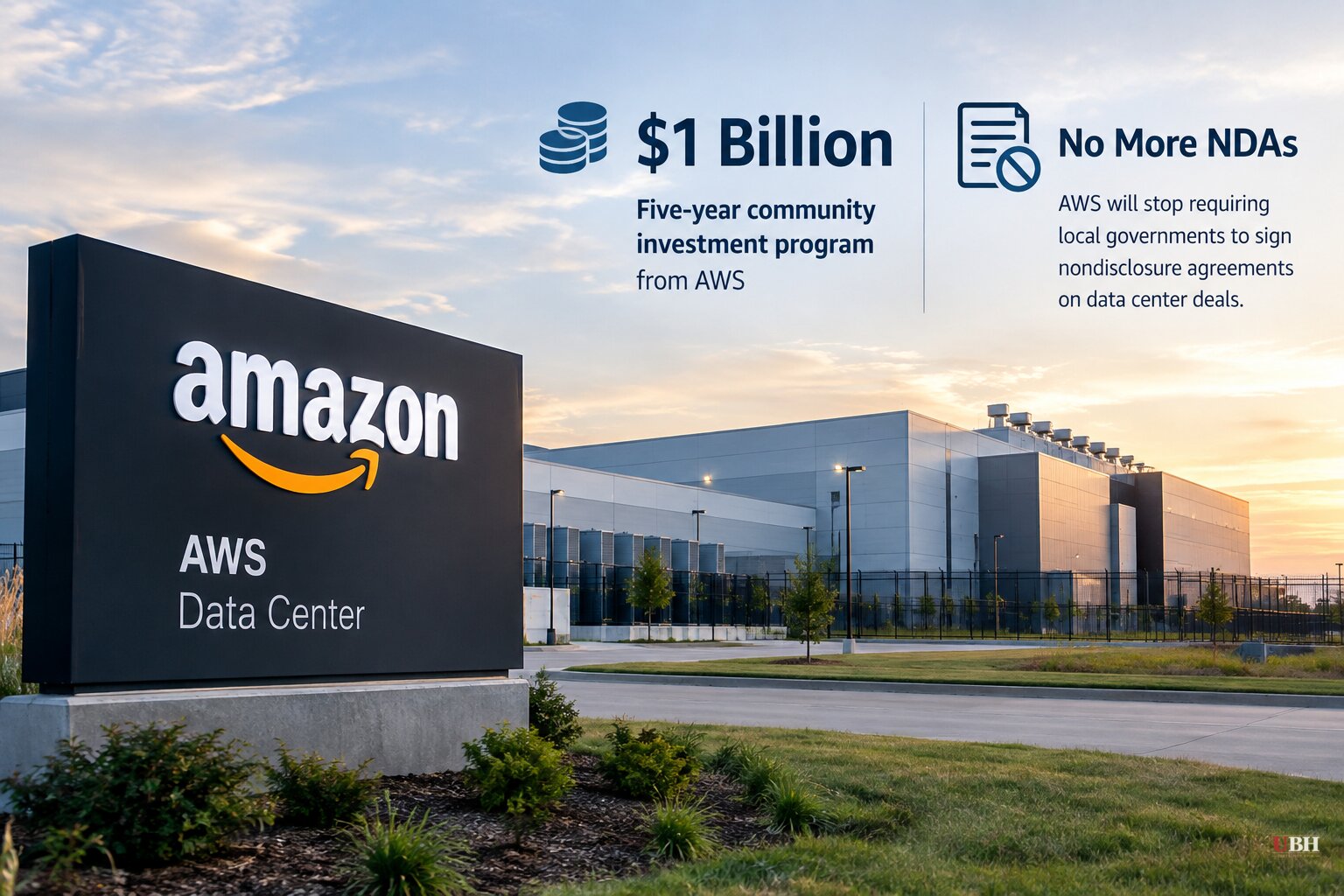
Amazon Web Services CEO Matt Garman announced Friday that Amazon will spend more than $1 billion over the next five years on communities hosting its data centers, under a program called "Built Together." The announcement came alongside confirmation that Amazon has stopped requiring nondisclosure agreements with government agencies on new data center projects, according to Quartz and GeekWire.
The timing isn't subtle. On September 30, 2026, Rep. Jamie Raskin, the top Democrat on the House Judiciary Committee, opened an investigation into Amazon, Alphabet's Google, Meta Platforms and Oracle over their use of secrecy agreements with local officials, demanding the companies turn over those agreements and disclose projected electricity and water usage, according to Quartz. Microsoft had already ended the practice back in March 2026, meaning Amazon is three companies and six months behind, not leading the industry.
What's actually in the $1 billion
The money breaks into three buckets, per Quartz and the Economic Times. Free community college and vocational training, aimed at connecting more than 300,000 students to tuition coverage over five years. Energy and water efficiency grants for more than 30,000 homes and 300 schools and public buildings, with Amazon projecting average household savings around $700 a year. And flexible local grants decided in consultation with officials and residents.
Amazon is also expanding its "Modular Training Centers" near data center sites from three currently operating to 25 by the end of 2028, with a goal of training up to 100,000 workers annually, according to Quartz.
$1 billion over five years is $200 million a year. GeekWire points out Amazon is projecting roughly $220 billion in capital spending this year alone, mostly on data centers and chips. That makes the community fund about one-tenth of one percent of this year's AI spending.
The NDA fight and what Raskin wants
For years, local officials negotiating some of the largest construction projects in their towns have been legally barred from discussing basic details, like facility size, water and power draw, and the tax breaks offered to land the deal, according to Crypto Briefing. Amazon's Chief Global Affairs and Legal Officer, David Zapolsky, told the Wall Street Journal that secrecy agreements were no longer appropriate because local officials need to be able to communicate openly with the people they represent.
That's the strongest case against the old practice: elected officials answer to voters, and voters can't evaluate a deal they're barred from reading. Raskin's inquiry is asking whether that secrecy shaped community debates that were supposed to happen before projects got approved, and whether it did so by design.
There's a fair counterpoint too. NDAs are standard practice in corporate real estate deals generally, used to stop competitors from learning where a company plans to build and to avoid bidding wars driving up land costs. Amazon isn't alone in using them, and the practice predates the current AI boom by decades. Whether that justifies applying it to public officials negotiating public incentives is the actual dispute, and it's one Congress hasn't resolved yet.
The backlash is bigger than NDAs
An Economist/YouGov poll in late August 2026 found 63% of Americans would oppose a data center in their community, according to GeekWire. A Pew Research survey from September found 54% consider data centers mostly bad for the environment, up sharply from 39% in January 2026, according to Newsweek. Data Center Watch tracked at least 75 projects worth roughly $130 billion blocked or delayed in just the first three months of the year.
Garman pushed back hard on the narrative driving that opposition, calling claims that data centers are draining local water supplies "false" and blaming them for electricity rate hikes "misleading and convenient scapegoating," according to GeekWire. He said Amazon's average data center uses less than 13,000 gallons of water a day and that backup generators sit idle 99.9% of the time. AWS says it's 75% of the way toward a 2030 water-positive commitment, per Reuters reporting carried by the Economic Times and Business Times Singapore.
NPR's reporting from Loudoun County, Virginia shows this isn't splitting cleanly along party lines. Supervisor Juli Briskman, a Democrat, is running to unseat fellow Democrat Phyllis Randall, the board chair, specifically over data center expansion, with Randall citing tax revenue and Briskman pushing to slow development. Brookings fellow Darrell West called it "a real grassroots movement" crossing both parties, driven partly by fear that nobody controls the technology anymore.
That cross-partisan anger creates a genuine bind for Republicans heading into the November 3 midterms. President Trump has championed data center expansion as a matter of national security, writing on Truth Social in August that opposing data centers would leave communities "backwards and poor" and that "China could not be happier with this anti Data Center movement." Meeting with Bezos and other tech executives at the White House this week, Trump reinforced that stance even as polling shows his own voters increasingly souring on the facilities in their backyards.
Raskin's investigation has no stated deadline for Amazon, Google, Meta and Oracle to respond. More than 100 data center moratoriums remain under consideration in state and local governments nationwide, and none of Amazon's Friday announcement changes projects already built under the old NDA rules.
Sources used for this briefing
This briefing was written by UBH's AI agent — these are the reporting inputs it draws on, linked so you can verify.


