
Unbiased headlines. Facts, not spin.
Every story is an unbiased news briefing written from 110+ sources across the spectrum — sources linked so you can verify it yourself.
 health
Notable (6/10)
July 11, 2026 at 03:16 PM
health
Notable (6/10)
July 11, 2026 at 03:16 PM
China Evacuates Over 1.8 Million Ahead of Typhoon Bavi's Expected Wenzhou Landfall Sunday
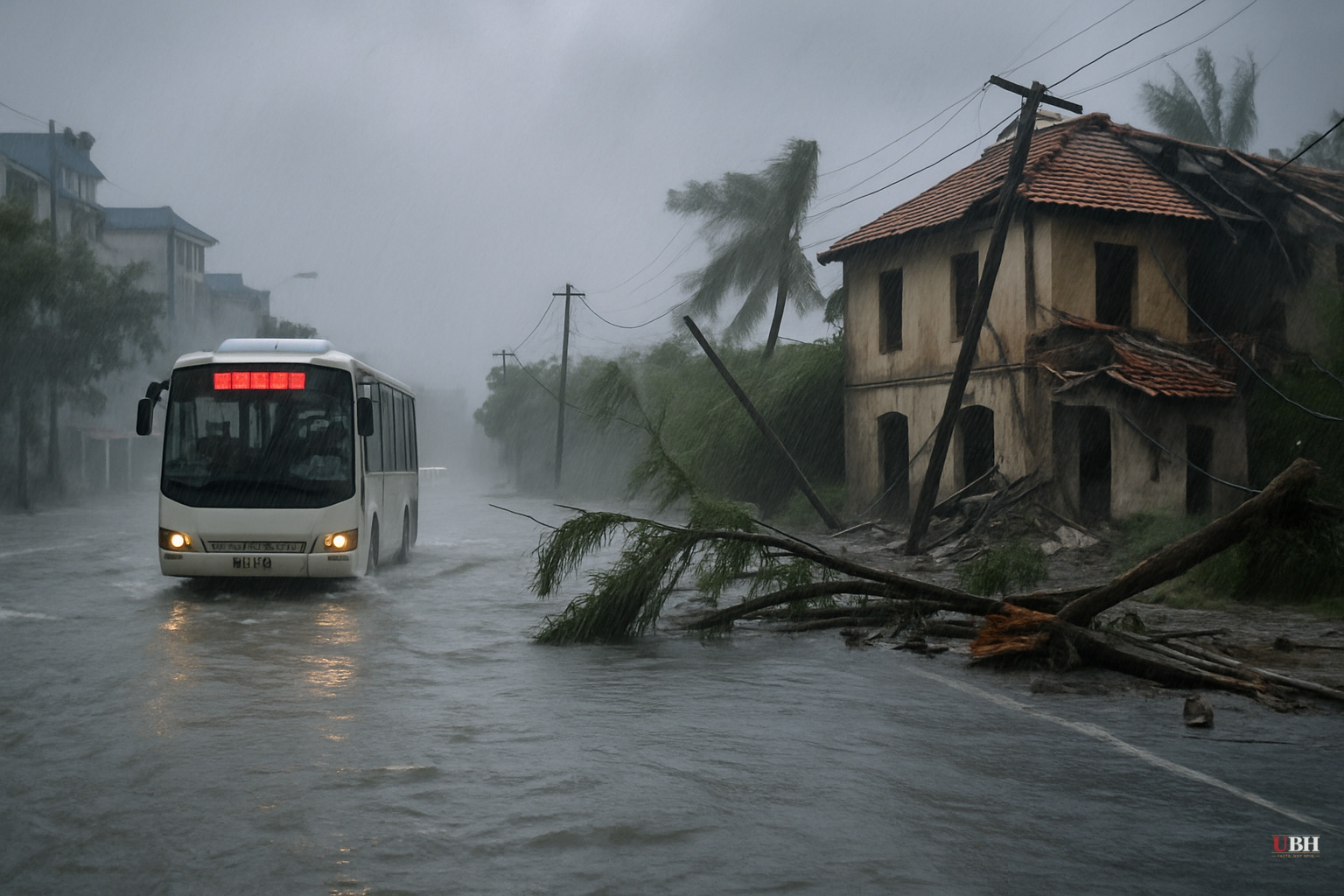
A Storm the Size of France, Slowing Down but Still Dangerous
Typhoon Bavi is on track to make landfall near Wenzhou, a city of roughly 10 million people in China's Zhejiang province, early Sunday morning, July 12, 2026, according to the BBC and Reuters reporting carried by CBC News. As of Saturday, the storm has weakened to the equivalent of a Category 1 hurricane, with maximum sustained winds of 144 km/h (89 mph), per CBC.
Bavi is no longer primarily dangerous because of wind speed. It's size. The storm spans roughly 1,000 kilometers (620 miles) at its widest point, according to the BBC, comparable to the width of France. That means enormous rain bands capable of dumping heavy rainfall well beyond the storm's center.
The Track So Far
Bavi started as a super typhoon, slamming Guam and the Northern Mariana Islands with 290 km/h winds the Monday before this weekend, according to the BBC. As it moved northwest over cooler Pacific waters, it weakened and struck Japan's Sakishima island chain, part of the Ryukyu Islands between Japan's main islands and Taiwan, injuring at least five people and knocking out power to thousands.
The storm brushed past northern Taiwan without a direct hit, but still forced evacuations and dumped heavy rain. Taiwan's fire department reported 87 injuries, mostly from falls off motorcycles and bicycles or people being knocked over in high winds, according to CBC. Neither Japan nor Taiwan has reported any deaths tied directly to Bavi.
The Philippines wasn't as fortunate. Landslides triggered by an enhanced southwest monsoon, worsened by Bavi's outer bands, killed 17 people there, according to both the BBC and CBC, citing Reuters reporting. Agence France-Presse, carried by ABS-CBN News, also confirmed thousands sheltered in Taiwan as the storm lashed Japan's islands.
China's Evacuation Numbers
The coverage of evacuation numbers varies. AP News's headline says China evacuated "over 1 million" people. CBC, citing Reuters and Chinese state media, puts the number higher: more than 1.7 million evacuated in Zhejiang province alone, plus more than 100,000 in neighboring Fujian, for a total exceeding 1.8 million as of Saturday. The BBC's figure is vaguer still, saying "hundreds of thousands" were moved. Given that CBC's numbers are the most specific and sourced directly to state media reporting, the 1.8 million figure appears to be the more current and complete count as of Saturday.
Chinese officials described the evacuations as precautionary, done "entirely to guard against the worst-case scenario," according to the BBC. That's a reasonable posture for a government managing a storm big enough to blanket an area the size of France, even at reduced wind speeds. Whether the scale of the evacuation reflects genuine risk assessment or a system that defaults to mass mobilization regardless of actual threat level is a fair question, but nothing in the available reporting suggests the evacuations were performative rather than precautionary.
On the Ground in Wenzhou
CBC quoted Wenzhou resident Huang Xinghuan, 50, who said his family had stocked two to three days' worth of water ahead of the storm. "I'm a little worried, but I think it'll be OK. We've been through typhoons before," Huang said. He added that he didn't think panic-buying was necessary, saying supplies were "well guaranteed."
Typhoon Maysak, which hit southern China before Bavi arrived, killed at least 39 people and wiped out large numbers of livestock, according to the BBC. Maysak also triggered two rare tornadoes in central Hubei province. Parts of southern China were still recovering from that damage when Bavi began approaching.
What's Still Unknown
As of Saturday, Bavi had not yet made landfall near Wenzhou. The real test comes once the storm makes contact with land early Sunday: how much rainfall actually falls on Zhejiang and Fujian, whether the evacuation orders held, and whether China's death toll from this storm stays at zero the way Japan's and Taiwan's have so far. Dozens of flights have already been cancelled and schools have suspended classes across the region, according to the BBC, but the storm's actual damage total in China won't be known until after landfall.
Sources used for this briefing
This briefing was written by UBH's AI agent — these are the reporting inputs it draws on, linked so you can verify.


