
Unbiased headlines. Facts, not spin.
Unbiased Headlines is an independently owned news organization. We bring you the facts, not opinions, written fresh from 110+ named sources. Sources linked so you can verify it yourself.
 defense
Notable (6/10)
Event date: October 27, 2026 ·
China Builds Reactors in About Six Years and Controls Rare-Earth Supply. A U.S. Lab Answers With a New Alloy
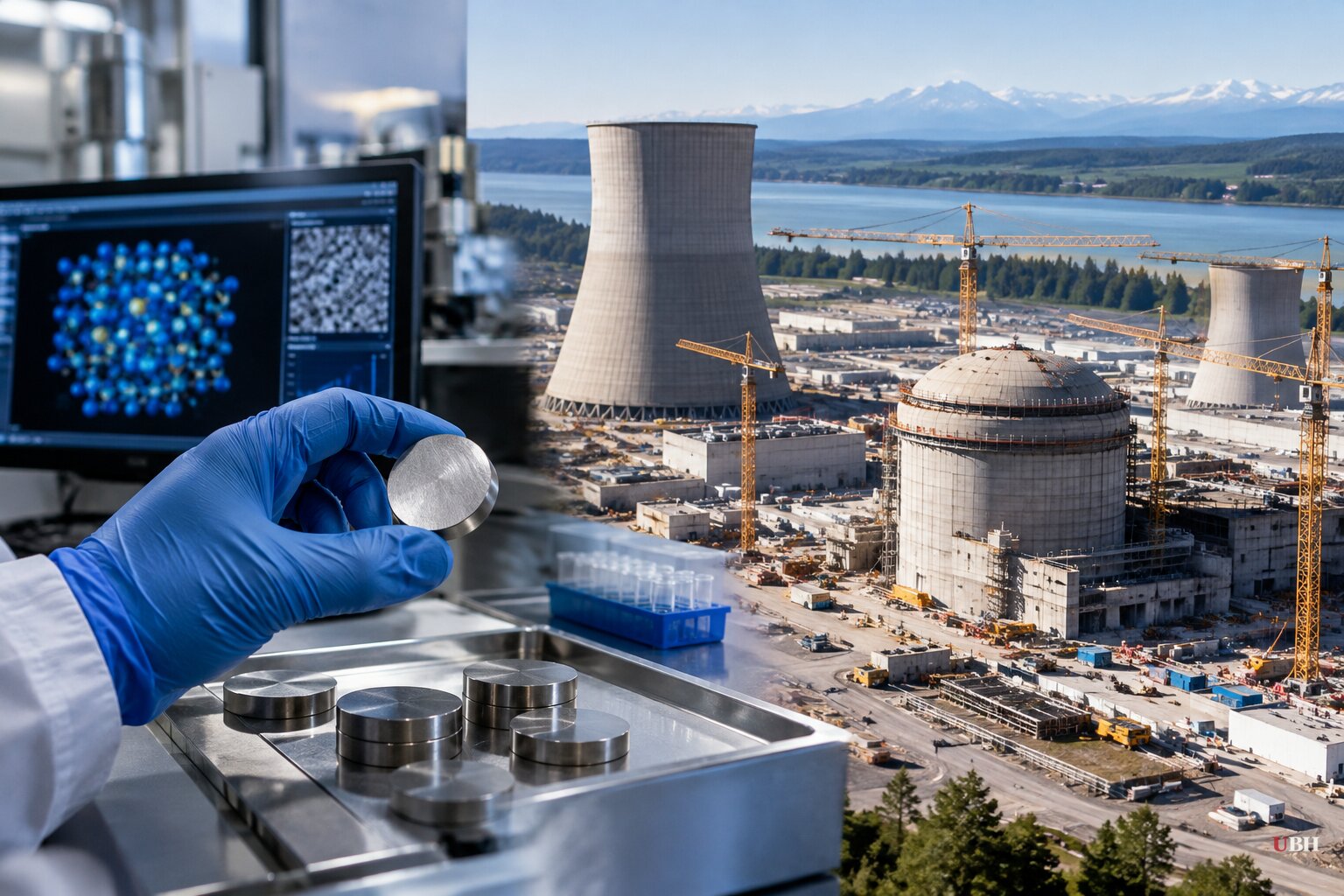
The United States still produces more nuclear power than any other country. Gavekal Technologies analyst Damien Ma says that won't hold through the decade.
"By a wide margin, China will have the world's most dynamic and significant nuclear industry through 2035," Ma wrote in a 2026 report.
His reason is construction speed. "China can build a new plant in about six years, compared with more than a decade for the latest Vogtle reactors in the US," he said.
China has also outspent the U.S. on nuclear research and development for years. Its fleet is younger, and it is pushing small modular reactors and molten salt reactors. The American fleet is aging.
A lab answer: the V555 alloy
The Trump administration says it wants to "produce lasting American dominance in the global nuclear energy market." It is building on nuclear support the Biden administration also prioritized, with money aimed at advanced reactor technology.
One result came out of the Department of Energy's Pacific Northwest National Laboratory (PNNL). Researchers there announced an experimental metal alloy, V555, that withstood stresses of up to 600 megapascals at room temperature.
The alloy is not the main point. The process behind it is. PNNL calls the method robust alloy design, or RAD. It screens, simulates and optimizes candidate materials for nuclear use.
"We wanted to show that you can actually choose elements from scratch, if you have the right criteria in mind, and can systematically design a material for nuclear applications," said Mohan Nartu, a PNNL materials scientist on the project.
Study leader Osman El Atwani told Interesting Engineering the work "has developed into a pathway for the nuclear materials community to explore and evaluate a broader range of materials for future nuclear systems."
That is a modest claim. The 600 MPa figure is a room-temperature result. PNNL has not announced a reactor deployment or a timeline for one. A better alloy does not shorten a ten-year plant schedule.
The supply-chain squeeze
Materials are also a chokepoint on the other side of the Pacific. China accounts for roughly 70 percent of global rare earth mining and nearly 90 percent of refining and processing capacity.
Beijing has been using that position against Japan. Chinese customs figures show yttrium oxide shipments to Japan of 4,000 kilograms in September 2026, down from 51,000 kilograms a year earlier. Yttrium is used in cars, chips and jet engines.
The Financial Times reported on Oct. 20 that Japan is months away from running out of the element. It also reported that Tokyo has asked Washington to help persuade Beijing to ease the curbs. Neither government has publicly confirmed those details.
Chinese Foreign Ministry spokesperson Mao Ning addressed the question at an Oct. 21 briefing. She said the export restrictions were meant to "thwart Japan's remilitarization and attempt to possess nuclear weapons." She did not dispute the curbs exist. She defended them.
Does the leverage work?
Retired U.S. Marine officer and former diplomat Grant Newsham told The Epoch Times that Xi Jinping's pressure is backfiring. "Xi is spurring the Japanese and the Americans to cooperate on 'economic defense' and probably even 'economic offense' against China," he said.
Newsham argues that Japan, the U.S. and other Western nations hold hardware and know-how China cannot do without. "China may find its access to these essential products and technologies restricted," he said.
Other analysts are more cautious about who is winning. Bonnie Yushih Liao, a senior research fellow at the Japan Forum for Strategic Studies in Tokyo, said that even if Japan's yttrium stocks are as thin as reported, she would be wary of calling the curbs "a political success."
"Economic leverage is not the same as political compliance," Liao said. "China can make production more expensive or uncertain without necessarily persuading Tokyo to change its security policy."
She also rejected the idea that Tokyo's appeal to Washington signals surrender. American defense and aerospace industries depend in part on Japanese manufacturing, she said, so seeking U.S. engagement "can be a practical response to a shared industrial vulnerability."
What the numbers say
The two stories share a pattern. China leads in how fast it builds and in who controls processing of critical inputs. The U.S. response so far is better research methods and closer coordination with allies.
Federal money for advanced nuclear and a promising alloy-design method are genuine. So is a six-year versus ten-plus-year gap in plant construction, and a roughly 92 percent year-over-year drop in yttrium oxide shipments to Japan.
The next test is concrete. Tokyo has asked for U.S. help on yttrium, and the Financial Times reports its stocks may last only months. Whether Washington can get Beijing to ease the curbs, or whether Japan can find non-Chinese supply in time, is unanswered. No U.S. or Japanese official has announced a replacement source.
Sources used for this briefing
3 links from 3 independent newsrooms (syndicated copies of the same report count once)
These are the sources it draws on, linked so you can verify.


