
Unbiased headlines. Facts, not spin.
Unbiased Headlines is an independently owned news organization. We bring you the facts, not opinions, written fresh from 110+ named sources. Sources linked so you can verify it yourself.
 defense
Breaking / Critical (9/10)
Event date: October 30, 2026 ·
Riyadh Airport Cancelled 94% of Departures After Oct. 10 Houthi Strike; US Pulls Non-Emergency Staff From Saudi Arabia
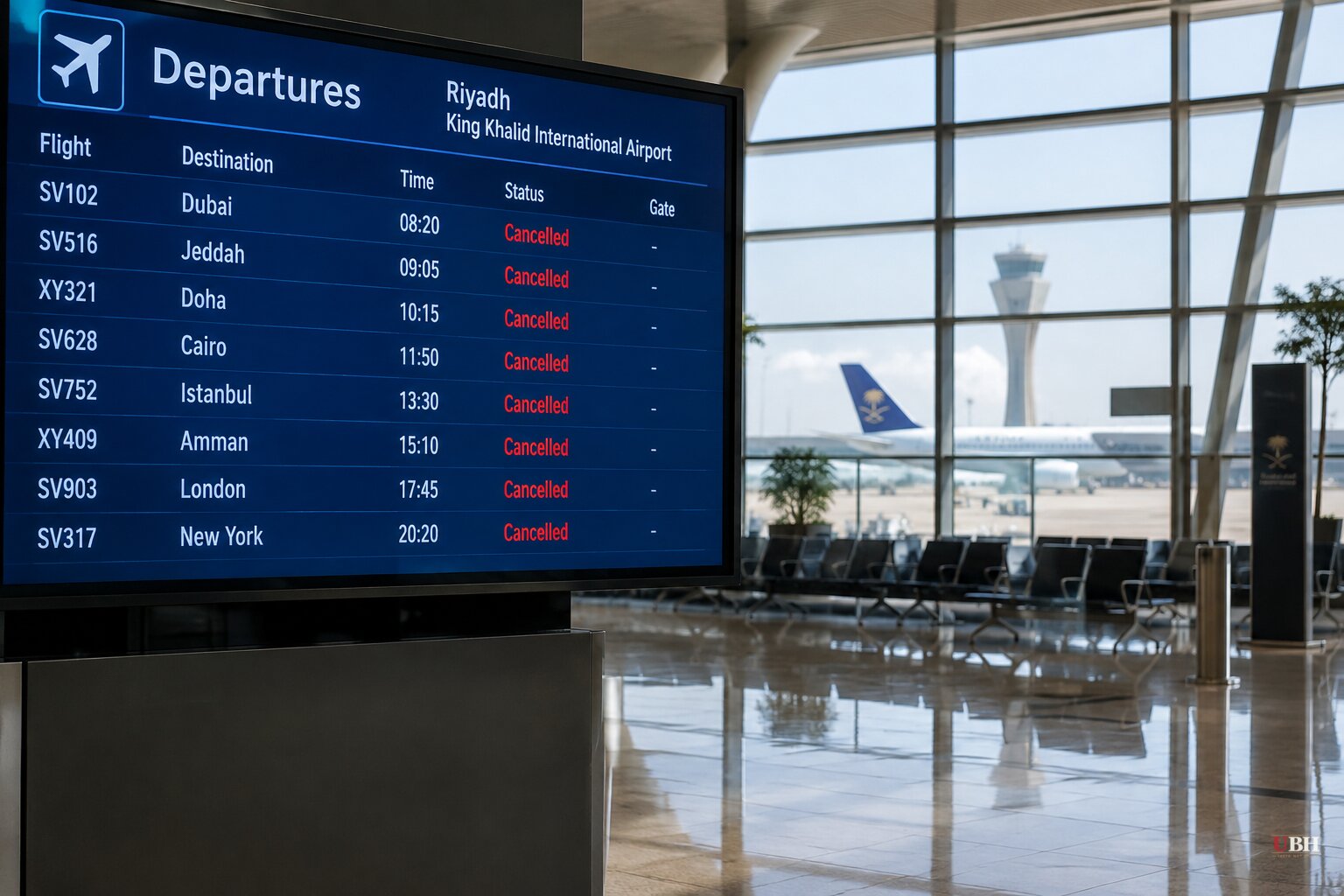
The Houthi attack on Riyadh's main airport has done more than kill people. It has effectively shut down one of the Gulf's biggest aviation hubs for weeks.
From Oct. 10 through Oct. 27, about 94% of the 4,345 flights scheduled to depart King Khalid International Airport were cancelled, according to data from aviation analytics firm Cirium. Saudi authorities suspended operations after the Oct. 10 strike. Limited service resumed Oct. 25.
The attack
The strike killed at least 14 people and injured more than 300, according to Saudi Arabia's General Authority of Civil Aviation (GACA). Secretary of State Marco Rubio confirmed an American citizen was among the dead. GACA said another victim was a Pakistani resident, and India's embassy said an injured Indian national later died.
Coalition spokesman Maj. Gen. Turki al-Maliki said an "unknown projectile" caused the explosion and fire at Passenger Hall Number 4. He said the coalition also intercepted a cruise missile near the airport. The coalition called the attack a "full-fledged war crime."
The Epoch Times reported that a barrage of missiles and drones was not intercepted by Saudi air defenses, and that Saudi Arabia has opened an investigation into how they got through. Riyadh has not publicly explained the gap.
GACA said at least 20 people were killed and 356 injured in Houthi attacks on Saudi airports in the days around the strike. Dammam's airport was also targeted. The Houthis claimed an earlier Oct. 7 attack on King Khalid and strikes on two Saudi Aramco oil facilities.
The Houthi position
The Houthis say they are the ones responding to aggression. Their Yemen-based foreign ministry said the attacks were carried out in response to Saudi support for Yemeni government forces. In a statement carried by Al Masirah television, it warned: "Unless the Saudi enemy stops its aggression and interference in Yemen, worse is yet to come."
The fighting follows weeks of combat between the Houthis and the Saudi-backed Yemeni government since a 2022 U.N.-backed ceasefire. The Houthis have made territorial gains that give them significant control over the Red Sea and the Bab al-Mandeb Strait, a key trade route, according to the Epoch Times.
Saudi Energy Minister Prince Abdul Aziz bin Salman said at the World Petroleum Energy Congress in Riyadh: "The events of recent weeks are serious. Our response must be equally serious."
Washington's response
President Donald Trump said the US might join the Saudi coalition's operation against the Houthis. "We may. We're gonna look at it. We just found out about the recent attack. So we'll make a decision. We move very quickly," he told reporters. No decision has been announced.
The State Department issued a Level 3 "Reconsider Travel" advisory for Saudi Arabia on Oct. 12, with some areas at Level 4, "Do Not Travel." It cited regional conflict, terrorism, missile and drone attacks, exit bans and strict social media laws. It also warned Americans not to photograph or share information about missile or drone interceptions, noting that Americans have been detained for taking photos of recent events.
On Friday, Oct. 30, the US embassy in Riyadh said non-emergency government employees and their families were ordered to leave Saudi Arabia effective Oct. 23, citing Houthi attacks on civilian airports and other critical infrastructure. US government employees now need special authorization to use Saudi airports. The embassy warned of possible further attacks, airspace closures and flight cancellations.
Gulf aviation takes the hit
Riyadh is one piece of a bigger collapse. From Feb. 1 through Oct. 27, 26,561 flights were cancelled at Dubai, Doha and Riyadh, a fivefold increase from a year earlier, per Cirium. Scheduled flights at those three hubs fell almost 21%.
The US and Israel attacked Iran on Feb. 28, and the long-standing conflict between Saudi Arabia and the Houthis reignited. The Gulf had spent decades building a reputation as a stable transit point between Europe and Asia. Dubai's airport overtook Heathrow as the world's busiest for international traffic in 2014.
Riyadh Air, Saudi Arabia's youngest airline, has moved operations to an airport about 249 miles (400 km) away and is running a limited schedule until further notice, according to its website. Air France extended its Riyadh suspension to Dec. 12. KLM cancelled service to Riyadh and Dammam through Nov. 27.
Abdulaziz Al-Duailej, president of Saudi Arabia's civil aviation authority, told counterparts at a meeting in Doha that regional developments have "cast a shadow on the civil aviation sector, air transport traffic, demand levels and operational capacity of airlines."
Ameneh Mehvar, Middle East regional expert at conflict monitor Acled, said attacks on airports are deliberate. "Airports bring a lot of visibility, the destruction they create, and that's the strategy," she said.
The State Department says commercial flights are still operating in Saudi Arabia, though with major disruptions at times.
What comes next
The wider war is in a diplomatic holding pattern. Iran's foreign minister, Abbas Araghchi, said a proposal reached with mediators could reopen the Strait of Hormuz fully within two days. Iran's supreme leader, Ayatollah Mojtaba Khamenei, warned that any US or Israeli threat would draw an immediate response with no "geographic limits," according to Iranian state media. Saudi Arabia and Egypt have both warned against another round of fighting.
None of that addresses Yemen. The open questions are whether Trump commits US forces to the Saudi-led campaign, how Saudi air defenses failed on Oct. 10, and whether airlines return when the KLM and Air France suspensions expire on Nov. 27 and Dec. 12.
Sources used for this briefing
7 links from 7 independent newsrooms (syndicated copies of the same report count once)
These are the sources it draws on, linked so you can verify.


