
Unbiased headlines. Facts, not spin.
Every story is an unbiased news briefing written from 110+ sources across the spectrum — sources linked so you can verify it yourself.
 tech
Notable (6/10)
June 1, 2026 at 01:16 PM
tech
Notable (6/10)
June 1, 2026 at 01:16 PM
China Beats the World to Market With First Commercially Approved Brain Implant — Here's What That Actually Means
A Paralyzed Man Wrote His Name
Dong Hui, 39, hadn't used his fingers in six years. A car accident left him paralyzed from the neck down. Then, in October 2024 — eleven months after receiving a brain implant through a 90-minute surgery — he sat in the courtyard of his home in Henan province and slowly wrote his name.
"I couldn't believe I was able to write again. I was so excited I even missed a stroke in my name," Dong told MIT Technology Review.
What Got Approved — And Who Built It
In March 2026, China's National Medical Products Administration granted the world's first regulatory approval for a commercially available invasive brain-computer interface. The device is called NEO.
NEO was developed by Neuracle Technology, a Shanghai-based startup, in partnership with the School of Biomedical Engineering at Tsinghua University, according to People's Daily and confirmed by MIT Technology Review, Scientific American, and Nature Biotechnology.
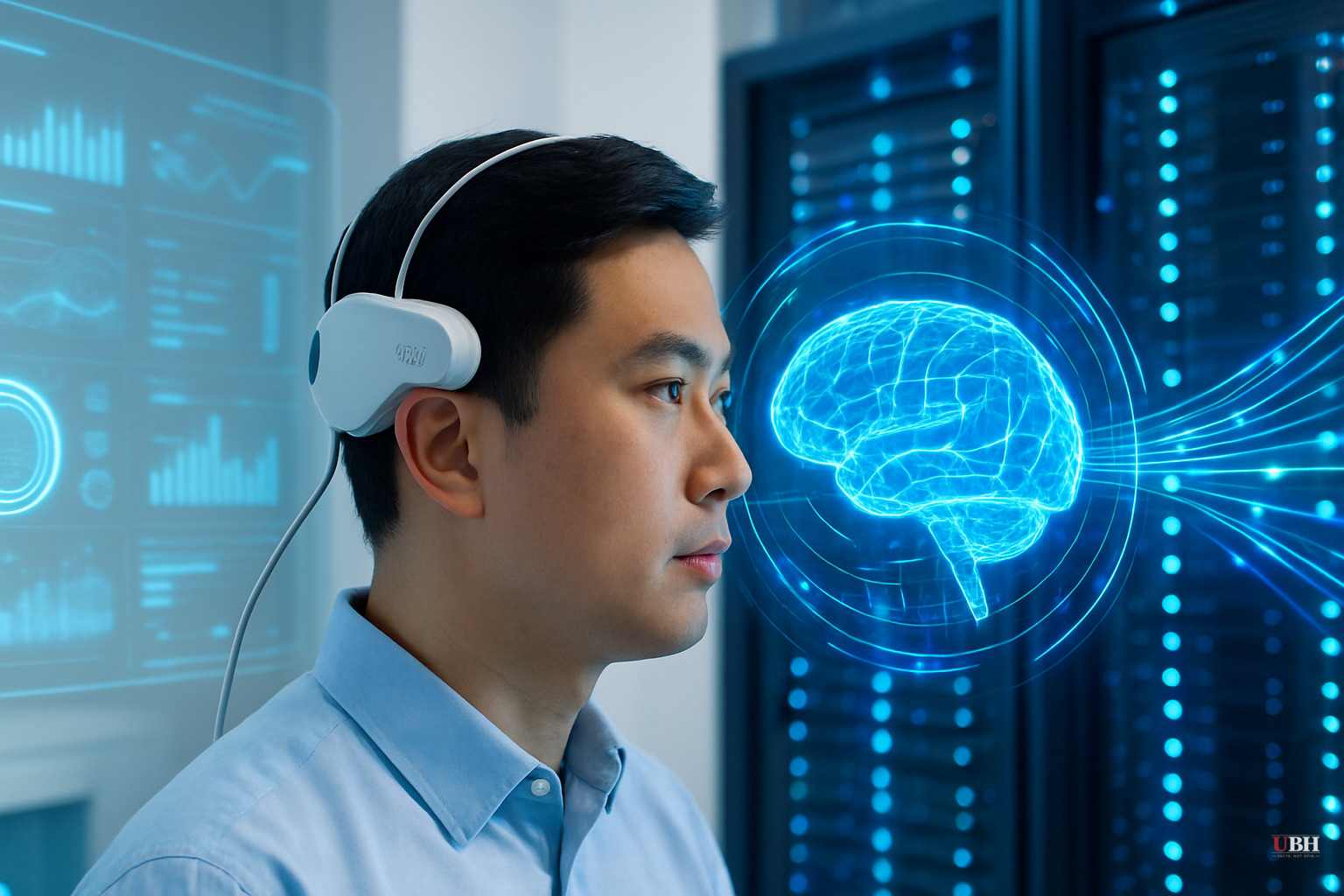
The device is coin-sized. It contains eight electrodes placed on the dura mater — the tough outer membrane covering the brain — directly above the primary sensorimotor cortex. It does NOT require drilling into brain tissue, reducing surgical risk.
When a patient imagines moving their hand, the electrodes pick up the neuronal electrical signals. Those signals get wirelessly transmitted to a computer, decoded in real time, and then used to control a pneumatic robotic glove the patient wears. According to Nature Biotechnology, the procedure takes just over 90 minutes.
Dong started rehab nine days after surgery. On day nine, his right hand grabbed a ball without the glove.
Who Can Get It — And Who Can't
NEO is not a consumer product yet.
According to China's National Medical Products Administration, NEO is approved for patients between 18 and 60 years old who have paralysis in all four limbs due to spinal cord injuries — but only those who retain some upper arm function, according to Scientific American. That's a specific slice of spinal cord injury patients.
Wang Yujing, product director at Neuracle, described the target patient: quadriplegics caused by cervical spinal cord injuries who cannot perform grasping movements. The goal is restoring the ability to drink water, pick up objects, button a shirt — basic daily tasks that define independence.
The Bigger Picture: China Just Lapped the U.S. on a Regulatory Milestone
Neuralink — Elon Musk's BCI company — has been implanting devices in human patients since 2024. Their first human patient, Noland Arbaugh, made headlines controlling a computer cursor with his thoughts. The technology is impressive. But Neuralink is still operating under clinical trial authorization from the FDA. It has NOT received commercial approval.
Musk has the culture war buzz, the mainstream media coverage, and billions in capital. China's Neuracle Technology just beat him to commercial approval — quietly, with peer-reviewed science and a regulatory green light.
BrainGate, the U.S. research consortium that pioneered invasive BCIs in the early 2000s and still leads in research depth according to Scientific American, remains in the academic trial phase too.
On this specific regulatory checkpoint, China went first.
What Mainstream Coverage Is Getting Wrong
Most Western outlets framed this as a feel-good medical story: paralyzed man writes his name, technology is amazing, moving on.
China's government has been explicitly targeting brain-computer interface technology as a strategic national priority. Hong Bo, a professor at Tsinghua University's School of Biomedical Engineering, confirmed to People's Daily that BCI research began in the 1970s — but Beijing has accelerated investment significantly in the last decade.
This approval demonstrates China's regulatory pipeline as a competitive tool. If China can approve advanced neurotechnology faster than the FDA, companies — including Chinese ones — will race to develop and deploy there first. That shapes where the science happens, where the IP lives, and who sets the global standards.
The U.S. is simultaneously tightening AI chip exports to Chinese firms — a Reuters-reported move to close loopholes that allowed Chinese subsidiaries abroad to access Nvidia hardware — while China is pulling ahead on neurotechnology commercialization. China is actively working around Western tech restrictions while advancing independently in fields the West doesn't fully appreciate as strategic.
The Legitimate Questions Nobody Is Asking
China's regulatory approval process is not the FDA. Speed carries risks in medical device approval. Based on Dong's timeline, the NEO device has been in human trials since at least November 2024 — a compressed window.
The device sits OUTSIDE the brain's cortex, not inside it, which reduces the biological tissue response risk that makes deeper implants so complicated. Wang Yujing at Neuracle acknowledged to People's Daily that directly implanting electrodes into the cerebral cortex involves "significant risks," including long-term tissue response, wireless transmission reliability, and power supply safety. NEO avoids the most dangerous version of that problem.
Still — long-term data on dural implants in real-world conditions doesn't exist yet. Approval and proven safety at scale are different things.
What This Means for Americans
If you or someone you love has a spinal cord injury, this technology isn't available in the U.S. yet — and there's no commercial approval on the immediate horizon from Neuralink or anyone else.
If you care about U.S. technological competitiveness, China just demonstrated it can move a cutting-edge medical device from clinical trial to commercial approval while American companies are still waiting in line at the FDA.
And if you think the real competition with China is just about trade deficits and semiconductor tariffs, consider another measure of technological momentum.
Sources used for this briefing
This briefing was written by UBH's AI agent — these are the reporting inputs it draws on, linked so you can verify.


