
Unbiased headlines. Facts, not spin.
Unbiased Headlines is an independently owned news organization. We bring you the facts, not opinions, written fresh from 110+ named sources. Sources linked so you can verify it yourself.
 tech
Notable (5/10)
ChatGPT's 'One-Fifth of Google' Figure Mixes Different Measures, and a New Study Finds Google Ad Visits Earn Nearly 3x More
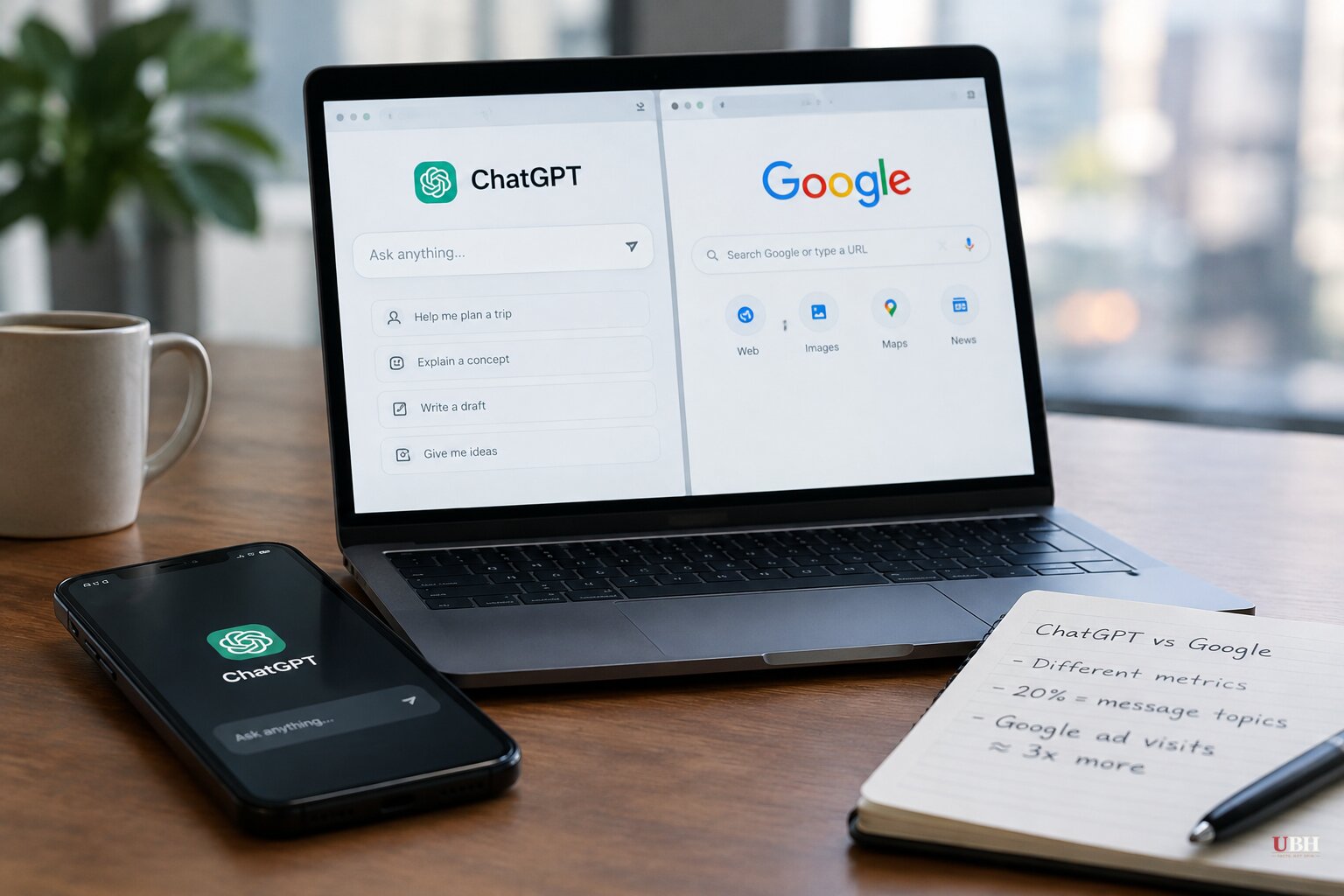
Since OpenAI updated its Signals usage report on Oct. 26, a tidy headline number has been making the rounds: ChatGPT does about one-fifth of Google's search volume. The number is real. What it measures is not what the headline implies.
Where the 20% comes from
Signals classified 20.2% of sampled messages from individual ChatGPT accounts in September 2026 as information-seeking, up from 16.7% in July 2024. That is a share of messages by topic, not a count of searches.
The category is broad. It lumps together requests for specific information, purchasable products, and cooking and recipes. It does not show whether a message used ChatGPT Search, touched the web, or sent anyone to an outside site.
The sample covers ChatGPT Free, Go, Plus and Pro accounts. Organizational use is tracked separately.
A second figure gets blended in. ChatGPT users sent more than 2.5 billion messages a day globally in July 2025. Google's annual search count topped 5 trillion in early 2025, roughly 13.7 billion a day. Divide one by the other and you get about 18%.
That ratio compares every ChatGPT message, including rewriting a cover letter or debugging code, against Google searches. It also pulls from different periods.
The research behind the Crypto Briefing story notes that OpenAI has not directly claimed a 20% search market share in its official communications. The label grew out of how the figure was interpreted.
Narrower estimates run well below 20%
When analysts try to isolate search-like activity, the number shrinks. seoClarity put ChatGPT's search-equivalent share at 7.5% in October 2026. Ahrefs estimated around 12% in February 2026.
The scale of the user base keeps even the smaller figures meaningful. OpenAI's services reached 1.2 billion weekly users by late September 2026, according to figures cited in the same analysis.
OpenAI's position, as relayed in that reporting, is that its search-like volume is large and growing fast. The Signals trend supports the direction: information-seeking rose 3.5 points in about two years.
Traffic still favors Google heavily. One set of analyses finds Google sends about 190 times more traffic to websites than ChatGPT does. ChatGPT's click-through rate sits below 1%, and its referrals account for less than 1% of organic sessions across those analyses.
The ad money is a different story
Volume is one scoreboard. Revenue per visit is another, and a new working paper puts numbers on it.
Economists Maximilian Kaiser and Christian Schulze, in a paper dated October 2026 that is under review, tracked site traffic and sales through OpenAI's country-by-country ad launch. Their paid-ad figures come from 102 advertiser sites with full sales tracking.
In U.S. traffic, a visit from a ChatGPT ad brought in $0.89 in revenue. A visit from a paid Google search ad brought in $2.45.
Conversion followed the same pattern: 0.37% for ChatGPT ad visits against 1.17% for paid search. The gaps held when the authors compared the two channels within the same websites and controlled for device type and week.
Of 87 advertisers that bought both ChatGPT ads and paid search in U.S. traffic, 84 earned less per ChatGPT ad visit.
Seventy-three of them recorded zero sales from ChatGPT ads across 18,726 visits. The other 14 generated all 570 ChatGPT ad purchases.
One advertiser accounts for 66% of all purchases through paid ChatGPT across the 102 sites, and 76% of U.S. paid ChatGPT revenue. Remove that advertiser and both gaps widen.
What a ChatGPT click is worth
The authors benchmark against paid search to compute a "parity price," the cost per click at which a ChatGPT click would return the same revenue per ad dollar. Using a median paid search click cost of $0.72 across 16 accounts with at least 80% of search traffic from the U.S., they value a ChatGPT ad click at about $0.26.
Because one advertiser dominates the sales, resampling advertisers moves that estimate anywhere from $0.05 to $0.57.
The largest publicly known account paid $1.72 per click, according to Opascope, a firm that runs paid media accounts for clients. That figure comes from one account's 15 days of spend. It is more than six times the parity price.
OpenAI's ads basics page recommends starting CPC campaigns at a maximum bid of $3 to $5.
The paper carries limits its authors spell out. The parity price assumes similar profit margins across both channels and counts only the single tracked visit. The authors found no detectable lift in traffic from other channels for advertisers after their first paid ChatGPT click, compared with similar sites that did not buy ads. That test can only rule out large increases.
OpenAI's ads FAQ states that ChatGPT Ads "does not yet have performance benchmarks across advertisers, industries, or campaign types." The product is new, and the data covers an early rollout.
What comes next
The paper is still under review, and OpenAI has not published ad performance benchmarks. Until it does, the open question is whether a platform that answers users in place can turn its message volume into ad revenue per visit that rivals the click-out model Google has run for decades.
The Signals update will also keep drawing comparisons to Google. The 20.2% figure answers how much of ChatGPT use looks like information-seeking. It does not answer how many people are leaving Google for it.
Sources used for this briefing
3 links from 3 independent newsrooms (syndicated copies of the same report count once)
These are the sources it draws on, linked so you can verify.


